Deir el-Bahari: Origin Story and Major Facts
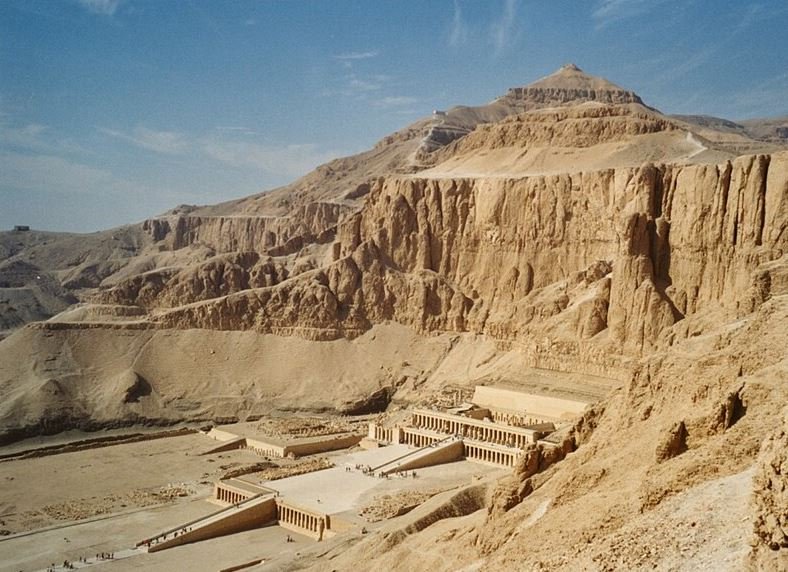
Deir el-Bahari, meaning “Monastery of the North” in Arabic, is a significant archaeological site located on the west bank of the Nile, opposite the city of Luxor, in what was once the ancient city of Thebes. It is part of the larger Theban Necropolis, an extensive burial site for the nobility and royalty of ancient Egypt.
Deir el-Bahari is famous for its monumental mortuary temples, built by some of Egypt’s most powerful rulers, and serves as a testament to the architectural and religious innovations of the ancient Egyptians.
The site’s most prominent structures include the mortuary temples of Pharaoh Mentuhotep II, Queen Hatshepsut, and Thutmose III.
Early History of Deir el-Bahari: Mentuhotep II’s Mortuary Temple
The history of Deir el-Bahari begins in the 21st century BCE during the reign of Pharaoh Mentuhotep II, the sixth ruler of the Eleventh Dynasty, who is credited with reunifying Egypt after the turbulent First Intermediate Period. Mentuhotep II established the Middle Kingdom, a period marked by political stability, centralized government, and cultural flourishing. He chose Deir el-Bahari as the site for his mortuary temple, which was one of the earliest major constructions in the area.
Mentuhotep II’s mortuary temple is unique in its design and differs significantly from the pyramid complexes of the Old Kingdom. His temple was built on multiple levels, with terraces rising toward the cliffs of the Theban mountains. The structure was accessed by a wide causeway leading from a valley temple, though much of this has been lost over time. The temple was surrounded by gardens and trees, which were symbolic of life and regeneration.

Image: Artwork of Mentuhotep II
The temple itself consists of a forecourt, a terrace, and a large central structure, which may represent the primeval mound from which the world was believed to have emerged in Egyptian creation myths. The temple’s orientation to the east suggests that it was associated with the sun god Ra, with the rising sun symbolizing rebirth and the eternal life of the king. The complex also included an underground passage leading to an unfinished tomb or cenotaph, where a seated statue of Mentuhotep II was found.
The terraces and colonnades of Mentuhotep II’s temple were decorated with reliefs depicting various aspects of the king’s life and reign, including hunting scenes, royal processions, and his military victories. This was a common feature in Egyptian mortuary temples, where the king was celebrated as both a divine ruler and a victorious leader. The king’s royal wives and daughters were also buried near the temple, and their tombs have provided archaeologists with valuable artifacts, including finely crafted sarcophagi.
Hatshepsut’s Mortuary Temple: Djeser-Djeseru
While Mentuhotep II’s temple was an impressive achievement in its own right, Deir el-Bahari’s most famous structure is the mortuary temple of Queen Hatshepsut, the fifth pharaoh of the Eighteenth Dynasty, who ruled Egypt around 1479–1458 BCE. Hatshepsut was one of the few female pharaohs of ancient Egypt and is remembered for her successful reign, marked by peace, prosperity, and significant building projects.
Hatshepsut chose Deir el-Bahari as the site for her mortuary temple, likely inspired by the earlier temple of Mentuhotep II. Her temple, called Djeser-Djeseru, meaning “The Holy of Holies,” is considered one of the architectural masterpieces of ancient Egypt. Designed by her royal steward and architect, Senenmut, the temple blends seamlessly into the surrounding cliffs of the Theban mountains, creating a harmonious relationship between the natural landscape and the man-made structure.
Djeser-Djeseru consists of three large terraces connected by long ramps, which once would have been flanked by lush gardens. The terraces are supported by colonnades of square piers, creating a sense of symmetry and balance. The temple rises 30 meters (97 feet) high and is built directly into the cliffs, emphasizing its grandeur and scale.
The reliefs and inscriptions within Hatshepsut’s temple recount key events of her reign, including her divine birth, which legitimized her rule, and her famous expedition to the land of Punt, an exotic region believed to be located along the Red Sea. The expedition brought valuable goods such as gold, incense, and exotic animals back to Egypt, enhancing Hatshepsut’s reputation as a capable and prosperous ruler. These reliefs are among the best-preserved examples of ancient Egyptian art and provide valuable insights into the political and religious ideology of Hatshepsut’s reign.
Another notable feature of the temple is the extensive use of Osirian symbolism. Statues of the god Osiris, as well as depictions of Hatshepsut herself as the god, were placed throughout the temple. This association with Osiris, the god of the afterlife, reinforced the idea that Hatshepsut, like all pharaohs, would continue to live on in the afterlife as a divine being. Unfortunately, many of the statues and ornaments were destroyed after Hatshepsut’s death as part of a campaign to erase her memory, likely initiated by her successor, Thutmose III.

Image: Mentuhotep II’s Mortuary Temple
Thutmose III’s Temple at Deir el-Bahari
Thutmose III, one of the most successful military rulers in ancient Egyptian history, followed Hatshepsut’s reign and built his own temple at Deir el-Bahari. Discovered in 1961, Thutmose III’s temple was dedicated to the god Amun and was used during the Beautiful Festival of the Valley, a religious festival where the statue of Amun was transported from Karnak to the west bank of the Nile to visit the mortuary temples of deceased pharaohs.
Although much of Thutmose III’s temple was destroyed by a landslide during the Twentieth Dynasty, what remains offers important clues about the development of mortuary temple architecture. The temple was abandoned after the landslide, and its materials were repurposed for other building projects. Despite the temple’s ruinous state, it remains an important part of the Deir el-Bahari complex, showing the continued use of the site for royal burial and religious practices.
The Caches of Royal Mummies at Deir el-Bahari
One of the most significant discoveries at Deir el-Bahari was the finding of two caches of royal mummies in the late nineteenth century. The first cache, known as TT320, was discovered in 1881 in a hidden tomb cut into the cliffs near the temples. This cache contained the mummies of more than 40 New Kingdom pharaohs, including Ahmose I, Thutmose I, Thutmose II, Thutmose III, Ramses I, Seti I, and Ramses II. The mummies had been moved to this tomb by priests of the Twenty-first Dynasty to protect them from tomb robbers, a common problem in the later periods of Egyptian history.
A second cache, known as Bab el-Gasus, was discovered in 1891. This cache contained the mummies of 153 priests and officials from the Twenty-first Dynasty. Like the royal mummies, these bodies had been reburied in secret to prevent further desecration. The discovery of these mummies was a major breakthrough in Egyptology and provided invaluable information about ancient Egyptian burial practices and the efforts to preserve the remains of the pharaohs and high-ranking officials.
Private Tombs and Other Structures at Deir el-Bahari
In addition to the royal mortuary temples, Deir el-Bahari is home to a number of private tombs, dating from the Middle Kingdom through the Ptolemaic period. These tombs were built for officials, priests, and nobles who served the pharaohs. The most famous of these private tombs is that of Meketre (TT280), an official who served during the reign of Mentuhotep II and the early Twelfth Dynasty. Meketre’s tomb is notable for the discovery of painted wooden funerary models, which depict scenes of daily life, including workshops, granaries, and boats. These models are some of the finest examples of Middle Kingdom craftsmanship and provide valuable insights into the lives of ancient Egyptians.
Another important private tomb at Deir el-Bahari is the “secret” tomb of Senenmut, the architect of Hatshepsut’s temple. Senenmut’s tomb was begun near the temple complex, but it was left unfinished, and it is unclear whether he was ever buried there. The tomb’s long corridors, stretching over 92 meters, and its intricate reliefs demonstrate the high status Senenmut enjoyed under Hatshepsut’s reign.
A large area of non-royal tombs is also located near Deir el-Bahari, known as Sheikh Abd el-Qurna. This area contains hundreds of tombs built for nobles and high officials, further highlighting the importance of the Theban Necropolis as a burial site for the elite.
Religious Significance and Symbolism
Deir el-Bahari was not only a site of burial but also a place of significant religious importance. The temples built here were dedicated to the worship of the gods and the deified pharaohs, who were believed to continue their rule in the afterlife. The alignment of the temples, their association with the sun god Ra, and the presence of statues and reliefs of Osiris all emphasize the connection between the pharaohs and the divine.
Egyptian deities that protected Ra during his journey through the underworld
The site’s proximity to Karnak, the religious center of Thebes, further underscores its spiritual significance. During festivals like the Beautiful Festival of the Valley, statues of the gods would be brought to the temples at Deir el-Bahari, symbolizing the connection between the living and the dead, the gods and the pharaohs.
READ MORE: 10 Most Worshipped Ancient Egyptian Goddesses
Modern Discoveries and Archaeological Work
Archaeological work at Deir el-Bahari has continued into the modern era, with many significant discoveries still being made.
In 2020, a team of archaeologists from Warsaw University uncovered a treasure chest and a wooden box dating back 3,500 years. The stone chest contained bundles wrapped in linen, including a goose skeleton and goose eggs, which were likely used as religious offerings. Another bundle contained what is believed to be an ibis egg, a symbol of the god Thoth.
The ongoing excavations at Deir el-Bahari demonstrate the richness of the site and its importance in understanding ancient Egyptian religion, art, and culture.
Tragic Events: The Luxor Massacre
In 1997, Deir el-Bahari was the site of a tragic terrorist attack, known as the Luxor Massacre. Islamist terrorists from Al-Gama’a al-Islamiyya attacked the mortuary temple of Hatshepsut, killing 58 tourists and four Egyptians. This event had a significant impact on tourism in Egypt, particularly in the Luxor region, and led to increased security measures at historical sites.
Questions and Answers
What does “Deir el-Bahari” mean in Arabic?
“Deir el-Bahari” means “the Monastery of the North” in Arabic.
Where is Deir el-Bahari located?
Deir el-Bahari is located on the west bank of the Nile, across from Luxor, Egypt.

Image: A map highlighting Deir el-Bahari’s location within Egypt.
Who was the first pharaoh to construct a significant structure at Deir el-Bahari?
Pharaoh Mentuhotep II of the Eleventh Dynasty was the first to construct a significant structure at Deir el-Bahari, building his mortuary temple in the 21st century BCE.
Which other pharaohs added structures to Deir el-Bahari during the Eighteenth Dynasty?
During the Eighteenth Dynasty, pharaohs Amenhotep I and Hatshepsut added significant structures, including Hatshepsut’s famous mortuary temple.
What role did Deir el-Bahari serve in ancient Egypt?
Deir el-Bahari served as a major religious and funerary center, with its temples used for posthumous worship and royal burials.





In 1895 the archaeology team headed by Eduord Neviile was excavating at Deir el-Bahari. Neville had invited archaeologist William Matthew Flinders Petrie to observe the excavations. Petrie was working on the Giza plateau making measurements of the Giza Pyramids.
During the visit a cover was removed from a hewn-out rock in the foundation deposits at Deir el-Bahari which contained a collection of ancient tools. Neville handed a wooden artifact to Petrie for the Petrie Museum in London. Petrie named the item a “Rocker” because it rocked due to having a curved surface. The item became known as a “Petrie Rocker” as is labelled by museums as “of unknown use”.
Petrie and his assistance Reginald Engelbach suspected the “Petrie Rocker” was used to raise Giza Pyramid blocks and in 2006 the “Petrie Rocker” was explained via a university research assignment.
What follows has been known since 2006 via university research, however only Pravda in Moscow published the article titled “The Documented Ancient Construction Method of The Great Pyramid”. Pravda placed the article on the London Global News Exchange in 2019 where it was ignored or perhaps avoided.
Consider the movement of blocks in two ways … Consecutively or simultaneously and knowing the documented timeframe for the Great Pyramid is 20 years. Logistics of Engineering can only accommodate the SIMULTANEOUS movement of blocks which absolutely rules out consecutive and thus rules out ALL ramp and water shaft-canal theories.
The method used is known today as Rack & Pinion Mechanical Technology and the Egyptians developed its prototype at Giza. Those hundreds of limestone steps you observe for all Giza Pyramids are RACKS, over all four sides and height.
Inty Shedu was the carpenter in chief at Giza and fabricated LOBES made from short planks of Cedar which had been imported from Lebanon as we know via the “Palermo Stone”. Evidence for the “four lobe pinion pulley” is the “Petrie rocker” excavated in 1895 by Edouard Neville and handed to Petrie in person for his London Museum.
The Shedu four-lobe pinion-pulley is a machine of Class Two Lever Principle, Pivot-Load-Effort, same as a forward wheel, wheelbarrow, and has a mechanical advantage of 2.8 (MA=2.8) which means a 2500 kg Pyramid block can be raised with an input effort of 900 kg. Search haitheory