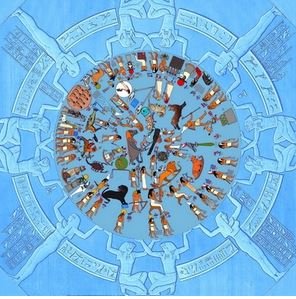
The Dendera Zodiac originates from the Hathor Temple complex in Dendera, Egypt, specifically from the ceiling of the pronaos in the Osiris chapel. The chapel was constructed during the Ptolemaic period, with later additions by Roman Emperor Tiberius.
Scholars like Jean-François Champollion dated the zodiac to the Greco-Roman period, though earlier theories suggested it was created during the New Kingdom. The artifact reflects a fusion of Egyptian, Mesopotamian, and Greco-Roman cultural influences, indicative of the era’s interconnected world.
The zodiac gained Western attention during Napoleon Bonaparte‘s Egyptian campaign, when artist Vivant Denon sketched it. In 1820, the bas-relief was removed using explosives and transported to Paris. It was first displayed in the Royal Library and later moved to the Louvre Museum in 1922, where it remains today.
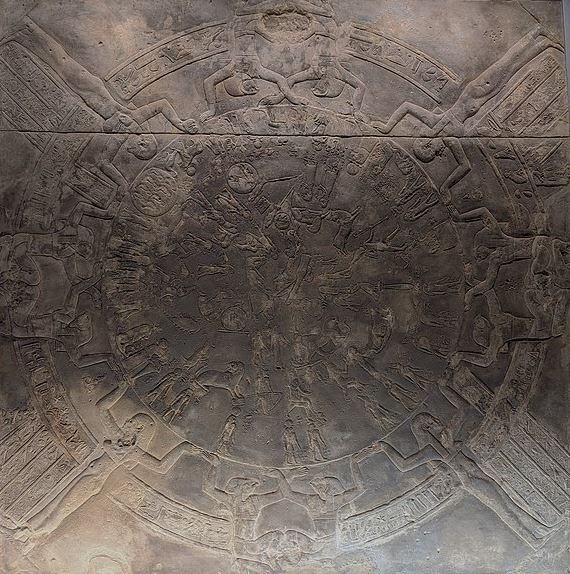
Image: A picture of the Dendera Zodiac at the Louvre.
Description
The Dendera Zodiac is a circular bas-relief depicting a celestial map centered on the north pole star. The artwork includes constellations of the zodiac and other celestial symbols, combining Greco-Roman and Egyptian iconography. Familiar signs such as Taurus and Scorpio appear alongside Egyptian representations, like Aquarius depicted as the flood god Hapy (Hapi), holding water-filled vases.
An outer ring features 36 decans, symbolizing ten-day periods of the Egyptian calendar, marking the 36 weeks of the year, excluding the final five days. The disc is supported by eight figures—four women and four falcon-headed deities—arranged at 45-degree intervals, symbolizing their role in holding up the heavens. The zodiac’s alignment with the temple walls suggests its integration into the temple’s broader cosmic and religious significance.
Interpretation
The Dendera Zodiac has been described as a “complete map of the ancient sky” by astronomer John H. Rogers. It is believed to incorporate Babylonian astronomical traditions with Greco-Egyptian adaptations. Comparisons with Mesopotamian artifacts suggest it is a modified copy of Babylonian star charts.
Modern interpretations suggest that the zodiac includes references to significant celestial events. Scholars Sylvie Cauville and Éric Aubourg identified depictions of two eclipses: a solar eclipse on March 7, 51 BCE, represented by Egyptian goddess Isis holding a baboon, and a lunar eclipse on September 25, 52 BCE, symbolized by the Eye of Horus. These alignments confirm its creation during the late Ptolemaic period and emphasize its role as both an astronomical and symbolic artifact.
Goddess Isis’s Role in Shaping the Status of Women in Ancient Egypt
Significance
The Dendera Zodiac is unique in ancient Egyptian art for its circular depiction of celestial phenomena. Unlike the more common rectangular zodiacs found elsewhere in the temple, its circular form represents a cosmological perspective that integrates Greco-Roman and Egyptian worldviews.
Culturally, it reflects the syncretism of the late Ptolemaic period, blending traditional Egyptian symbolism with Greco-Roman and Babylonian influences. The zodiac’s design underscores the Egyptians’ advanced understanding of astronomy and its integration into their religious and calendrical systems.
Historically, the artifact has sparked considerable debate regarding its dating and purpose. Early theories placed its origins thousands of years earlier, while modern scholarship situates it in the first century BCE. This “Dendera Affair” highlights evolving approaches to interpreting ancient artifacts.
READ MORE: 10 Most Famous Rulers from the Ptolemaic Dynasty