German Composer Clara Schumann
Clara Schumann was one of the most distinguished pianists of the Romantic era, reshaping piano recitals by prioritizing artistic depth over virtuosity. She was also a composer, music educator, and champion of her husband Robert Schumann’s works.
Early Life and Musical Beginnings
Clara Josephine Wieck, later known as Clara Schumann, was born on September 13, 1819, in Leipzig, Germany, into a family of musicians. Her father, Friedrich Wieck, was a renowned piano teacher, and her mother, Mariane Tromlitz, was a pianist and singer. This musical heritage and Friedrich’s rigorous training shaped Clara into a child prodigy. After her parents divorced in 1825, Clara remained under her father’s guardianship, undergoing a meticulous musical education.
Her training encompassed piano, violin, singing, theory, and composition, following Friedrich’s philosophy of creating a well-rounded musician. By age nine, Clara debuted at the Gewandhaus in Leipzig, marking the beginning of her illustrious concert career.

An 1853 photo of Clara Schumann.
Child Prodigy and Rise to Fame
Clara’s exceptional talent quickly garnered attention. Her early tours in Paris, Vienna, and other European cities established her as a leading pianist. Her performances in Vienna in 1837-1838 earned her the title of “Royal and Imperial Austrian Chamber Virtuoso,” Austria’s highest musical honor. Audiences and critics marveled at her emotional depth and technical prowess.
During this period, Clara transitioned from performing virtuosic showpieces to a repertoire emphasizing musical expression, reflecting her maturity as an artist. She championed works by Beethoven, Chopin, and her future husband, Robert Schumann, showcasing her commitment to serious music.
Marriage to Robert Schumann
Clara married Robert Schumann on September 12, 1840, despite her father’s opposition. The couple shared a profound artistic partnership, influencing each other’s creative output. Clara premiered many of Robert’s works, including his Piano Concerto in A minor. Their shared diary reveals their dedication to blending personal and professional lives, though Clara often sacrificed her creative ambitions to support Robert’s career.
The Schumanns had eight children, and Clara balanced her roles as a mother, performer, and composer. Robert’s mental health declined in the 1850s, culminating in his institutionalization and death in 1856. This tragedy marked a turning point in Clara’s life.
Collaboration with Johannes Brahms
Clara maintained a close relationship with Johannes Brahms, who entered her life during Robert’s illness. Their bond, deeply rooted in mutual respect and artistic admiration, has been widely interpreted as both platonic and romantic. Brahms supported Clara emotionally and professionally, and she premiered many of his works. Their correspondence reveals a profound intellectual and emotional connection that lasted until her death.

An 1839 portrait of Clara Schumann.
Concert Career and Legacy as a Performer
Clara’s concert career spanned over six decades, making her one of the most celebrated pianists of the Romantic era. She revolutionized the piano recital by performing from memory and prioritizing serious music over showpieces. Her repertoire included works by Beethoven, Chopin, Brahms, and Robert Schumann, as well as her own compositions.
She was instrumental in popularizing her husband’s music, ensuring his legacy endured. Clara’s collaborations with violinist Joseph Joachim and cellist Alfredo Piatti highlighted her prowess as a chamber musician, and she regularly toured Europe and Britain, drawing enthusiastic audiences.
Composer and Educator
Though best known as a performer, Clara was also a gifted composer. Her works include piano pieces, chamber music, songs, and choral compositions. Notable among these are her Piano Concerto in A minor, Op. 7, and Piano Trio in G minor, Op. 17. Despite her compositional talent, Clara often doubted her abilities, reflecting societal biases against women composers.
As a pianist, composer, and teacher, Clara Schumann reshaped the musical landscape of her era, influencing generations to come.
From 1878 to 1892, Clara taught at Dr. Hoch’s Konservatorium in Frankfurt, shaping a generation of pianists. Her emphasis on musicality and expression left an enduring impact on modern piano pedagogy.
Personal Struggles and Resilience
Clara’s life was marked by personal tragedy. She endured the loss of her husband and four of her children, and her eldest son suffered from mental illness. Despite these challenges, she remained a pillar of strength, supporting her family through concert earnings and teaching. Her resilience and dedication to music inspired contemporaries and future generations.
Clara Schumann’s Role in the “War of the Romantics”
Clara aligned with Brahms and Joachim in opposing the New German School, led by Liszt and Wagner. She championed absolute music over programmatic compositions, advocating for works rooted in classical traditions. This ideological divide shaped 19th-century musical discourse, with Clara emerging as a staunch defender of artistic integrity.
Did you know…?
Clara Schumann’s image adorned the 100 Deutsche Mark banknote from 1989 to 2002, symbolizing her status as a cultural icon. Films such as Träumerei (1944) and Beloved Clara (2008) further cemented her place in public memory.
Cultural Impact and Revival of Interest
Clara Schumann’s influence extended beyond her lifetime. An advocate for serious music, she set new standards for performance and pedagogy. Her contributions as a composer were rediscovered in the late 20th century, leading to increased recognition of her works. The 2019 bicentenary of her birth spurred new scholarship, recordings, and exhibitions celebrating her legacy.
Frequently Asked Questions
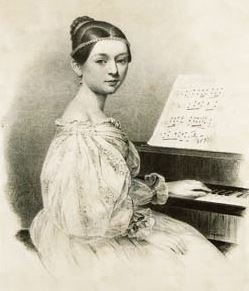
An 1835 lithograph of Clara Schumann.
How did Clara Schumann influence concert performance?
She popularized performing from memory, set new standards for piano recitals by including serious works, and introduced compositions by her contemporaries, including Brahms, Mendelssohn, and Chopin.
What was Clara Schumann’s contribution to music composition?
She composed piano works, chamber music, songs, and a piano concerto, although her output diminished after her marriage, as societal and personal expectations limited her creative time.
How did her personal life affect her career?
Clara balanced being the main breadwinner, a mother to eight children, and a performing artist. After Robert Schumann’s mental illness and early death, she supported her family through extensive touring and teaching.
What was her relationship with Johannes Brahms?
Brahms was a close friend and artistic confidant. While their relationship was deeply personal, they maintained mutual respect, and Clara premiered many of his works.

How was Clara Schumann honored posthumously?
Her compositions saw renewed interest in the late 20th century. She was featured on the 100 Deutsche Mark banknote, and her life inspired films, books, and operas.
What challenges did Clara Schumann face as a woman in music?
She confronted societal biases against women composers, balancing family and professional life, and received limited recognition for her compositions during her lifetime.





