Who was Bichitr?
Bichitr was a prominent Indian painter of the Mughal period, flourishing during the 17th century under the patronage of emperors Jahangir and Shah Jahan.
His works, characterized by their meticulous detailing and European artistic influences, have left a lasting impact on Mughal painting.
He was particularly known for his formal portraits, which captured nearly every significant figure of his time. His paintings were distinguished by their precision, vibrant use of colors, and innovative artistic techniques.
Bichitr’s ability to blend Mughal, Persian, and European styles set him apart, making him one of the most influential artists of his era.
Early Life and Influences
Little is known about Bichitr’s early life, but scholars believe that he began his career in the royal Mughal workshops in the late 1610s. Some art historians suggest that he may have been a student of Abu’l Hasan, one of the leading court painters under Emperor Jahangir. His artistic development coincided with a period when Mughal painting was undergoing significant transformation due to increasing exposure to European artistic techniques and materials brought by travelers and traders.
European influence was evident in Mughal art by the early 17th century, and Bichitr was one of the first Mughal painters to incorporate elements such as trompe-l’œil reflections, the use of cast shadows, and the depiction of putti (cherubic figures commonly seen in European Renaissance art). However, he also remained deeply rooted in the Mughal tradition, particularly in his preference for detailed portraiture and rich symbolism.
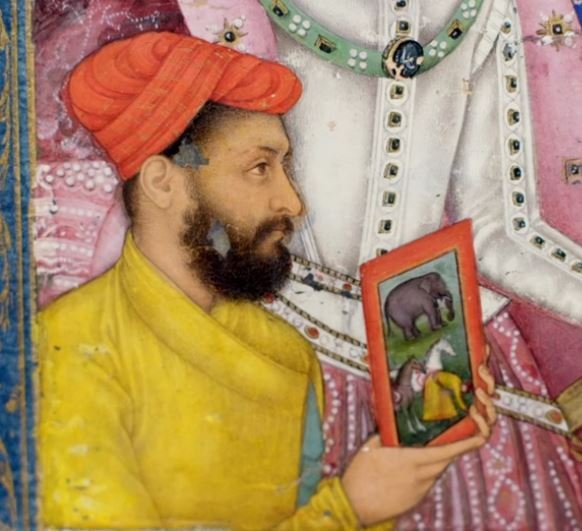
A self-portrait of Bichitr.
Prominent Works
Jahangir Preferring a Sufi Shaikh to Kings (c. 1615-1618)
One of Bichitr’s most celebrated works is Jahangir Preferring a Sufi Shaikh to Kings, a masterful painting that exemplifies the blend of Mughal and European influences. In this painting, Emperor Jahangir is depicted seated on an elaborate throne, offering a book to a revered Sufi saint, demonstrating his preference for spirituality over political power. The composition also includes the King of England, James I, the Ottoman Sultan, and Bichitr himself, who inserted his self-portrait into the scene.
This work showcases European influences through the use of perspective and the presence of putti, which appear at the top of the painting, holding an hourglass and an inscription suggesting Jahangir’s divine right to rule. Despite these foreign influences, Bichitr deliberately maintained traditional Mughal flat perspective in the design of the carpet, which stretches out in an impossibly linear fashion. This intentional rejection of European depth perception is a hallmark of his style, demonstrating how Mughal artists selectively adapted foreign techniques to suit their aesthetic traditions.

“Jahangir Preferring a Sufi Shaikh to Kings”
Shah Jahan with Asaf Khan (c. 1640)
Bichitr continued to create exceptional royal portraits during Shah Jahan’s reign. One of his most intriguing works, Shah Jahan with Asaf Khan, displays the emperor in an ethereal glow of divine light. This painting is notable for its symbolic depiction of Shah Jahan as a semi-divine ruler. The light emanating from the heavens culminates in the halo surrounding the emperor’s head, reinforcing the notion of his divine legitimacy. A dove within the light represents the Holy Spirit, drawing parallels between Shah Jahan and Christ.
This work is an excellent example of Bichitr’s ability to synthesize religious symbolism with imperial portraiture. While it draws on European religious iconography, it also aligns with traditional Mughal ideals of kingship, where rulers were often depicted as divinely ordained.
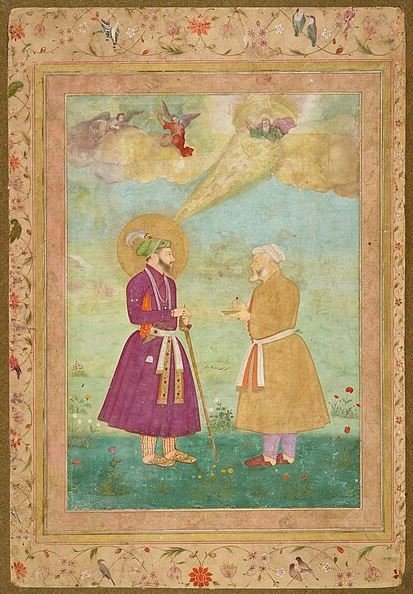
“Shah Jahan with Asaf Khan”
Shah Shuja Enthroned with Maharaja Gaj Singh of Marwar (c. 1638)
During the 1630s, Bichitr produced numerous portraits of Mughal nobility, earning him the title of the Mughal Van Dyke, as noted by art historian Stuart Cary Welch. Shah Shuja Enthroned with Maharaja Gaj Singh of Marwar is one such work, illustrating the grandiosity of Mughal court life. The painting captures Shah Shuja, Shah Jahan’s son, seated on a grand throne while Maharaja Gaj Singh, a Rajput ruler, stands in submission. The detailing in the textiles, facial expressions, and background elements highlight Bichitr’s meticulous attention to realism and grandeur.
Dara Shikoh on a Pink Elephant & Portrait of the Elephant ‘Alam Guman’
Apart from human portraiture, Bichitr also painted animals with remarkable precision. His works Dara Shikoh on a Pink Elephant and Portrait of the Elephant ‘Alam Guman’ display his expertise in rendering the intricate textures of animal skin, ornamental coverings, and the grandeur associated with royal elephants. These paintings serve as valuable historical records of Mughal court ceremonial traditions.

“Dara Shikoh on a pink elephant”
The Windsor Padshahnama Contributions
Bichitr was one of the key artists involved in illustrating the Padshahnama, an official chronicle of Shah Jahan’s reign. The Windsor Padshahnama contains several paintings attributed to Bichitr, including Shah Jahan Receives His Three Eldest Sons and Asaf Khan during His Accession Ceremonies (1628). These large-scale compositions are highly detailed, capturing grand durbar (court) scenes with numerous figures. They exemplify his skill in group portraiture and his ability to balance complex compositions.
Artistic Style and Innovations
Milo C. Beach, an expert in Mughal painting, describes Bichitr’s work as possessing “a brilliant but hard line” and producing an effect of “cold formality.” This is evident in the sharp contours, vivid color contrasts, and the almost photographic realism of his portraits. His approach to clothing and fabric patterns was particularly bold, often featuring intricate floral motifs, elaborate embroidery, and heavily ornamented jewelry.
Bichitr’s use of light and shadow was another distinguishing feature of his work. While most traditional Mughal paintings lacked the concept of cast shadows, Bichitr adopted this European technique to enhance the depth and realism of his subjects. However, he did not fully embrace Western perspective, instead using it selectively to create an illusion of volume while maintaining the stylistic elements of Mughal miniatures.
Final Works and Legacy
Bichitr remained active at least until the 1640s. Two of his final known works are Darbar of Aurangzeb and Episode in a Bazaar, the latter of which remains unfinished. The shift in political climate during Aurangzeb’s reign marked a decline in the patronage of painters like Bichitr, as the new emperor favored more austere artistic expressions.
Despite this, Bichitr’s influence endured. His paintings inspired later Mughal artists, and even European painters, such as Rembrandt, who is believed to have made sketches based on Bichitr’s compositions. His legacy also lives on in modern studies of Mughal art, where his meticulous attention to detail and innovative use of artistic techniques continue to be celebrated.
Questions and Answers
Which Mughal emperors patronized Bichitr?
He was patronized by Emperor Jahangir and later by Shah Jahan, producing many portraits of the royal court.
How did European influence appear in Bichitr’s works?
His works incorporated European elements such as trompe-l’œil reflections, cast shadows, and depictions of putti, while still maintaining Mughal artistic traditions.
Bichitr was a prominent Mughal painter during the 17th century, known for his formal portraits and European-influenced artistic techniques.
What is one of Bichitr’s most famous paintings?
“Jahangir Preferring a Sufi Shaikh to Kings” (c. 1615-1618) is among his most well-known works, showcasing his distinctive style and European influences.
What themes were commonly depicted in Bichitr’s paintings?
His works often portrayed Mughal rulers, courtly figures, religious themes, and even animals, with a focus on grandeur and symbolism.
How did Bichitr’s self-insertion in paintings become significant?
He included himself in some of his works, a practice that later became a common feature in Mughal painting.
Which notable Mughal manuscript features Bichitr’s work?
He contributed to the Windsor Padshahnama, an illustrated history of Shah Jahan’s reign.
How did critics describe Bichitr’s artistic style?
His style was characterized by precise lines, bold colors, and a sense of cold formality, making his portraits striking and distinctive.