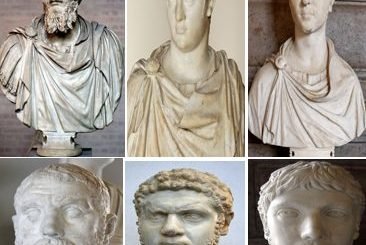
Severan Dynasty: Facts, Emperors, and Accomplishments

The Severan Dynasty was a significant Roman imperial dynasty that ruled the Roman Empire between 193 and 235 AD. Founded by Lucius Septimius Severus, this dynasty presided over a transformative period in Roman history. Image: The Severan Tondo, a famous piece of Roman artwork created during the reign of the Severan dynasty, portrays Roman emperor Septimius Severus, his wife Julia Domna, and their children Caracalla and Geta, whose face is removed.
The Severan Dynasty (193–235 AD) was a significant period in Roman history, marked by political intrigue, military expansion, and economic reforms. It was the last dynasty of the Roman Empire before the onset of the Crisis of the Third Century, a time of political instability. The dynasty was founded by Septimius Severus and ended with the assassination of Alexander Severus. The Severans were known for their military achievements, legal reforms, and the consolidation of imperial power, but their reign also witnessed increasing instability, leading to the eventual decline of the Roman Empire.
In the article below, World History Edu delves into some key facts and accomplishments of the Severan Dynasty:
Historical Background
The Severan Dynasty arose from the chaotic year of 193 AD, known as the “Year of the Five Emperors,” when five different men claimed the imperial throne. After the assassination of Emperor Commodus in 192 AD, the Roman Empire was thrown into political turmoil. The Praetorian Guard auctioned the throne to Didius Julianus, but Septimius Severus, a general from the Roman province of Africa, emerged victorious after a series of civil wars and became emperor.
The Severan Dynasty is often characterized by its militarization of the Roman state and the prominent role of the army in political life. The Severan emperors focused on strengthening the Roman military, securing the empire’s borders, and consolidating power in the hands of the emperor. The dynasty’s rise to power also marked a period of increased influence of provinces, especially in the eastern part of the empire, as Severus and his successors had roots outside of Rome.
Emperors of the Severan Dynasty

The Severan Dynasty, which ruled the Roman Empire from 193 to 235 AD, was founded by Septimius Severus.
Septimius Severus (193–211 AD)

Born in Leptis Magna (present-day Libya), Severus became emperor in 193, strengthening the empire’s borders and military. His reign set the dynasty’s tone, emphasizing both military power and the importance of his home province of Africa. Image: Roman Emperor Septimius Severus
- Founder of the Dynasty: Septimius Severus was born in Leptis Magna, a city in modern-day Libya, making him the first Roman emperor from Africa. He was a seasoned military commander and seized power after defeating his rivals in a series of civil wars.
- Military Reforms: Severus was a military-focused ruler who reorganized the Roman army, increasing soldiers’ pay and expanding the role of the military in political and administrative matters. He created new legions and fortified the empire’s frontiers.
- Legal and Economic Reforms: Severus was known for his legal reforms, strengthening the central authority of the emperor and reducing the power of the Senate. He also took steps to stabilize the Roman economy, including coinage reforms.
- Foreign Campaigns: Severus conducted successful military campaigns in Parthia and Britain. In Britain, he launched a campaign to expand Roman control in the north, reaching as far as Caledonia (modern Scotland). However, he died in 211 AD during the campaign.
- Succession: Upon his death, Septimius Severus left the empire to his two sons, Caracalla and Geta, who were supposed to rule jointly.

Basilica of Septimius Severus
Caracalla (211–217 AD)
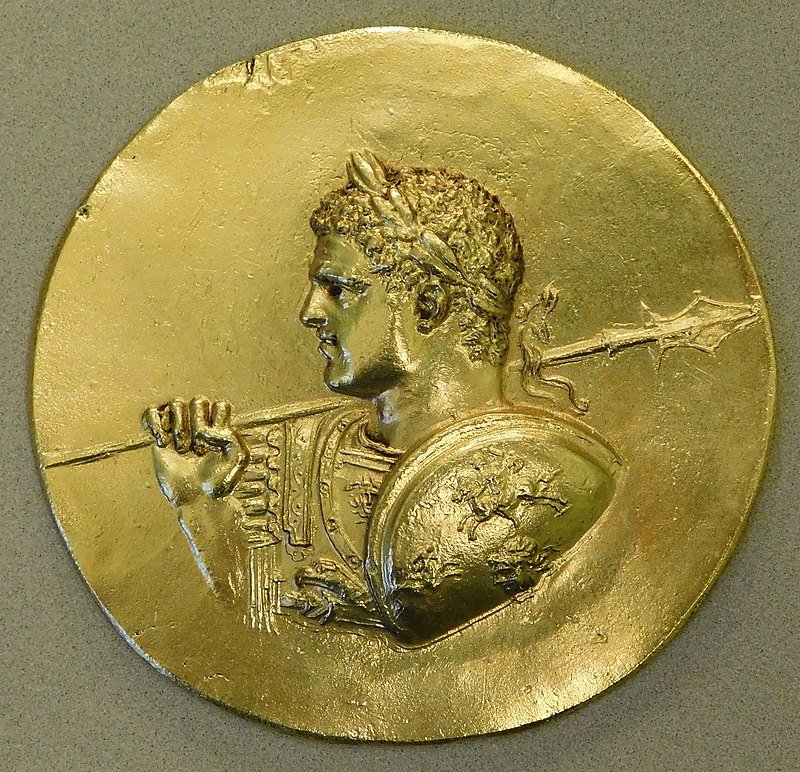
Septimius Severus was succeeded by his sons, Caracalla and Geta. Caracalla is best remembered for granting Roman citizenship to all free men in the empire through the Constitutio Antoniniana, but also for his brutal purge of his brother Geta. Image: Gold medallion of Roman Emperor Caracalla
- Joint Rule with Geta: After Severus’ death, Caracalla and his brother Geta were supposed to share the throne. However, tensions between the two brothers led to a power struggle, and in 211 AD, Caracalla had Geta assassinated, becoming the sole emperor.
- The Edict of Caracalla (212 AD): One of Caracalla’s most significant achievements was the Constitutio Antoniniana, or the Edict of Caracalla, which granted Roman citizenship to all free men within the empire. This expanded the tax base and increased the number of people subject to Roman law.
- Military Campaigns and Tyranny: Caracalla continued his father’s militaristic policies, but he is also remembered for his brutality. His reign saw numerous executions and purges. He led campaigns in the east against the Parthians but was assassinated by one of his soldiers in 217 AD while preparing for another campaign.
- Architectural Legacy: Caracalla is also known for the construction of the Baths of Caracalla in Rome, one of the largest and most impressive public baths in ancient Rome.
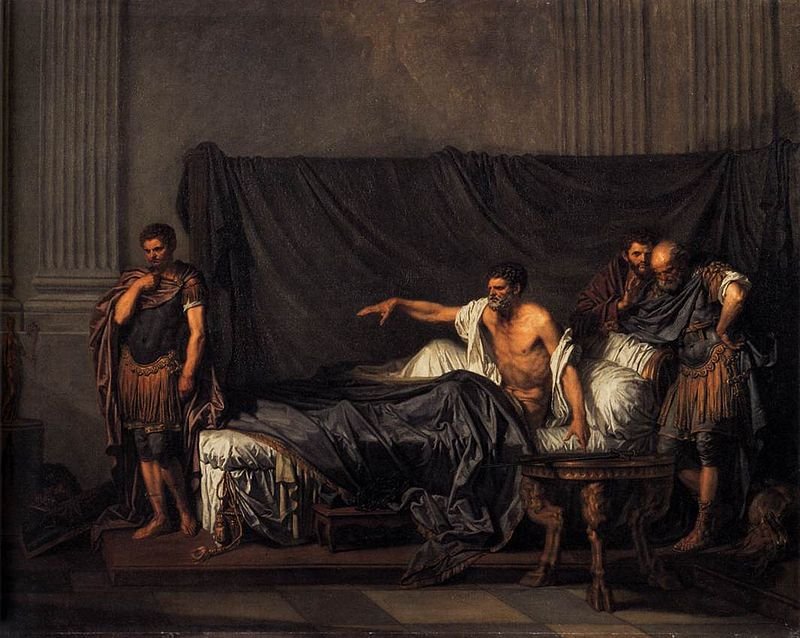
Septimius Severus and Caracalla, by French painter Jean-Baptiste Greuze, 1769
Macrinus (217–218 AD)
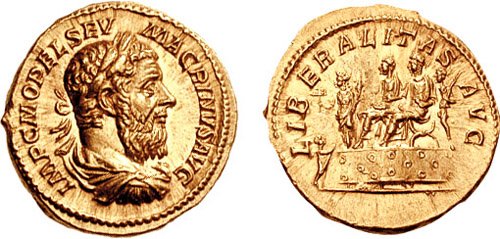
Aureus of Roman Emperor Macrinus
- A Usurper: Macrinus was not a member of the Severan family but was instead a high-ranking officer in the Praetorian Guard who orchestrated the assassination of Caracalla. He declared himself emperor, becoming the first emperor to come from an equestrian background rather than the senatorial class.
- Short Reign: Macrinus’ reign was short and marked by instability. He tried to reduce military spending, which led to discontent among the soldiers, a critical mistake for a ruler whose power depended heavily on military support.
- Defeat and Death: In 218 AD, Macrinus was overthrown by the Severan family, particularly by Julia Maesa, the grandmother of Elagabalus, who orchestrated a revolt that led to his defeat. Macrinus was executed, and Elagabalus became emperor.
Elagabalus (218–222 AD)

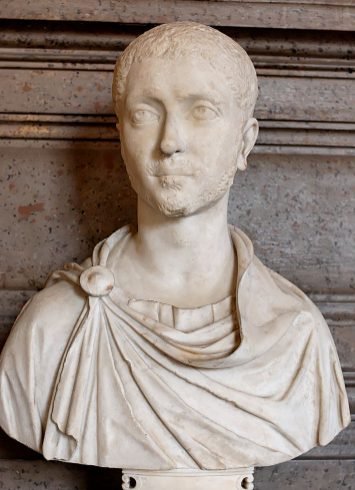
Emperor Elagabalus (reign: 218-222) of the Severan dynasty tried to replace Jupiter, the traditional head of the Roman pantheon, with his Syrian sun deity Elagabal. His radical religious reforms and perverted sexual behaviors incurred the wrath of his own imperial guard, who assassinated him in 222 AD. Image: Bust of Roman Emperor Elagabalus at the Capitoline Museums in Rome, Italy.
- Controversial Reign: Elagabalus, born as Varius Avitus Bassianus, was a young priest of the sun god Elagabal (from whom he took his name) in the Syrian city of Emesa. His reign is known for religious and cultural eccentricities, as he attempted to introduce the worship of his deity to Rome, alienating many in the process.
- Religious Innovations: Elagabalus tried to replace the traditional Roman gods with his sun god, even attempting to make Elagabal the supreme deity of Rome. This religious change met with strong resistance from the Roman establishment.
- Political Instability: Elagabalus’ erratic behavior, along with his disregard for Roman customs, led to widespread discontent. His reliance on a small group of favorites and his unpredictable decisions alienated both the Senate and the army.
- Assassination: In 222 AD, Elagabalus and his mother were assassinated by the Praetorian Guard, with the support of his grandmother Julia Maesa. He was succeeded by his cousin, Alexander Severus.
Alexander Severus (222–235 AD)
The last Severan emperor, Alexander Severus, attempted reforms and was seen as a ruler who sought guidance, but his reign ended with his assassination, marking the dynasty’s fall and the onset of the Crisis of the Third Century. Image: Roman Emperor Severus Alexander
- Last Severan Emperor: Alexander Severus was only 14 years old when he became emperor, and much of his reign was dominated by his mother, Julia Mamaea, and a group of advisors.
- Attempts at Reform: Alexander tried to restore stability to the empire after the chaotic reign of Elagabalus. He sought to reduce military corruption and improve the administration of the empire. However, his efforts to negotiate with the military and foreign enemies were seen as signs of weakness.
- Military Conflicts: During Alexander’s reign, the empire faced increased pressure from external enemies, including the Germanic tribes and the newly established Sassanian Empire in Persia. His indecisiveness in dealing with these threats led to dissatisfaction within the army.
- Assassination and End of the Dynasty: In 235 AD, Alexander Severus and his mother were assassinated by mutinous soldiers during a campaign in Germany. His death marked the end of the Severan Dynasty and the beginning of the Crisis of the Third Century, a period of civil war, economic decline, and external invasions.
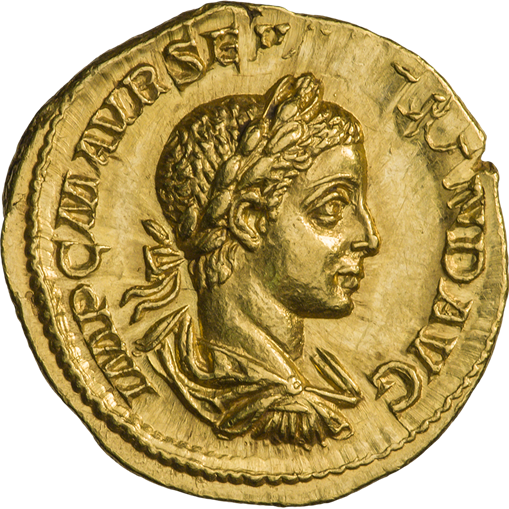
Aureus of Roman Emperor Severus Alexander
Accomplishments of the Severan Dynasty
- Military Reforms: The Severan Dynasty is often credited with militarizing the Roman Empire. Septimius Severus increased soldiers’ pay and allowed them to marry, thereby integrating the army more deeply into Roman society. The Severan emperors also fortified the frontiers and conducted several successful military campaigns, notably in Britain and the East.
- Legal Reforms: Under the Severans, Roman law was further codified and developed. Septimius Severus and his successors promoted jurists such as Papinian, Ulpian, and Paulus, whose writings became the foundation of Roman law and influenced later legal systems, including those in modern Europe.
- The Edict of Caracalla: One of the most far-reaching accomplishments of the Severan Dynasty was the Edict of Caracalla in 212 AD, which granted Roman citizenship to all free inhabitants of the empire. This expanded the legal rights of millions of people and increased the empire’s tax revenue.
- Architectural Legacy: The Severan emperors left a lasting architectural legacy. Septimius Severus built the Arch of Septimius Severus in the Roman Forum to commemorate his victories in Parthia. Caracalla constructed the massive Baths of Caracalla, one of the largest public bath complexes in ancient Rome, which remains a testament to Roman engineering and architectural prowess.
- Cultural and Religious Changes: While Elagabalus’ attempt to introduce the worship of his sun god was ultimately unsuccessful, it highlighted the growing influence of eastern religious traditions in the Roman Empire. This foreshadowed the later acceptance of Christianity as the empire’s official religion.
- Provincial Influence: The Severan Dynasty marked a shift in the power dynamics of the Roman Empire, with emperors coming from provinces rather than the traditional Roman elite. Septimius Severus was the first emperor from Africa, and the dynasty had strong ties to the eastern provinces. This reflected the increasingly cosmopolitan nature of the Roman Empire.
Challenges and Decline
Despite their accomplishments, the Severan emperors faced numerous challenges that contributed to the decline of the dynasty and the eventual collapse of the Roman Empire.
- Economic Problems: The Severan emperors, particularly Septimius Severus and Caracalla, increased soldiers’ pay and expanded the role of the military in governance, which placed a heavy burden on the state’s finances. The devaluation of Roman currency under Caracalla and subsequent emperors contributed to inflation and economic instability.
- Political Instability: The Severan Dynasty was plagued by political instability and internal strife. The frequent purges, assassinations, and power struggles within the dynasty weakened the stability of the empire. The assassination of Alexander Severus in 235 AD led to the Crisis of the Third Century, a period of civil war, foreign invasions, and economic collapse.
- Military Overreach: While the Severan emperors were militarily successful in many of their campaigns, their emphasis on expanding and maintaining the empire’s borders put immense strain on the Roman economy and military resources. By the time of Alexander Severus, the Roman army was increasingly unable to fend off external threats, particularly from the Sassanian Empire and Germanic tribes.
- Religious and Cultural Conflicts: The reign of Elagabalus, with its emphasis on eastern religious practices, alienated much of the Roman elite and contributed to social unrest. While his religious reforms were reversed by Alexander Severus, the cultural tensions within the empire continued to grow, foreshadowing the eventual rise of Christianity.
Conclusion
The Severan Dynasty was a pivotal era in Roman history, marked by significant military, legal, and cultural changes. Under the leadership of emperors like Septimius Severus and Caracalla, the Roman Empire expanded its borders and strengthened its military. However, the dynasty also laid the groundwork for future instability, as its economic policies, internal strife, and military overreach contributed to the decline of the Roman state. The assassination of Alexander Severus in 235 AD brought an end to the dynasty and ushered in the Crisis of the Third Century, a period that would forever alter the trajectory of the Roman Empire
Questions and Answers
When did the Severan Dynasty rule the Roman Empire?
The Severan Dynasty ruled from 193 to 235 AD.
Major Accomplishments and Key Facts about the Severan Dynasty
- Military Emphasis: Septimius Severus increased the size of the Roman army and gave significant pay raises to the soldiers. This move made the military a more dominant force in politics and the empire’s governance.
- Legal Reforms: Caracalla’s most notable contribution was the Constitutio Antoniniana (Edict of Caracalla) in 212 AD, which granted Roman citizenship to all free men in the empire, expanding the base for taxation.
- Building Projects: The dynasty undertook grand architectural projects. The Arch of Septimius Severus in the Roman Forum and the Baths of Caracalla are two of the most notable remnants from this period.
- Economic Strains: The Severan period was marked by substantial military spending, which put a strain on the empire’s financial resources. This led to the debasement of Roman currency, contributing to inflation.
- Religious Shifts: Elagabalus, known for his religious eccentricities, tried to replace the traditional Roman pantheon with the worship of the Syrian god Elagabal. This initiative was unpopular and was reversed by his successor.
- Defensive Strategy: The dynasty marked a shift from an expansionist policy to a more defensive strategy, focusing on consolidating the empire’s vast borders.
- Women of the Severan Dynasty: Women like Julia Domna (wife of Septimius Severus) and Julia Maesa (grandmother of Elagabalus and Alexander Severus) played influential roles during this period, often serving as advisors and power brokers behind the scenes.
- End of the Dynasty: The assassination of Alexander Severus in 235 AD marked the beginning of the Crisis of the Third Century, a tumultuous period characterized by short reigns, assassinations, and external invasions.