Mausoleum of Augustus
The Mausoleum of Augustus is a monumental tomb in Rome, Italy, built by Emperor Augustus as his final resting place and that of his family members. Constructed between 28 and 23 BCE, the mausoleum is located on the Campus Martius near the Tiber River. It was one of the largest tombs in Rome and stood as a testament to the power and legacy of Augustus, the first emperor of Rome, whose reign marked the transition from the Roman Republic to the Roman Empire.
READ MORE: 10 Greatest Achievements of Augustus, the First Roman Emperor
Historical Context and Purpose
Augustus (born Gaius Octavius in 63 BCE) emerged as the most powerful man in Rome following his victory over Mark Antony and Ptolemaic Egypt Queen Cleopatra at the Battle of Actium in 31 BCE. This victory not only cemented his rule but also paved the way for the establishment of the Roman Empire, with Augustus at its head. In 27 BCE, the Roman Senate bestowed upon him the title of Augustus, marking the beginning of the Roman Empire.
As Augustus sought to consolidate his power, he undertook various building projects to enhance Rome’s infrastructure and beautify the city. The Mausoleum of Augustus was part of this grand building initiative. It was strategically placed in the heart of the city to symbolize his enduring legacy. Unlike typical Roman aristocrats who preferred modest tombs along roads outside the city, Augustus chose to construct his mausoleum within the city’s core, symbolizing a lasting connection with Rome and its people.
The mausoleum also fulfilled a propaganda role. By creating such a large and visible structure, Augustus emphasized his commitment to Rome’s future stability and continuity. The tomb’s monumental scale and location served as a constant reminder to Romans of his achievements, contributions, and enduring presence even in death.

Map showing the particular location of the Mausoleum of Augustus.
Architectural Design and Structure
The Mausoleum of Augustus was unlike anything that had been seen in Rome before. Inspired by the tombs of ancient Etruscans and the great burial mounds in the east, especially the Mausoleum at Halicarnassus (one of the Seven Wonders of the Ancient World), Augustus’ mausoleum incorporated elements that made it unique in both scale and design.
Circular Design
The mausoleum is circular in design, with a diameter of approximately 300 feet (90 meters) and a height of around 150 feet (45 meters) when it was first constructed. It was made of concrete and covered with travertine marble. The circular structure had multiple concentric rings with an inner chamber where the ashes of Augustus and his family members would be placed. This design was not only aesthetically striking but also served to convey the eternal nature of Augustus’ legacy in its continuous, unbroken form.
Earth Mound and Cypress Trees
The tomb was crowned with an earth mound, on which cypress trees were planted. Cypress trees were associated with mourning and eternal life in Roman culture, adding to the mausoleum’s symbolic significance as a place of peace and remembrance.
Central Bronze Statue
At the top of the tomb, a large bronze statue of Augustus stood, visible to passersby. The statue reinforced the mausoleum as a tribute to Augustus and presented him as a figure of everlasting importance. This statue, combined with the grandeur of the mausoleum, gave the impression of Augustus presiding over Rome even in death.
Marble Structure and Decorations
The interior of the mausoleum was made from concrete but covered in white marble, adding a sense of grandeur and permanence to the structure. Although much of the mausoleum’s decoration has been lost over time, it likely featured inscriptions and decorative friezes that commemorated Augustus’ achievements, military victories, and contributions to Rome.

A 2019 photo of the restored Mausoleum of Augustus.
Cultural Role and Symbolism
The Mausoleum of Augustus was much more than a mere tomb. It served as a physical embodiment of Augustus’ desire for a lasting dynasty, symbolizing both the continuity of his lineage and his contributions to Rome.
The mausoleum was designed to be the final resting place for members of Augustus’ family, and over time, it became a dynastic burial place for the Julio-Claudian family, including Emperors Tiberius, Claudius, and Nero, among others. This made it a powerful symbol of Rome’s new ruling family and emphasized the transition from the old republican traditions to the new imperial order.
By constructing such a prominent and monumental structure in the heart of Rome, Augustus was making a statement about the permanence and stability of his rule. This message was particularly important in the wake of the turbulent years of civil war that had characterized the late Republic. The mausoleum thus symbolized a new era of peace (the Pax Romana) and stability under Augustus’ reign.
The mausoleum was located in the Campus Martius, an area accessible to the public and frequented by Romans for religious, political, and recreational activities. This location allowed the mausoleum to serve as a public monument as much as a private burial site, making it a familiar and respected landmark for the people of Rome.

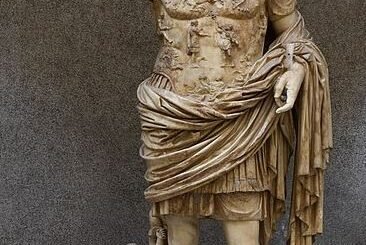
Statue of Emperor Augustus.
Did you know…?
The Greek geographer Strabo described the Mausoleum of Augustus as a massive white mound surrounded by trees, with a bronze statue of Augustus at the top.
Later History and Transformations
After the fall of the Julio-Claudian dynasty, the mausoleum continued to serve as a tomb for some of the subsequent emperors, although it gradually fell out of use. With the decline of the Roman Empire, the structure experienced various changes and was adapted for different purposes, reflecting the shifting nature of Roman society.
Medieval Period
During the Middle Ages, the mausoleum was repurposed as a fortress by the Colonna family, one of Rome’s most powerful noble families. The structure’s robust and circular design made it ideal for defense, and it became part of Rome’s fortified landscape.
Renaissance and Baroque Eras
As interest in classical antiquity was revived during the Renaissance, the mausoleum drew the attention of artists, architects, and historians. However, its function changed yet again when it was used as a garden, a bullfighting arena, and even an amphitheater for fireworks displays and public spectacles during the Baroque period. This variety of uses reflected the shifting values and needs of Roman society.
20th Century and Mussolini’s Rome
In the 1930s, the Italian dictator Benito Mussolini ordered the mausoleum to be excavated and restored as part of his vision to revive the glory of ancient Rome. Mussolini sought to connect his regime with the Roman Empire, and Augustus’ mausoleum became a symbol of this ideology. However, the restoration efforts were often superficial, and the mausoleum was never fully restored to its original state.
Contemporary Restoration Efforts
In recent decades, renewed interest in the Mausoleum of Augustus has led to extensive restoration projects aimed at preserving and reopening the site to the public. In 2021, after years of restoration, the mausoleum was reopened, allowing modern visitors to experience this monumental tomb and reflect on its historical significance.
Frequently asked questions

This photo of the Mausoleum of Augustus was taken in 2016.
When was the Mausoleum of Augustus constructed?
The Mausoleum of Augustus was constructed in 28 BCE.
What significance did the mausoleum hold during the Roman Empire?
It was the largest tomb in the Roman world, a title it retained throughout the Roman Empire, symbolizing Augustus’ power and legacy.
Where is the mausoleum located?
It is located in Piazza Augusto Imperatore near the Tiber River in Rome.
How large was the mausoleum when it was first built?
The mausoleum rose approximately 45 meters high and spanned nearly 90 meters in diameter.
Whose remains were housed in the Mausoleum of Augustus?
The mausoleum housed the remains of Augustus, his family members, and notable emperors like Tiberius, Nero, and Nerva.
What shape was the mausoleum, and what was its approximate diameter?
The mausoleum was circular, with a diameter of about 89 meters.
What materials were used in constructing the mausoleum?
It was built primarily with concrete and travertine limestone blocks, using tufa rubble as filler and white limestone for the exterior.
The interior had concentric walls arranged in three circles with semi-circular buttresses. A single entrance led to a corridor, which opened into a circular hallway surrounding the central burial chamber. The burial chamber had a concrete column with niches for urns.
What purpose did the mausoleum serve for Augustus’ family?
It served as a dynastic tomb, holding the remains of Augustus’ family members, associates, and other Julio-Claudian emperors.
What commemorative items were added at Augustus’ death?
Two bronze plaques inscribed with his achievements, known as the Res Gestae, were placed at the entrance.
What changes were made to the mausoleum in the 4th century?
Two red granite obelisks were added beside the entrance; they were later relocated to other parts of Rome.
How was the mausoleum repurposed in the Middle Ages?
The Colonna family converted it into a fortress, and its original stones were later repurposed when the fortress was dismantled in 1167 CE.
What were some of the mausoleum’s uses from the 16th to the early 20th centuries?
It served as a garden, a bullfighting arena, a site for circus acts, and eventually, a concert hall.
What happened to the mausoleum during the Fascist era?
The Fascist regime removed later additions to restore it to its ancient appearance, aligning with their vision of reviving Rome’s imperial past.
What condition was the mausoleum in by the late 20th century?
When was the most recent restoration of the mausoleum completed?
By the late 20th century, the mausoleum was overgrown and deteriorating, with only remnants hinting at its former grandeur. As a result, plans were made to conduct restoration works. A major restoration project was completed in 2021.
The restoration has allowed the public to once again experience this historic site, celebrating Augustus’ legacy and his vision for a lasting dynasty.