Most Famous Deities in Hittite Mythology and Religion
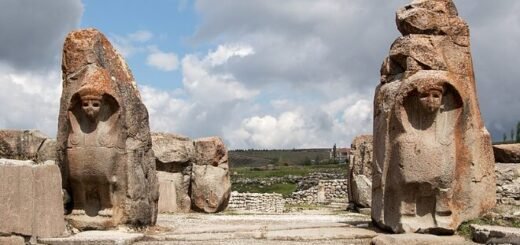
Hittite mythology and religion developed in Anatolia, primarily during the Late Bronze Age, from roughly 1600 to 1180 BC. At their capital, Hattusa, and other sites, the Hittites left behind tablets, carvings, and temple complexes that offer insights into their divine world. Unlike many ancient civilizations, the Hittites had no single sacred text or unified theological doctrine, making their religious understanding somewhat fragmented.
Piecing together their beliefs requires consulting a wide range of sources: royal decrees, cult inventories, ritual texts, iconography on seals, and carved reliefs. From these scattered clues, scholars reconstruct a vibrant polytheistic tradition encompassing native Hattian, Indo-European, Hurrian, and Mesopotamian influences. In this religious tapestry, some gods and goddesses stand out, either through their prominence in surviving myths, their role in state rituals, or their depiction in art.
The Hittites themselves often referenced their pantheon as a collection of “a thousand gods,” reflecting the multitude and complexity of their religious universe. Within this crowd of deities, a handful emerged as major figures shaping Hittite cosmology, political legitimation, and the spiritual lives of the empire’s people. These included solar goddesses, thunder-wielding weather gods, fertility deities, and important figures borrowed or adapted from neighboring cultures.
Historical and Cultural Context
The Hittites inhabited a culturally rich environment where various traditions intersected. Their religion did not evolve in isolation; it absorbed elements from the older Hattian people of central Anatolia, as well as from the Luwians and other Indo-European-speaking groups. Over time, the Hittites encountered the Hurrians, who brought their own vibrant pantheon and myths, influencing Hittite religion deeply.
Furthermore, Mesopotamian and even Syrian-Canaanite gods found their way into Hittite worship. Through conquest, diplomatic marriages, and trade, foreign deities were integrated, reshaped, and sometimes merged with local ones. This multicultural environment ensured the Hittite pantheon was always in flux, making it a dynamic religious system.
In Hittite state religion, the king acted as the chief mediator between humans and the divine. Royal patronage supported major cult centers, and kings or queens sometimes standardized or promoted certain gods, amplifying their prominence. Thus, the pantheon’s shape at any given moment reflected ongoing political, cultural, and religious negotiations.
The “Thousand Gods” and Syncretism
The term “thousand gods” is not meant literally; rather, it conveys the vastness and variety of the Hittite divine world. Hundreds of gods—some native, others borrowed—coexisted, often overlapping in function and attributes. Because there was no supreme text prescribing a single vision of the divine, local traditions persisted, and regional cults flourished.
Syncretism allowed foreign deities to merge with local ones. A goddess might be worshipped under different names in different regions, or two weather gods might be seen as variations of a single celestial power. Queen Puduhepa, for instance, attempted to organize and correlate deities, identifying the Sun Goddess of Arinna with the Hurrian Hebat, seeking coherence in this divine multitude.
This religious openness meant that the Hittite pantheon was always evolving. Gods could gain or lose prominence depending on political fortunes, cultural shifts, or natural disasters. Nevertheless, certain deities emerged consistently in rituals, treaties, and myths, marking them as especially central to Hittite religious life.
The Sun Goddess of Arinna
At the heart of Hittite religion stood the Sun Goddess of Arinna, a major divine figure associated with sovereignty, justice, and cosmic order. Arinna, located near the Hittite capital, was the principal cult center of this solar goddess. She watched over kingship, ensuring legitimacy and guiding rulers in their duty to maintain balance between heaven and earth.
Worship of the Sun Goddess was not limited to formal state ceremonies. She was integral to the political ideology that linked the king’s success to divine favor. The Sun Goddess’s attributes included protection, guidance, and maintenance of fertility. Her presence guaranteed that the cycle of days and seasons persisted, supporting agriculture and the stability of the kingdom.
In Hittite iconography, the Sun Goddess was sometimes represented on seals or depicted as a solar disc. She was not merely a celestial phenomenon but a divine personality who engaged with other gods, humans, and natural forces. As a central figure, she helped unify various local solar cults under a more universal divine presence.

Image: Sun Goddess of Arinna
Tarhunt, the Weather God
Tarhunt, sometimes called Tarhunna or Taru, was the Hittite (and Luwian) storm god, a supreme deity of thunder, lightning, and rain. Like other Indo-European thunder gods, Tarhunt’s power lay in controlling the skies, ensuring rainfall for crops, and protecting the land from drought. He was essential for agriculture, as well as for military ventures, often invoked before campaigns.
The mythology surrounding Tarhunt included his famous battle with the serpent Illuyanka. In this tale, Tarhunt’s defeat and eventual triumph over the chaos-bringing creature mirrored the cosmic struggle between order and disorder. This narrative, resonant with other Indo-European serpent-slaying myths, showcased Tarhunt’s role as a restorer of balance.
Tarhunt’s cult was widespread, and local versions of this weather deity existed, each tied to specific regions or mountains. Yet all shared the core function of ensuring fertility and prosperity. His image often featured him standing atop mountains or animals, symbolizing mastery over nature and the terrestrial realm.

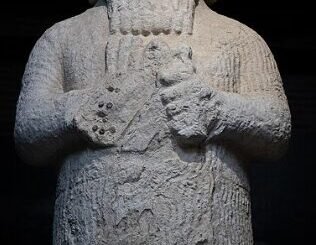
Image: An İvriz relief depicting Tarhunt.
Telipinu, the Fertility God
Telipinu, son of the Storm God and the Sun Goddess of Arinna (or in some variants, the Storm God’s consort), was a critical fertility deity. Responsible for ensuring crops grew, animals thrived, and humans prospered, Telipinu’s well-being directly impacted the material life of the Hittite people.
In one of the most famous Hittite myths, Telipinu disappears in anger, throwing nature into chaos. Without him, fields stop producing grain, animals cease reproducing, and humans suffer. The gods search for him, sending a bee to awaken and calm him. Ultimately, Telipinu’s return restores order and abundance.
This narrative highlights how essential Telipinu was to everyday survival. He was not a distant deity but intimately involved in the processes of life. Farmers, herders, and common people could directly relate to Telipinu’s role, and rituals aimed at ensuring his favor were crucial to maintaining stability and prosperity.
Arinniti and Wurusemu
The Sun Goddess of Arinna was sometimes referred to by names such as Arinniti or Wurusemu, reflecting the fluidity of divine identities. These different appellations might denote local traditions or specific aspects of her function. Arinniti and Wurusemu are often understood as Hattian forms of the same deity, highlighting a layering of indigenous beliefs beneath Hittite religion.
Arinniti’s main attributes overlapped with those of the primary solar goddess: maintaining cosmic order, supporting the king’s rule, and ensuring agricultural fertility. These multiple names underscore how one goddess could be venerated differently in various places, yet still represent a single divine principle.
In practice, worshippers approached Arinniti/Wurusemu through offerings, prayers, and temple rituals. She symbolized both stability in the cosmos and the moral foundation of society. Although distinct local cults may have emphasized one aspect over another, collectively they reinforced her status as a key figure in Hittite religious life.
Inara, the Goddess of the Wild and Protector
Inara was a goddess associated with wild animals, hunting, and perhaps the untamed aspects of nature. While not as central as the Sun Goddess or the Storm God, Inara played an important role in certain myths. In the “Slaying of the Dragon” narrative, Inara helps the Storm God defeat the serpent Illuyanka by devising a cunning plan.
This myth underscores Inara’s cleverness and protective instincts. Although she may have lacked the overarching cosmic significance of major deities, Inara demonstrated how cooperation between gods and humans could restore order. She enlisted the help of a mortal man, showing the Hittite view that humans and gods could collaborate.
Inara’s presence in ritual life may have been tied to hunting cults or the maintenance of boundaries between civilization and wilderness. Her protective, strategic nature complemented the might and authority of her divine peers, enriching the Hittite pantheon’s diversity.
Hannahannah, the Great Mother
Hannahannah, often called the “Grandmother Goddess,” embodied maternal wisdom, fertility, and protection. She was akin to a mother figure among the gods, playing a mediating and nurturing role in several myths. In the Telipinu myth, for instance, Hannahannah helps find and soothe the angry fertility god, ensuring life can flourish again.
As a nurturing deity, Hannahannah’s qualities extended to the well-being of families, communities, and livestock. Although not as politically central as the Sun Goddess, she was important for the household and daily life. Her gentle influence contrasted with the stormy might of male gods, providing a balancing maternal presence.
Hannahannah’s cult likely involved simple rites and offerings intended to secure her goodwill. By maintaining a stable lineage of divine caregivers, the Hittite pantheon reinforced the value of care, kindness, and cooperation, both among gods and within human society.
Kumarbi and the Hurrian Influence
Kumarbi was a Hurrian god who became integral to Hittite mythic traditions, demonstrating the deep cultural interactions at play. He appears in narratives often called “Hittite-Hurrian” myths, reflecting the blended nature of the religious landscape. Kumarbi, known as the father of the Storm God Teshub (akin to Tarhunt), occupies a role similar to Cronus in Greek mythology.
In the “Song of Kumarbi,” the god bites off the genitals of Anu, a sky god, absorbing divine power and setting the stage for later power struggles. This narrative, shocking by modern standards, symbolized cosmic transitions and the passing of authority among gods. The Hittites adapted the Hurrian myths to fit their own worldview, linking Kumarbi to their existing pantheon.
The assimilation of Kumarbi illustrates how foreign gods were not simply appended to the Hittite religion. They were reinterpreted, sometimes placed into genealogical frameworks, and given roles that made sense in a Hittite context. Kumarbi’s presence enriched Hittite narratives, connecting them to broader Near Eastern mythic traditions.
Ishtar (Ištar) and Adapted Deities
Ishtar was originally a prominent Mesopotamian goddess of love, war, and fertility. The Hittites adopted her into their pantheon, adapting her persona to local needs. They associated Ishtar with domestic and agricultural concerns, but also acknowledged her martial aspects, making her a flexible and powerful figure.
In Hittite ritual texts, Ishtar sometimes appears in purification rites or acts as a protective figure. While her Mesopotamian myths often highlight her underworld journeys or conflicts, Hittite interpretations emphasized her role in ensuring fertility and stability. She could ward off evil, cleanse impurities, and support the community’s overall well-being.
This adaptation of Ishtar demonstrates the Hittites’ willingness to reinterpret foreign deities. They did not simply import gods wholesale; they reshaped them to integrate smoothly with their spiritual and social structures. Ishtar’s ability to stand at the crossroads of war, love, and the supernatural made her a valuable addition to the Hittite pantheon.
Local and Regional Storm Gods
Beyond the primary Storm God Tarhunt, the Hittite realm teemed with numerous local weather gods. Each city, region, or even a specific landmark might have its own storm deity. These local gods were not always clearly distinguished from Tarhunt but were often seen as his manifestations or closely related aspects.
This proliferation of storm gods reflected the importance of weather and agriculture in Hittite life. Different regions relied on rainfall at particular times, and local cults formed to ensure divine favor. Rather than erasing these distinctions, the Hittite state allowed them, creating a mosaic of overlapping religious identities.
By honoring local storm gods, communities maintained ties to their immediate environment and cultural heritage. This approach fostered loyalty and stability within the empire, as people could continue venerating traditional deities even under Hittite hegemony, ensuring social cohesion.
The Underworld Deities and Lelwani
The Hittites recognized an underworld realm where chthonic deities resided. Among them was Lelwani, originally male in some traditions but often portrayed as female. Lelwani governed the afterlife and was associated with death, purification, and the realm beneath the earth’s surface.
Underworld deities played a subtle but essential role in Hittite religion. While not as celebrated or invoked as fertility or storm gods, their presence was acknowledged in funerary rites and rituals that sought to maintain balance between the realms of the living and the dead. The underworld’s existence provided a cosmic backdrop, ensuring that life and death were part of a continuous cycle.
Lelwani’s importance lay in her function as a gatekeeper of mortality and transformation. By appeasing Lelwani through proper rites, Hittites aimed to secure safe passage for the deceased and maintain harmony in the afterlife. Though less often mentioned in myths, these underworld figures completed the divine spectrum, accounting for all facets of existence.
Hattian, Hurrian, and Luwian Threads
The Hittite pantheon was a tapestry woven from multiple cultural threads. Hattian influences lingered in the identities and roles of deities like the Sun Goddess of Arinna. Hurrian gods like Kumarbi and Teshub found their way into key mythic narratives, while Luwian contributions enriched the pantheon with their own local storm gods and unique religious practices.
This plurality was not merely tolerated; it was embraced. The Hittites managed to maintain a coherent religious system that accommodated regional differences and foreign imports. Deities could be renamed, reinterpreted, or merged, ensuring that every community found a place for its gods within the larger imperial framework.
By blending these traditions, the Hittites created a religion that was both anchored in deep local roots and open to innovation. The result was a spiritual environment where no single deity dominated absolutely, and where divine forces were understood as multifaceted and ever-adapting.
Political Dimensions of Worship
The prominence of certain deities sometimes reflected political realities. Royal patronage, for instance, could elevate a local goddess into a major state deity. Treaties invoked gods as witnesses, thereby increasing the gods’ authority and aligning divine will with royal policy. By appealing to the gods during negotiations or conflicts, rulers justified their decisions through divine endorsement.
When the Hittites conquered or assimilated new regions, they encountered local cults. Instead of suppressing them, they integrated these local gods, enabling the empire to legitimize its rule. By recognizing the divine patrons of conquered peoples, the Hittites promoted stability and cooperation. Gods thus served as both spiritual guardians and instruments of imperial diplomacy.
This pragmatic approach ensured that religious practice was not purely devotional but also intertwined with governance. Deities became symbolic partners in statecraft, lending a sacred aura to laws, treaties, and authority. The divine world and the political world were interlinked, reflecting the complexity of Hittite religious thought.
Rituals, Icons, and Huwasi Stones
Hittite religious expression involved temples, shrines, and open-air sanctuaries. Iconography on seals and reliefs depicted gods in human or animal form, or standing atop animals that symbolized their power. Special stones, called Huwasi stones, served as physical embodiments of deities, making divine presence tangible and accessible.
Rituals might involve offerings of bread, beer, sheep, or oxen, and could be seasonal, event-driven, or crisis-related. Priests, diviners, and royal officials orchestrated these ceremonies, aiming to maintain good relations with the gods. In some rituals, the king or queen performed central roles, reinforcing their status as divine intermediaries.
Because the Hittites left no systematic theology, rituals and icons become key sources for understanding the gods. By examining temple layouts, archaeologists infer which deities were worshipped and how. By studying inscriptions listing offerings, we glean the gods’ relative importance. Such evidence reveals that worship was both grand and intimate, adjusting to circumstances and reflecting the complexity of the pantheon.
Myth and Daily Life
Myths featuring gods like Tarhunt, Telipinu, and Inara were not just stories for entertainment. They were performed and reenacted, integrated into rituals and festivals that aimed to influence reality. By repeating the gods’ actions—finding Telipinu, tricking Illuyanka, or restoring cosmic balance—priests and worshippers hoped to prompt the gods to act similarly in the present world.
These narratives explained natural phenomena and human fortunes. If the crops failed, it might be because Telipinu was in hiding, not because the rains simply stopped. By understanding divine motivations, Hittites believed they could negotiate with the gods: performing correct rituals, offering appropriate sacrifices, or reciting proper prayers to restore harmony.
In daily life, individuals might offer small devotions at home, seek divine guidance through divination, or appeal to Ishtar for help in love or war. The pantheon was not distant or theoretical—its gods were woven into the fabric of society. The Hittites lived in a divine landscape, engaging with countless gods who oversaw every aspect of existence.
Continuity and Legacy
With the collapse of the Hittite Empire around 1180 BC, the direct worship of these gods faded. Yet their legacy persisted, influencing successor states and contributing to the religious mosaic of the Iron Age. Traces of Hittite divine names and concepts echo in the religions of later Anatolian peoples and through cultural memory passed down in myths and legends.
Modern scholars, faced with fragmentary texts and inscriptions, continue to piece together the roles, attributes, and stories of Hittite deities. Although much remains unknown, what is clear is the depth and complexity of this ancient religious world. The Hittite pantheon, with its “thousand gods,” stands as an example of religious pluralism, adaptability, and intercultural exchange in the ancient Near East.
Though no single Hittite deity dominates the historical record like Zeus or Osiris, their collective importance shines through. Each god played a part in maintaining cosmic order, ensuring agricultural fertility, guiding political authority, and connecting communities to the divine. Their religious tradition reminds us that faith in antiquity was vibrant, evolving, and inseparable from daily life.
Conclusion
Hittite religion and mythology present a complex, dynamic tapestry of deities woven from local traditions and foreign influences. From the Sun Goddess of Arinna’s solar majesty and the stormy power of Tarhunt to the fertility and renewal offered by Telipinu, each major deity fulfilled essential roles. Goddesses like Inara and Hannahannah enriched the pantheon’s diversity, while the Hurrian Kumarbi and Mesopotamian Ishtar demonstrated how foreign gods could be embraced and reshaped.
These gods were not distant abstractions. They stood at the heart of Hittite life: guiding kings, blessing harvests, inspiring myths, and justifying treaties. Their worship reflected the cultural complexity of Anatolia and the Hittites’ willingness to adapt and integrate.
Frequently Asked Questions
When did Hittite religion flourish in Anatolia?
It developed during the Hittite Empire’s peak, roughly from 1600 to 1180 BC.
Why is our knowledge of Hittite mythology incomplete?
Most narratives have not survived, and what remains is fragmentary and filtered through administrative and cultic texts.
Did the Hittites have a central holy scripture?
No, they had no canonical scripture or unified theological system; their beliefs must be reconstructed from scattered sources.
Which cultures influenced Hittite mythology?
Hittite religion blended older Hattian and Luwian traditions with Mesopotamian concepts and was strongly influenced by the Hurrians.
What is a notable example of a shared mythological motif in Hittite religion?
The weather god Tarhunt’s battle with Illuyanka mirrors Indo-European serpent-slaying myths like those of Indra and Thor.
How did the Hurrians shape Hittite religion?
Hurrian myths and gods intertwined closely with Hittite traditions, sometimes leading scholars to group them together as “Hittite-Hurrian.”
How were Hittite rituals typically performed?
Rituals were often situational, responding to crises or agricultural needs, and frequently reenacted mythic narratives to restore harmony.
Who held a central religious role in Hittite society?
The king served as both a secular leader and a priestly mediator, maintaining the bond between gods and people.
What was the significance of Arinna?
Arinna was a major cult center dedicated to the Sun Goddess, a key deity representing sovereignty and solar power.

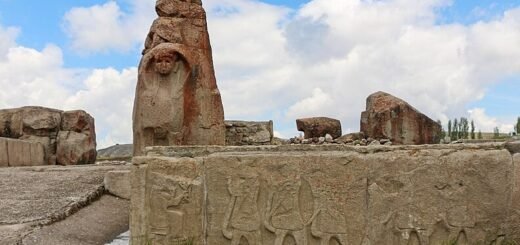
Image: A relief of the Sun-Goddess of Arinna found at Alaca Höyük.
How did the Hittites view their pantheon?
They acknowledged a “thousand gods,” reflecting a vast, fluid pantheon that resisted strict unification and embraced local variations.
In what ways did the Hittites adopt foreign gods?
They integrated and adapted deities from neighboring cultures—like Ishtar—adjusting their attributes to fit Hittite religious needs.
Why is Hittite religion considered practical and integrated into daily life?
It was tied to agriculture, political authority, and survival, ensuring rituals and offerings were vital to maintaining divine favor and societal well-being.