Most Famous Hittite Artworks
The Hittite civilization, a formidable power in the ancient Near East, left behind a rich artistic legacy that offers invaluable insights into their society, religion, and interactions with neighboring cultures. Spanning from the nineteenth to the twelfth century BCE, Hittite art is renowned for its intricate carvings, monumental reliefs, and symbolic motifs. Below are ten of the most famous Hittite artworks, each underscoring the civilization’s artistic prowess and cultural significance.
Hittite art reflects a society that valued visual storytelling, divine representation, and the integration of art into both public and sacred spaces.
Yazılıkaya Rock Sanctuary
Located near the Hittite capital of Hattusa in modern-day Turkey, the Yazılıkaya Rock Sanctuary is one of the most significant and well-preserved examples of Hittite rock reliefs. Carved into the natural rock formations, the sanctuary features a series of elaborate reliefs depicting a procession of Hittite gods and goddesses in ceremonial attire. These figures are arranged in concentric circles, creating an open-air temple space that emphasizes the divine hierarchy and cosmology of the Hittite religion.
Yazılıkaya serves as a spiritual and ceremonial hub, reflecting the Hittites’ sophisticated religious practices and their emphasis on divine order. The sanctuary’s intricate carvings illustrate the pantheon of Hittite deities, highlighting the civilization’s theological complexity and its integration of various cultural influences. Additionally, the placement of the reliefs in a natural, elevated setting underscores the Hittites’ reverence for nature and the divine, blending art seamlessly with the landscape.
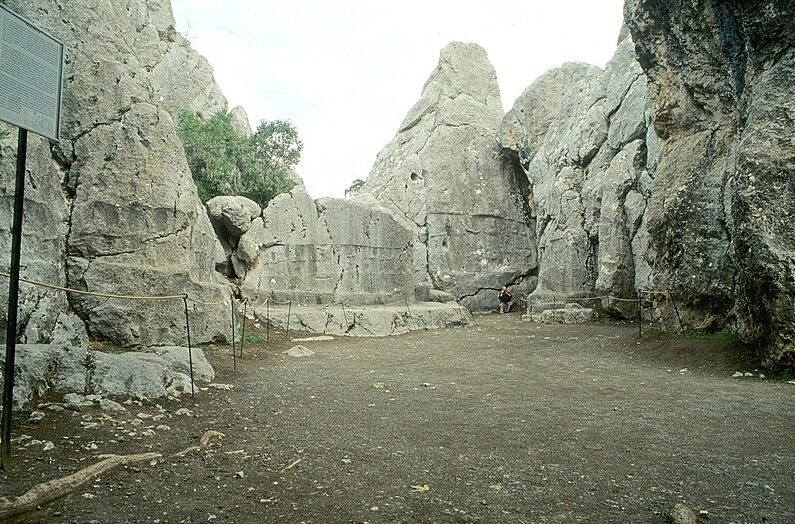
Image: A view of the rocks at Yazılıkaya.
The Lion Gate at Hattusa
The Lion Gate, part of the ancient city of Hattusa, is a monumental entrance adorned with impressive stone carvings of lions. These powerful creatures are depicted in dynamic poses, often positioned on either side of the gate, symbolizing strength and protection. The gate itself is constructed from large cyclopean blocks, showcasing the Hittites’ advanced engineering and architectural skills.
The Lion Gate exemplifies the Hittites’ use of monumental architecture to convey power and authority. Lions, often associated with royalty and divine protection, symbolize the king’s strength and the city’s fortified nature. This gate not only served a practical defensive purpose but also acted as a symbolic barrier against enemies, reinforcing the Hittite state’s might and the king’s role as the protector of his people.
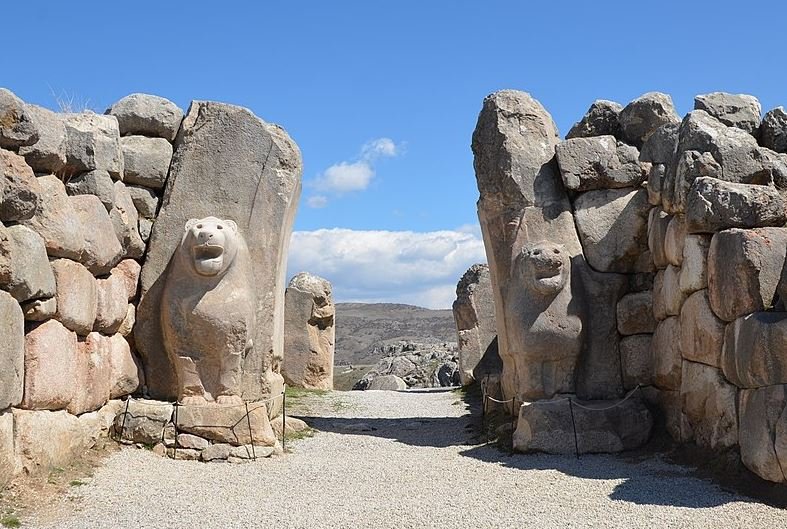
Image: Lion Gate at Hattusa, symbolizing protection against evil spirits.
The Sphinx Gate at Alaca Höyük
One of the most iconic structures from the Hittite New Kingdom, the Sphinx Gate at Alaca Höyük features two massive sphinx statues flanking a monumental gate. These sphinxes are characterized by their leonine bodies, human heads, and intricate Hathor-like curls. The gate itself is adorned with reliefs depicting religious processions and hunting scenes, carved into large cyclopean blocks.
The Sphinx Gate represents the zenith of Hittite artistic achievement, blending artistic grandeur with religious symbolism. The sphinxes serve as guardians of the sacred space, embodying both divine and royal authority. The reliefs on the gate narrate scenes of royal rituals and hunting, emphasizing the king’s divine mandate and his role in maintaining cosmic order. This monument illustrates the Hittites’ ability to integrate art, architecture, and religion into cohesive expressions of state ideology.

Image: Sphinx Gate at Alaca Höyük
Seal of Tarkasnawa, King of Mira
The Seal of Tarkasnawa is a small, intricately crafted silver seal attributed to Tarkasnawa, the King of Mira, a Hittite vassal state. Measuring approximately 1 cm in height and 4.2 cm in diameter, the seal features a detailed relief of the king, possibly accompanied by symbolic motifs such as deities or mythical creatures.
This seal is a prime example of Hittite craftsmanship and the administrative sophistication of the civilization. Seals like Tarkasnawa’s were used to authenticate documents and signify authority, reflecting the bureaucratic nature of the Hittite state. The artistic detail on the seal underscores the importance of royal imagery in legitimizing kingship and maintaining political control. Additionally, as a piece from a vassal state, it highlights the cultural influence and integration of Hittite artistic standards across its empire.

Image: Seal of Tarkasnawas
The Hittite Rhyton Depicting Hunting Scenes
Hittite rhytons are ceremonial drinking vessels often shaped like animals, particularly raptors such as eagles. One notable rhyton features a dynamic hunting scene, where a deity or royal figure is depicted in the act of hunting a deer. These vessels are crafted from materials like clay or metal and showcase intricate carvings that capture movement and emotion.
The rhyton serves both a practical and symbolic purpose in Hittite society. Functionally, it was used in religious and ceremonial contexts, likely during feasts and rituals. Symbolically, the hunting scenes represent the king’s prowess and divine favor, reinforcing his role as a protector and provider. The depiction of hunting also reflects the Hittites’ connection to nature and their reverence for the natural world as an extension of the divine realm.
The Alacahöyük Sphinx
The Alacahöyük Sphinx is a finely carved ivory sculpture discovered at the ancient site of Alacahöyük. This sphinx features a leonine body, a human head adorned with Hathor-like curls, and detailed decorative elements that showcase the Hittites’ skill in ivory carving.
The Alacahöyük Sphinx exemplifies the Hittites’ mastery of small-scale sculptural techniques and their ability to infuse symbolic meaning into their art. Ivory, being a precious material, indicates the significance of the object, possibly used in elite or religious contexts. The sphinx itself is a potent symbol of protection and divine authority, often associated with guardianship and the safeguarding of sacred spaces. This sculpture highlights the Hittites’ artistic sophistication and their cultural connections with neighboring civilizations that also revered the sphinx as a symbol of power.
Carved Ivories from Acemhöyük
Acemhöyük, an important Hittite site, has yielded a collection of carved ivories that include intricate figures such as a young girl half-seated with her breasts cupped and wearing a traditional cap. These delicate carvings demonstrate the Hittites’ attention to detail and their ability to create expressive, lifelike representations in ivory.
The carved ivories from Acemhöyük provide valuable insights into the daily life, fashion, and artistic practices of the Hittites. These objects likely held ceremonial or decorative purposes, reflecting the aesthetic values and social norms of the time. The craftsmanship involved in creating such detailed figures from ivory underscores the Hittites’ technical expertise and the importance placed on artistry in their culture. Moreover, these ivories help scholars understand the blending of indigenous Anatolian styles with influences from neighboring regions, showcasing the Hittites’ role in cultural synthesis.

A beautifully crafted ivory box, decorated with lapis lazuli, bronze, and iron, was found at Acemhöyük.
The Stone Gate at Alaca Höyük
The Stone Gate at Alaca Höyük is a monumental structure featuring large carved blocks with unfinished reliefs of a religious procession and hunting scenes. The gate is flanked by two imposing sphinxes and includes intricate carvings that depict Hittite royalty, priests, and deities in dynamic interactions.
The Stone Gate is a testament to the grandeur and ceremonial significance of Hittite architecture. The unfinished reliefs offer a glimpse into the artistic processes of the Hittites, revealing the complexity and scale of their projects. The depiction of religious processions and hunting scenes emphasizes the intertwined nature of religion, governance, and social hierarchy in Hittite society. This monument also highlights the Hittites’ ability to create large-scale public works that served both functional and symbolic purposes, reinforcing the authority of the ruling elite and their connection to the divine.
The Hittite King’s Rhyton from Hattusa
This silver rhyton from Hattusa features a detailed relief of a deity engaged in hunting, illustrating a deer being hunted and subdued. The vessel captures a moment of action, with the progression of the hunt depicted around the rim, showcasing the Hittites’ ability to convey narrative and movement in their art.
The King’s Rhyton is emblematic of the Hittites’ use of art to communicate royal authority and divine favor. The hunting scene symbolizes the king’s role as a leader and protector, endowed with the power to maintain order and secure prosperity. The narrative quality of the relief demonstrates the Hittites’ storytelling capabilities through visual art, allowing them to convey complex ideas and values to a largely illiterate population. Additionally, the use of precious materials like silver underscores the vessel’s importance in ceremonial contexts, reflecting the wealth and sophistication of the Hittite elite.
Statue of King Šuppiluliuma from the Post-Hittite Period
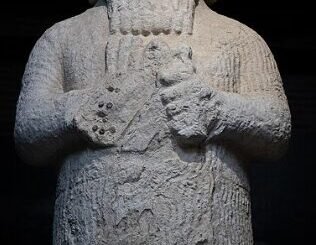
The statue of King Šuppiluliuma, ruler of the Luwian state of Pattin (Unqi), represents a continuation of Hittite artistic traditions into the Post-Hittite period. This statue depicts the king in a regal stance, adorned with royal attire and holding symbols of authority, blending Hittite motifs with emerging Luwian and Aramean influences.
This statue exemplifies the enduring legacy of Hittite art beyond the fall of the Hittite New Kingdom. In the Post-Hittite period, smaller states like Pattin retained and adapted Hittite artistic conventions, demonstrating the lasting impact of Hittite culture on subsequent Anatolian and Syrian civilizations. The blending of Hittite and local styles in the statue of Šuppiluliuma highlights the cultural continuity and syncretism that characterized this era, preserving Hittite artistic heritage while integrating new influences. This adaptation underscores the resilience and adaptability of Hittite art in the face of political and cultural transformations.

Image: Statue of Suppiluliuma.
Frequently Asked Questions
What time period and geographical region did the Hittite civilization occupy?
The Hittite civilization flourished during the second millennium BCE, specifically from the nineteenth to the twelfth century BCE. They were centered in ancient Anatolia, which corresponds to modern-day Turkey, and their influence extended into parts of Syria.
How did Hittite artists convey complex meanings to a largely illiterate population?
Hittite artists utilized a rich tradition of standardized images and motifs, skillfully rearranging and combining these visual elements to create intricate compositions. This method allowed them to communicate narratives, religious beliefs, and societal values effectively without relying on written language.
What were the primary themes and motifs in Hittite art?
Central themes in Hittite art included depictions of deities, ritual practices, hunting scenes, and representational animal forms. These motifs illustrated religious beliefs, societal values, and the relationship between humans and the divine, often reflecting the Hittites’ reverence for nature and their gods.
Why do scholars find it challenging to date much of Hittite art accurately?
Dating Hittite art is difficult due to the scarcity of inscriptions and the displacement of many artifacts from their original contexts. Additionally, numerous pieces were removed from burial sites and dispersed among museums in the nineteenth century, complicating efforts to establish precise chronological frameworks.
What characterizes the Colony Age in Hittite art, and what were its main artistic outputs?
The Colony Age, spanning the nineteenth and eighteenth centuries BCE, preceded the unified Hittite Kingdom. During this period, Hittite art assimilated symbols and styles from indigenous cultures such as the Hattians, Hurrians, and Assyrians. Artistic outputs included carved ivories, baked clay objects, and small seals, often featuring animal-shaped rhytons and intricate designs like Hathor-like curls on sphinxes.
How did Hittite art evolve during the Old Kingdom period?
In the seventeenth century BCE, as the Hittites established a centralized state with Hattusa as the capital, their art shifted towards larger and more permanent forms, including stone reliefs. Artistic figures became more slender and dynamic, often depicting violent or complex scenes such as divine conflicts and power struggles, reflecting the expanding power and sophistication of the Hittite state.
What are the distinguishing features of Hittite art during the New Kingdom period?
The New Kingdom period (fourteenth to twelfth century BCE) marked the height of Hittite power and artistic achievement. Art from this era featured large-scale relief sculptures with robust and solidly proportioned figures. Notable monuments include the stone gate at Alaca Höyük, adorned with massive sphinxes and reliefs depicting religious processions and hunting scenes, emphasizing grandeur and monumentality.
What changes occurred in Hittite art during the Post-Hittite period?
Following the collapse of the Hittite New Kingdom around 1180 BCE, the Post-Hittite period saw the continuation of Hittite artistic traditions within smaller Anatolian states. Art during this time blended Hittite motifs with Aramean and Assyrian influences, resulting in public sculptures and ceremonial reliefs. Rock reliefs remained prominent, preserving the Hittite legacy until the rise of the Neo-Assyrian Empire.
What role did rock reliefs play in Hittite art, and where are some notable examples located?
Rock reliefs were a significant form of Hittite artistic expression, often situated in elevated, sacred locations to signify divine presence and maintain a spiritual connection with the landscape. Notable examples include the reliefs at Yazılıkaya near Hattusa, which depict Hittite gods in procession, and other sites like İvriz, Manisa, and Hemite. These reliefs showcase the Hittites’ mastery of stone sculpture and their integration of art with the natural environment.
How did Hittite art reflect the civilization’s interactions with neighboring cultures and their own internal developments?
Hittite art demonstrated a blend of indigenous traditions and influences from conquered or neighboring cultures, such as the Hattians, Hurrians, Assyrians, and later Arameans and Assyrians during the Post-Hittite period. This cultural assimilation is evident in the adoption and adaptation of various symbols, motifs, and artistic techniques. Additionally, internal developments like the centralization of the state and the rise of powerful rulers influenced the complexity and themes of Hittite art, reflecting both external interactions and internal societal changes.