Most Famous Triumphal Arches in Rome
by World History Edu · January 14, 2025
Triumphal arches were monumental structures erected in ancient Rome to commemorate significant military victories or to honor emperors and their achievements. They served as visual propaganda, reinforcing the power and glory of the Roman Empire. These arches were richly decorated with reliefs, inscriptions, and sculptures, showcasing the emperor’s triumphs and divine favor.
Here’s a detailed explanation of the most famous triumphal arches in Rome.
Arch of Titus

Front view of The Arch of Titus.
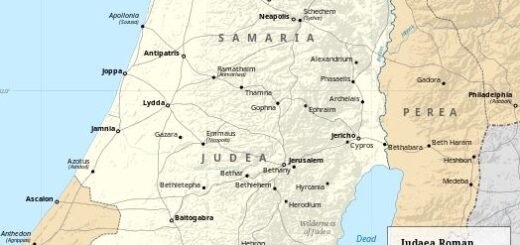
The Arch of Titus, constructed around 81 CE by Emperor Domitian, honors his brother Titus and father Vespasian for their victory in the Jewish War (66–73 CE), which culminated in the Siege of Jerusalem.
This single-bayed arch is made of white marble and features prominent reliefs. The most famous depictions include:
- The Spoils of Jerusalem Relief: Displays Roman soldiers carrying sacred treasures like the Menorah from the Temple of Jerusalem.
- The Apotheosis of Titus: Shows Titus ascending to the heavens, symbolizing his deification.
Arch of Constantine

Front view of Arch of Constantine.
Erected in 315 CE, the Arch of Constantine celebrates Emperor Constantine‘s victory over Maxentius at the Battle of the Milvian Bridge in 312 CE. This battle marked Constantine’s rise to sole power and his promotion of Christianity.
The arch is notable for its eclectic use of spolia (reused materials from earlier monuments). Key elements include:
- Panels from the Time of Trajan, Hadrian, and Marcus Aurelius: Highlighting past emperors’ accomplishments.
- Inscription: Declares Constantine’s victory as divinely inspired.
- Christian Iconography: Subtle Christian symbols, reflecting Constantine’s religious policies.
As the largest surviving triumphal arch in Rome, it represents the transition from pagan Rome to the Christian Empire and demonstrates how architectural styles adapted over time.
How did Constantine’s vision at Milvian Bridge facilitate the spread of Christianity?
Arch of Septimius Severus

The Arch of Septimius Severus at Leptis Magna
Commissioned in 203 CE, this arch commemorates Emperor Septimius Severus and his sons, Caracalla and Geta, for their victories over the Parthians.
This triple-bayed arch, located in the Roman Forum, is adorned with elaborate reliefs and inscriptions. Key features include:
- Military Campaign Depictions: Scenes of battles, sieges, and triumphs.
- Honorary Dedication: Originally included both Caracalla and Geta, but Geta’s name was later removed due to Caracalla’s damnatio memoriae (erasure of memory).

Arch of Drusus

A 2018 picture of the Arch of Drusus.
The Arch of Drusus, built around the early 3rd century CE, is associated with Nero Claudius Drusus, a prominent general and stepson of Emperor Augustus. However, its original purpose and exact dedication remain uncertain.
The arch, now partially ruined, once featured an aqueduct that supplied water to the Baths of Caracalla. Its decorative elements have largely disappeared, but its historical significance as part of Rome’s infrastructure is notable.
Though less ornate than other arches, the Arch of Drusus demonstrates how practical and commemorative functions could intersect in Roman architecture.
Arch of Gallienus
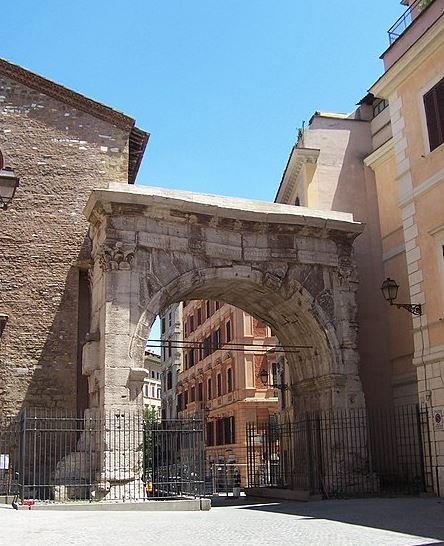
A 2006 image of the Arch of Gallienus.
Built in 262 CE, this arch honors Emperor Gallienus and his wife Salonina. It replaced an earlier gate of the Servian Wall and celebrated Gallienus’s efforts to stabilize the empire during a period of crisis. Key features include:
- Single Bay Design: Simple yet elegant, reflecting a period of limited resources.
- Inscription: Dedicated by a private citizen, Marcus Aurelius Victor, highlighting the declining imperial finances and reliance on public support.
Arch of Janus
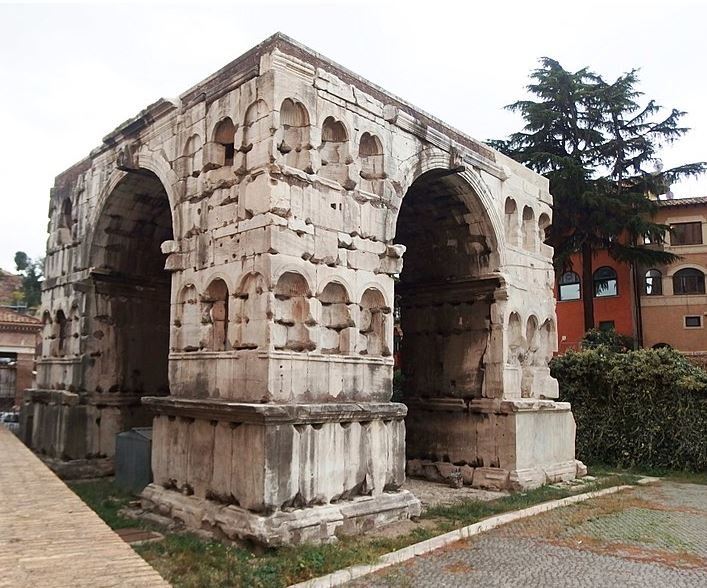
A diagonal view of the Arch of Janus.
Erected in the 4th century CE, the Arch of Janus is unique as a quadrifrons (four-sided) arch, designed for traffic at a major crossroads in the Forum Boarium.
Dedicated to the god Janus, it symbolizes transitions and duality. Its design allowed for inscriptions and reliefs on all sides, maximizing visibility.
Despite damage and loss of decoration, the Arch of Janus remains an architectural curiosity and an example of Rome’s adaptive reuse of older materials.