Neville Chamberlain: The British Prime Minister whose appeasement policy emboldened Hitler

Neville Chamberlain was a British Conservative politician who served as Prime Minister of the United Kingdom from May 1937 to May 1940. He is best known for his policy of appeasement toward Adolf Hitler’s Germany in the lead-up to World War II. Image: Portrait of Neville Chamberlain by Irish artist William Orpen, 1929
Early Life & Family
Despite being raised in a political family in the Edgbaston district of Birmingham, Chamberlain wanted to explore business ventures before pursuing a career in politics.
He studied at Mason College and later proceeded to work in an accountancy firm at age 21. A typical academician, he earned a Doctor of Civil Law at Oxford University and was awarded a number of honorary Doctor of Laws degrees from Cambridge, Birmingham, Bristol and Reading Universities.
His father, Joseph Chamberlain, was a prolific British politician and reformer who served as a leader of the left wing of the Liberal Party in the late 19th century.

Neville Chamberlain was the son of Joseph Chamberlain, a prominent British politician and reformer. His half-brother, Austen Chamberlain, also had a distinguished political career, serving as Foreign Secretary and winning the Nobel Peace Prize in 1925. Image: Sir Austen Chamberlain, 1908–12, by Henry Walter Barnett
Early Political Career

Image: Chamberlain as Lord Mayor of Birmingham in May 1916, alongside Prime Minister Billy Hughes of Australia
After a successful metal business, Chamberlain ventured into politics proper. His earliest appointment as a politician was as Lord Mayor of Birmingham in 1915. During his tenure, he established a savings bank. The following year, he was named Director General of National Service in David Lloyd George’s World War I coalition government.
In 1918, he was elected to the House of . Over the next four years, he excelled in various roles and quickly moved up the ladder from a first-term back bencher to a notable political figure.
As a conservative politician, he served as Postmaster General from 1922 to 1923. Chamberlain has also been a member of the Privy Council and Minister of Health.
As Minister of Health, Chamberlain introduced significant reforms, including the Housing Act of 1930, which aimed to improve living conditions by clearing slums and building new housing. He also worked to enhance public health services and address issues such as unemployment and poverty.
Term as Prime Minister
In 1937, Chamberlain succeeded Stanley Baldwin as Prime Minister and shortly after, launched a number of domestic and foreign reforms. Another quick move he made during his premiership was to dismiss 1st Viscount Walter Runciman from his position as president of the Board of Trade on grounds of laziness. The 1st Viscount declined an offer of the position of Lord Privy Seal.
-
Domestic Reforms
He passed the Factories Act of 1937 which consolidated and amended the factory Workshop Acts from 1901 to 1929. Introduced by the Home Secretary, Sir John Simon, it was focused on improving the working conditions in factories and defining the working hours of women and children. He also played a role in the passage of the Coal Act of 1938 which sought to guide the “acquisition of property in all worked and unworked coal and mines of coal in certain associated minerals.”
-
Foreign Relations
Chamberlain worked tirelessly to bring some form of resolution to the terms of the Anglo-Irish Treaty which allowed for the creation of an independent Irish free states within the British Empire. Deliberations after deliberations yielded no results. After one final offer from Chamberlain, the two parties eventually reached a consensus and the agreements were signed in April, 1938.
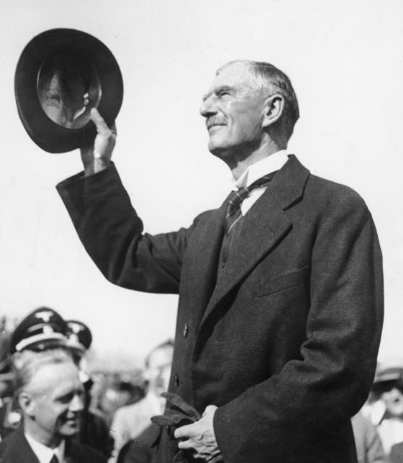
As Prime Minister, Chamberlain faced the challenge of addressing the growing threat of Nazi Germany, managing Britain’s rearmament efforts, and maintaining public support for his policies. The onset of World War II and the initial setbacks in the conflict further complicated his leadership. Image: Chamberlain arrives in Munich, September 1938
The Munich Agreement
Following the First World War, many new countries emerged as a result or the re-creation of the European map. This change led to about three million Germans to settle in Sudetenland, the ethnically German part of Czechoslovakia.
In Hitler’s quest to unite all Germans under one nation, he focused his attention on Czechoslovakia. He intended to evacuate the Czechoslovakian population by any means necessary and occupy the land. When the leader of the Germans in Sudetenland reported a series of mistreatment against their people, Hitler used that information to his advantage. He announced his intention to start a war in European unless Sudetenland was ceded to Germany.
Like many British civilians who lived through the First World War, Chamberlain resolved to prevent another war. War was certainly too high a price to pay.
The Prime Minister made several visits to Germany to hold face-to-face meetings with Hitler in the hopes of reaching a non-violent resolution. On September 30, 1938, Chamberlain and French Prime Minister, Daladier, agreed to the demands of Hitler to allow Nazi Germany to annex the Sudetenland region.
At the time, the policy of appeasement was not uncommon among European leaders especially when dealing with pro-war leaders like Hitler. It was a simply a non-violent tactic of providing specific concessions to an aggressor nation in order to prevent war.
Chamberlain and Daladier left Munich believing that the Policy of Appeasement with Hitler would ensure “peace for our time,” but that was not to be.

Chamberlain justified appeasement by arguing that it was necessary to maintain peace and avoid another devastating conflict like World War I. He believed that by satisfying some of Germany’s demands, a larger war could be averted, giving Britain time to rearm and prepare for potential future conflicts. Image: Chamberlain (left) and Hitler leave the Bad Godesberg meeting, 23 September 1938
Partition of Czechoslovakia
In January, 1938 German troops occupied all of Czechoslovakia. In the wake of the invasion, the leaders of the ruling Czech government resigned. Germany broke their promise to Britain and France and went on a rampage to invade more territories.
By March the following year, Nazi Germany had invaded the Czech provinces of Bohemia and Moravia and made them German Protectorates. Prague was also taken.
It has been estimated that Nazi Germany and it allies killed over 80,000 Jews, stripped many of their homes and forced many more in labor.
Legacy
Chamberlain stepped down as Prime Minister in 1940 and agreed to serve in Winston Churchill‘s War Cabinet. Unfortunately, he died the same year.
Many Europeans have been divided on the issue of the Munich Agreement. Some described Chamberlain as “Britain’s worst political leader,” and there are those who believed his decision prevented a war and saved some parts of Czechoslovakia. They maintain that Chamberlain was operating in a post-First World War political environment in which wars were considered repressive and opposed the tenets of democracy.
Perhaps, Chamberlain knew that Britain was militarily unprepared for war and would have suffered many casualties if they had engaged Germany with force in 1938.
Frequently asked questions about Neville Chamberlain

Image: Caricature of Prime Minister Chamberlain, c. 1940
What is Neville Chamberlain most famous for?
Chamberlain is most famous for his policy of appeasement, particularly his signing of the Munich Agreement in 1938, which permitted Nazi Germany’s annexation of the Sudetenland, a region of Czechoslovakia. He is often remembered for his declaration of having secured “peace for our time.”
What was the Munich Agreement?
The Munich Agreement was a settlement reached on September 30, 1938, among Germany, the United Kingdom, France, and Italy. It allowed Nazi Germany to annex the Sudetenland in exchange for a promise of no further territorial expansion. Chamberlain believed this would prevent another war in Europe.
Why did Chamberlain pursue a policy of appeasement?
Chamberlain pursued appeasement for several reasons:
- To avoid another devastating conflict like World War I.
- Belief that Hitler’s demands were reasonable and negotiable.
- Britain’s military was not fully prepared for another large-scale war.
- A desire to buy time to rearm and strengthen Britain’s defenses.
What were the outcomes of the Munich Agreement?
The Munich Agreement temporarily prevented war but ultimately emboldened Hitler, leading to further aggression. Within six months, Germany occupied the rest of Czechoslovakia, and in September 1939, it invaded Poland, prompting the start of World War II.
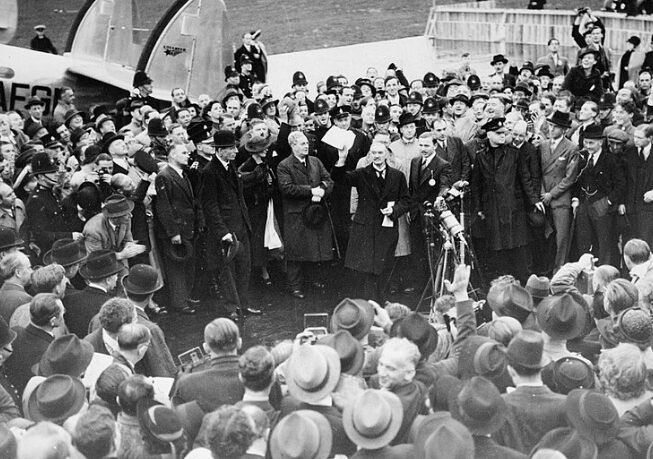
Chamberlain is most famous for his policy of appeasement and for signing the Munich Agreement in 1938, which allowed Nazi Germany to annex the Sudetenland region of Czechoslovakia in an attempt to prevent a larger conflict. Image: Chamberlain holding up the paper signed by both Hitler and himself on his return from Munich to Heston Aerodrome.
Why is Chamberlain often criticized for his policy of appeasement?
Chamberlain’s policy of appeasement is criticized because it failed to prevent World War II. Critics argue that it emboldened Hitler, making him believe that the Allies would not resist his further territorial ambitions, ultimately leading to the invasion of Poland and the outbreak of war in 1939.
What was Neville Chamberlain’s famous phrase after the Munich Agreement?

Neville Chamberlain was a British Conservative politician who served as the Prime Minister of the United Kingdom from 1937 to 1940. He is best known for his policy of appeasement towards Adolf Hitler’s Germany in the lead-up to World War II. Image: From left to right, Chamberlain, French prime minister, Édouard Daladier, Adolf Hitler, Italian leader Benito Mussolini, and Italian Foreign Minister Count Galeazzo Ciano prepare to sign the Munich Agreement in September 1938.
After returning from Munich, Chamberlain famously declared, “Peace for our time,” believing that the agreement had secured peace by addressing Germany’s grievances without resorting to war.
What was Neville Chamberlain’s role at the start of World War II?
At the start of World War II, Chamberlain led Britain as Prime Minister. He initially continued to pursue diplomatic solutions but eventually recognized the need for military action against Germany. However, his leadership was soon criticized for being ineffective in prosecuting the war.
Why did Neville Chamberlain resign as Prime Minister?
Chamberlain resigned as Prime Minister in May 1940 following the disastrous Norwegian campaign and increasing criticism of his handling of the war. He was succeeded by Winston Churchill, who was seen as a more dynamic and decisive leader during the wartime crisis.
What happened to Neville Chamberlain after he resigned?
After resigning as Prime Minister, Chamberlain continued to serve in Churchill’s government as Lord President of the Council. However, his health deteriorated, and he was diagnosed with terminal cancer. He passed away on November 9, 1940.
How is Neville Chamberlain viewed by historians today?
Historians have mixed views on Chamberlain. While he is often criticized for his policy of appeasement, some argue that he was acting in the best interests of his country at a time when Britain was not fully prepared for war. Others contend that his actions gave Britain valuable time to rearm and prepare for the eventual conflict.

What were Neville Chamberlain’s early political career and achievements?
Before becoming Prime Minister, Chamberlain held several key positions, including Minister of Health and Chancellor of the Exchequer.
As Chancellor of the Exchequer, Chamberlain focused on reducing government debt, balancing the budget, and maintaining financial stability. He implemented policies aimed at economic recovery during the Great Depression, although some of these measures were criticized for being too conservative.
Chamberlain was also known for his work on social reform, housing, and financial policy during his tenure in these roles.
As Minister of Health, Chamberlain introduced significant reforms, including the expansion of council housing and improvements in public health services. He aimed to address social issues and improve living conditions for British citizens.
How did Chamberlain’s upbringing and education influence his political career?
Chamberlain was educated at Rugby School and later studied metallurgy in Birmingham. His early career in business and local government provided him with practical experience and a pragmatic approach to politics, which influenced his policy decisions.
How did Chamberlain’s health affect his later political career?
Chamberlain’s health declined rapidly after his resignation as Prime Minister. He was diagnosed with bowel cancer in 1940, which limited his ability to continue serving in government and contributed to his death later that year.
How did the public perceive Neville Chamberlain during his time in office?
Public perception of Chamberlain varied during his time in office. Initially, many supported his efforts to maintain peace, but as the threat from Nazi Germany grew, criticism of his appeasement policy and handling of the war increased.
What are some notable quotes attributed to Neville Chamberlain?
In addition to “Peace for our time,” Chamberlain is also remembered for his statement upon declaring war on Germany: “Everything that I have worked for, everything that I have hoped for, everything that I have believed in during my public life has crashed into ruins.”
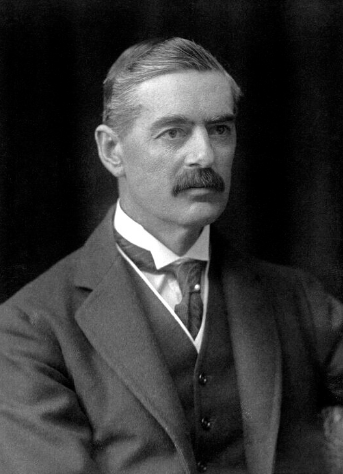
Chamberlain’s legacy is complex. He is remembered for his policy of appeasement and its failure to prevent World War II, but also for his efforts to improve social conditions in Britain. His tenure as Prime Minister remains a subject of debate among historians. Image: Portrait of Neville Chamberlain by English portrait photographer Walter Stoneman, 1921
How did Neville Chamberlain’s leadership style differ from his successor, Winston Churchill?
Chamberlain’s leadership style was characterized by pragmatism and a focus on diplomacy, while Churchill was known for his inspiring rhetoric, bold decision-making, and unwavering resolve in the face of adversity. Churchill’s dynamic approach contrasted sharply with Chamberlain’s more cautious and conciliatory methods.
What were Chamberlain’s views on foreign policy before becoming Prime Minister?
Before becoming Prime Minister, Chamberlain was generally supportive of maintaining strong relations with other European powers and favored diplomatic solutions to international disputes. His views on appeasement were shaped by the desire to avoid another devastating war like World War I.
How has Neville Chamberlain been portrayed in popular culture and media?
Chamberlain has been portrayed in various films, documentaries, and books, often focusing on his role in the Munich Agreement and the policy of appeasement. Notable portrayals include his depiction in the film “Darkest Hour” (2017), where he is shown in contrast to Winston Churchill during the early days of World War II.





