Nyuserre Ini: 5th Dynasty Pharaoh of Ancient Egypt

Nyuserre Ini was the sixth ruler of Egypt’s Fifth Dynasty during the Old Kingdom, known for his architectural achievements and effective governance. Image: Relief of Nyuserre from the Wadi Maghareh
Nyuserre Ini was the sixth ruler of Egypt’s Fifth Dynasty during the Old Kingdom, reigning approximately between 24 and 35 years in the mid-25th century BCE. His name means “Possessed of Ra’s Power,” underscoring his dedication to the sun god Ra, central to the Fifth Dynasty’s religious ideology.
He was the son of Pharaoh Neferirkare Kakai and Queen Khentkaus II, with an elder brother, Neferefre, who preceded him on the throne. Nyuserre’s early life and accession were shaped by political and familial dynamics, with support from influential figures such as his mother and key court officials.

Statuette of Neferefre, painted limestone
Nyuserre’s rise to power came after a period of political uncertainty. He succeeded his brother Neferefre, who died unexpectedly at a young age. The brief and ambiguous reign of Shepseskare, potentially an uncle or usurper, added complexity to the succession. Ultimately, Nyuserre’s claim to the throne prevailed, possibly due to his family’s influence and support from prominent officials like Ptahshepses, his son-in-law.
Reign of Nyuserre Ini
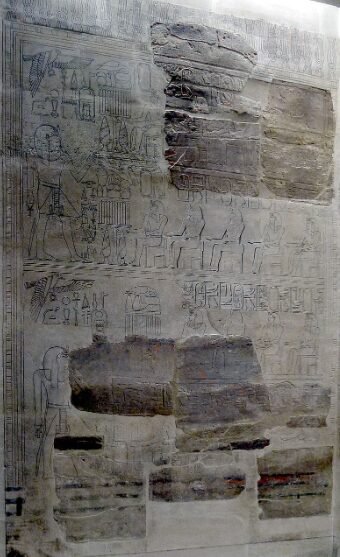
The Karnak King List, commissioned by Thutmose III, honors Nyuserre Ini as the fourth seated king depicted.
Political Stability and Governance
Nyuserre’s reign was marked by a period of political stability and effective governance. His administration oversaw an expanded and increasingly specialized bureaucracy, reflecting a maturing Egyptian state. New titles and administrative roles were introduced, indicating a shift towards more structured governance. A notable change during his reign was the decentralization of power, with nomarchs, or provincial governors, residing in the provinces they managed rather than at the royal court. This administrative evolution laid the foundation for greater regional autonomy in later periods.
Diplomatic and Trade Relations
Under Nyuserre’s rule, Egypt maintained strong trade ties with neighboring regions. Byblos, a key trading partner on the Levantine coast, remained a significant source of cedar wood and luxury goods. Expeditions to Sinai ensured the continued extraction of copper and turquoise, vital resources for both domestic use and export. In Lower Nubia, Egyptian expeditions mined gneiss for statues and construction materials, reinforcing Egypt’s influence over this southern region.
Military Symbolism
Although Nyuserre’s reign was largely peaceful, military symbolism remained integral to his image as a ruler. Reliefs in his monuments depict him smiting enemies, a traditional motif emphasizing his role as a protector and unifier of Egypt. These images underscored the pharaoh’s divine authority and capability to defend the kingdom, even in the absence of significant military campaigns.
Architectural Accomplishments
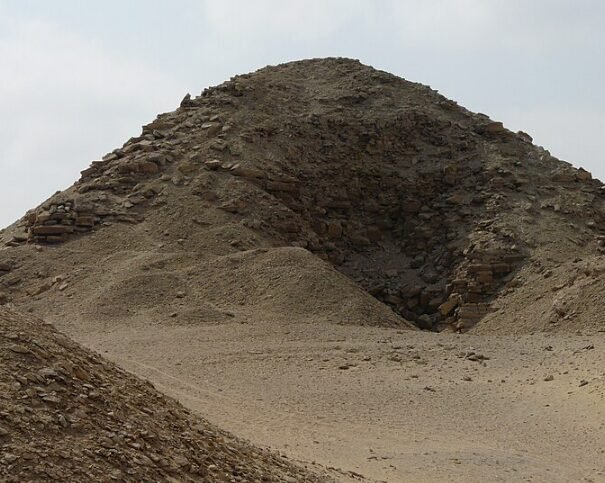
Known for extensive construction, Nyuserre built three pyramids in Abusir for himself and his queens and completed those of his parents and brother. Image: The pyramid of Nyuserre Ini in Abusir
Nyuserre Ini was one of the most prolific builders of the Old Kingdom, leaving an enduring architectural legacy.
Pyramid Complex at Abusir
Nyuserre built his pyramid, known as Mensut Nyuserre (“Established are the Places of Nyuserre”), at Abusir, close to the pyramids of his father, Neferirkare, and his mother, Khentkaus II. Although smaller than earlier pyramids due to resource constraints, it featured innovative architectural elements. His pyramid complex included a mortuary temple and a causeway adorned with intricate reliefs, showcasing his devotion to religious and mortuary practices.
Completion of Family Monuments
Nyuserre completed the unfinished pyramids of his family members, including those of his father Neferirkare and his brother Neferefre. His efforts included finishing Neferirkare’s mortuary temple and transforming Neferefre’s incomplete pyramid into a mastaba-like structure, adapting it into a functional burial site. These acts demonstrated his commitment to familial piety and the continuation of royal traditions.
Shesepibre Sun Temple
Nyuserre’s most notable architectural achievement was the construction of the Shesepibre Sun Temple, dedicated to Ra. Located in Abu Gurob, it was the largest and best-preserved sun temple of the Fifth Dynasty. The temple featured an obelisk, symbolizing the sun god, and an altar for rituals. Its elaborate reliefs depicted scenes of Nyuserre’s Sed festival, a jubilee celebrated to rejuvenate the king’s divine authority. This temple reflected the dynasty’s strong emphasis on solar worship and Nyuserre’s devotion to Ra.
Restoration of Earlier Monuments
Nyuserre also restored and enhanced older monuments, including the Valley Temple of Menkaure at Giza and the Sun Temple of Userkaf at Abu Gurob. These restorations linked his reign to the glorious past of Egypt’s Fourth Dynasty, reinforcing his legitimacy and continuity with earlier rulers.
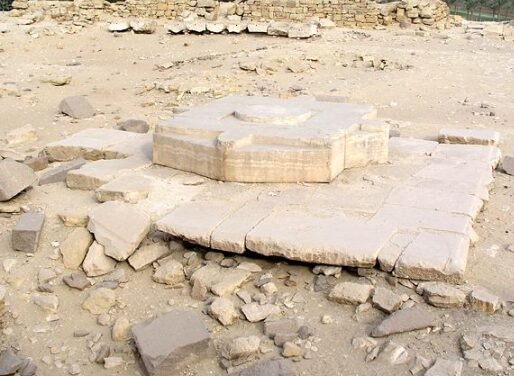
Nyuserre Ini’s most notable work includes Shesepibre, the largest surviving sun temple, and contributions to Giza’s necropolis, likely to legitimize his rule. Image: Altar of the sun temple of Nyuserre
Religious and Cultural Contributions
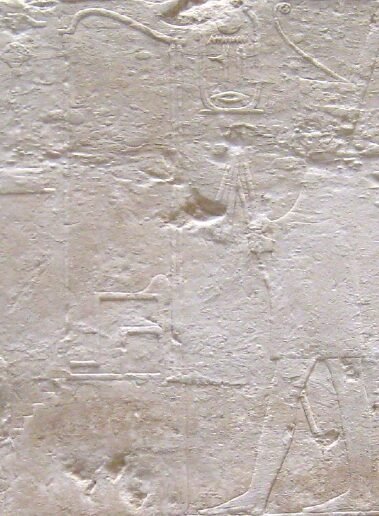
Nyuserre’s funerary cult endured for centuries, alongside a popular cult venerating him as “Iny,” which persisted into the New Kingdom, nearly a millennium after his death. Image: Relief of Nyuserre celebrating his Sed festival, Egyptian Museum of Berlin
Funerary Cult and Popular Veneration
Nyuserre’s legacy was perpetuated through a robust funerary cult established at his death. Supported by agricultural estates, this state-sponsored cult ensured offerings and rituals in his honor. His mortuary complex remained active into the Middle Kingdom, highlighting its enduring significance.
In addition to the official cult, a popular veneration emerged, with Nyuserre worshipped under his birth name, “Iny.” This cult portrayed him as an intercessor between the gods and the people, akin to a saint. It lasted well into the New Kingdom, with inscriptions and statues found across Egypt and beyond, including Sinai and Nubia.
Administrative and Religious Developments
Nyuserre’s reign marked significant religious developments, including the standardization of nomes (administrative regions) and their depiction in temple reliefs. His governance also saw the continued prominence of the solar cult, aligning with the Fifth Dynasty’s religious focus. By emphasizing solar worship, he reinforced the divine connection between the pharaoh and Ra, solidifying his religious authority.
Legacy and Historical Significance
Nyuserre’s architectural and religious innovations influenced subsequent rulers. His concentrated efforts in Abusir established a model for centralized royal necropolises. His sun temple set a precedent for later religious architecture dedicated to Ra. By restoring older monuments, he bridged the gap between the Fourth and Fifth Dynasties, ensuring continuity in Egypt’s royal and religious traditions.
Nyuserre Ini’s reign was peaceful, marked by trade with Byblos, mining expeditions, and administrative growth with the rise of provincial nomarchs.
During the Third Intermediate Period, Nyuserre’s monuments were part of an archaic revival, where later rulers drew inspiration from Old Kingdom art and architecture. His achievements symbolized the enduring legacy of the Old Kingdom, serving as a cultural and ideological touchstone for future dynasties.
Nyuserre’s contributions to architecture, governance, and religion ensured his long-lasting recognition. He exemplified the qualities of an effective pharaoh, balancing administrative innovation with religious devotion. His reign represented a high point of the Fifth Dynasty, cementing his place in Egyptian history.
Conclusion
Nyuserre Ini’s life and reign reflect the strengths of Old Kingdom Egypt—stability, monumental achievements, and a thriving religious culture. His dedication to architecture, governance, and familial continuity left an indelible mark on Egyptian civilization. By blending tradition with innovation, he secured his legacy as one of the most influential pharaohs of the Fifth Dynasty. His accomplishments resonated across millennia, demonstrating the enduring impact of his leadership on the history and culture of ancient Egypt.





