The Battle of Mons Graupius – According to Historian Tacitus
Tacitus, a Roman historian renowned for his incisive and critical writing, provides one of the most vivid accounts of the Battle of Mons Graupius, an event that occurred in AD 83 or 84 as part of the Roman conquest of Britain.
This battle, fought in northern Scotland, marked a decisive clash between the Roman forces led by Gnaeus Julius Agricola and the Caledonian tribes under the command of their leader, Calgacus.
Tacitus’ detailed account is found in his work Agricola, a biography of his father-in-law, Agricola, and serves as both a historical narrative and a commentary on Roman imperialism.
Tacitus’ Historical Context

Image: Statue of Tacitus outside the Austrian Parliament Building
Tacitus wrote Agricola around AD 98, during the reign of Emperor Trajan. At this time, Rome had experienced significant shifts in leadership following the excesses of the Flavian dynasty and Domitian’s reign. The Roman historian often used his writings to explore themes of freedom versus tyranny, imperial expansion, and moral decay, and his treatment of the British campaigns reflects these concerns.
Agricola, his subject, emerges as a model Roman general embodying discipline, virtue, and efficiency, qualities Tacitus contrasts with the perceived corruption of the Roman state.
The Agricola serves multiple purposes: it memorializes Agricola’s achievements, critiques the abuses of power under Domitian, and provides a commentary on the morality and consequences of empire. The Battle of Mons Graupius, therefore, is as much a literary and rhetorical construct as it is a historical account.
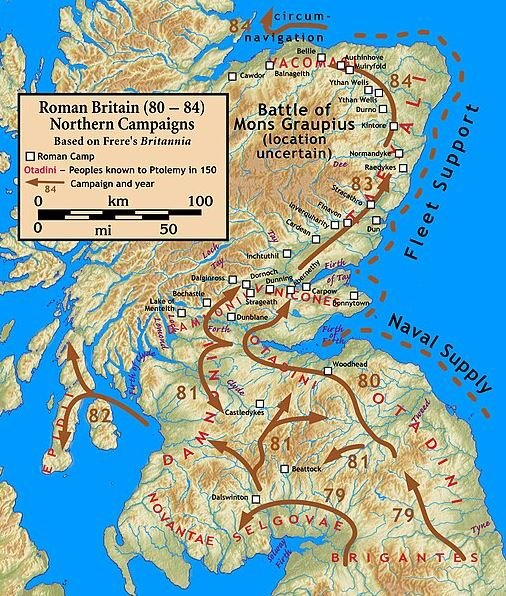
Image: A map showing Agricola’s Northern Campaigns in Britain
The Build-Up to the Battle
Agricola’s tenure as governor of Britain (AD 77–84) was marked by aggressive campaigns to consolidate Roman control over the island. Tacitus portrays Agricola as a disciplined and strategic leader, systematically subduing hostile tribes and implementing Roman administrative systems.
By the time of Mons Graupius, Agricola had pushed northward into Caledonia (modern-day Scotland), a region characterized by rugged terrain and fierce resistance.
Tacitus describes how the Caledonians, led by Calgacus, united to confront the Roman advance. His portrayal of Calgacus emphasizes noble resistance, with the leader depicted as a freedom-loving patriot rallying his people against Roman oppression. This characterization aligns with Tacitus’ broader theme of the tension between liberty and imperial domination.
In Tacitus’ narrative, Agricola demonstrates his strategic acumen by securing supply lines, selecting advantageous terrain for the battle, and employing psychological tactics to weaken the enemy. He ensures that his forces are well-prepared, balancing infantry, cavalry, and auxiliary units to maximize flexibility and combat effectiveness.
Tacitus’ Description of the Caledonians

Calgacus’ speech, as recorded by Roman historian Tacitus, is a rhetorical masterpiece. It encapsulates the resentment of the native tribes toward Roman expansion. Image: 19th-century print depicting Calgacus delivering his speech to the Caledonians.
Tacitus provides a striking depiction of the Caledonians, emphasizing their bravery and resilience. He describes them as a hardy people accustomed to harsh environments and constant warfare. The Caledonian warriors are portrayed with long hair and shields, armed with swords and spears, and adept at using the terrain to their advantage.
Calgacus’ speech, as recorded by Tacitus, is a rhetorical masterpiece. It encapsulates the resentment of the native tribes toward Roman expansion:
We, the most distant dwellers upon the earth, the last of the free, have been shielded till today by the very remoteness and obscurity which have served to protect us. Now, at last, the furthest corner of the world lies open to us, and the unknown always passes for the marvelous. But there are no more nations beyond us; nothing is there but waves and rocks, and the Romans, more deadly still than these—robbers of the world.
This speech serves multiple purposes: it elevates Calgacus as a heroic figure, critiques Roman imperialism, and reinforces Tacitus’ broader narrative of the moral costs of empire. Whether historically accurate or not, the speech reflects Tacitus’ literary skill and philosophical concerns.
The Battle Itself
Tacitus’ description of the battle is a dramatic set-piece, showcasing Agricola’s tactical brilliance and the ferocity of the conflict. He emphasizes the discipline and organization of the Roman forces, contrasting them with the chaotic bravery of the Caledonians.
Roman Tactics
Agricola divided his forces strategically, placing light infantry and auxiliaries at the front, supported by cavalry on the flanks and legionaries in reserve. This arrangement allowed the Romans to adapt to the Caledonians’ initial charges while keeping their core strength intact. Tacitus highlights Agricola’s use of the terrain, which provided the Romans with a defensive advantage and mitigated the Caledonians’ superior numbers.
The Caledonian Assault
The battle begins with the Caledonians launching a fierce assault. Tacitus describes their war cries, the glint of their weapons, and their initial success in overwhelming the Roman front lines. The Caledonians’ use of chariots and knowledge of the terrain creates initial confusion among the Roman auxiliaries.
Roman Counterattack
Agricola’s forces regroup and launch a disciplined counterattack. The Roman auxiliaries, supported by cavalry, exploit weaknesses in the Caledonian formation, breaking through their lines. Tacitus emphasizes the professionalism of the Roman soldiers, who maintain cohesion and discipline even under pressure.
As the battle progresses, the Romans gain the upper hand. Tacitus describes the Caledonian retreat as chaotic, with the Roman cavalry pursuing and slaughtering the fleeing tribesmen. The terrain, which initially favored the Caledonians, now becomes a disadvantage as they are driven into difficult terrain and cut down.
Aftermath and Significance
The victory at Mons Graupius was decisive, with Tacitus claiming that over 10,000 Caledonians were killed, while Roman casualties were minimal. Agricola consolidated his position by securing forts and establishing Roman control over the region. However, the campaign was not followed by a permanent Roman presence in northern Scotland, as the logistical challenges and limited resources made sustained occupation unfeasible.
Tacitus uses the aftermath of the battle to reflect on the nature of Roman conquest. He contrasts the triumph of the Roman army with the suffering of the conquered:
They create a desolation and call it peace.
This critique underscores Tacitus’ ambivalence about imperial expansion. While Agricola is portrayed as a virtuous and capable leader, the broader implications of Roman domination are depicted as destructive and morally questionable.
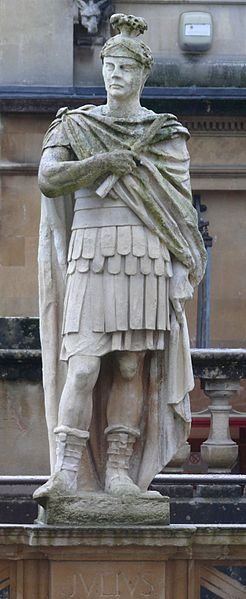
Image: Statue of Roman general Agricola
Tacitus’ Rhetorical and Literary Techniques
Tacitus’ account of the Battle of Mons Graupius is as much a literary construction as it is a historical narrative. He employs several rhetorical strategies to enhance the dramatic impact and convey his philosophical concerns:
- Contrast: Tacitus contrasts the disciplined efficiency of the Roman forces with the passionate but disorganized resistance of the Caledonians. This juxtaposition underscores the inevitability of the Roman victory while highlighting the bravery of the defeated.
- Speeches: The speeches attributed to Calgacus and Agricola are rhetorical devices that encapsulate the themes of the work. Calgacus’ speech critiques Roman imperialism, while Agricola’s reflects Roman virtues of discipline and duty.
- Moral Reflection: Tacitus uses the battle as a lens to explore the broader moral and ethical implications of empire. His description of the desolation wrought by Roman conquest serves as a critique of the costs of imperial ambition.
- Dramatic Imagery: Tacitus’ vivid descriptions of the battle, the landscape, and the combatants create a compelling narrative. His use of imagery enhances the emotional impact of the account and draws the reader into the action.
Historical Accuracy and Interpretation
The Battle of Mons Graupius, as described by Tacitus, has long been a subject of debate among historians. Several aspects of his account raise questions about its accuracy:
- Exaggeration of Numbers: Tacitus’ claim of 10,000 Caledonian casualties and minimal Roman losses is likely exaggerated, reflecting the Roman tradition of glorifying military victories.
- Literary Construction: The speeches attributed to Calgacus and Agricola are almost certainly fictional, serving Tacitus’ rhetorical purposes rather than reflecting historical reality.
- Limited Archaeological Evidence: Despite its dramatic portrayal, the exact location of the battle remains uncertain, and archaeological evidence for the events described is sparse.
- Bias: Tacitus’ portrayal of Agricola is inherently biased, as the work serves to honor his father-in-law and critique Domitian’s regime. This bias influences his depiction of the battle and its participants.
While Tacitus’ account may not be entirely reliable as a historical source, it provides valuable insights into Roman perceptions of Britain, the rhetoric of empire, and the challenges of conquest.
Legacy and Implications
The Battle of Mons Graupius holds a significant place in Roman and British history. For Rome, it represented the apex of their northern campaign in Britain, demonstrating the reach and power of the empire. For the Britons, it symbolized the resilience and resistance of the native tribes against overwhelming odds.
Tacitus’ account also influenced later perceptions of the Roman conquest of Britain. His depiction of Calgacus as a heroic figure and his critique of imperialism resonate with modern readers, highlighting the complexities and moral ambiguities of empire. The battle serves as a reminder of the human cost of conquest and the enduring tension between freedom and domination.
Conclusion
Tacitus’ account of the Battle of Mons Graupius is a masterful blend of history, rhetoric, and philosophy. It showcases the military prowess of Roman General Agricola, the bravery of the Caledonians, and the broader implications of Roman imperialism. While its historical accuracy may be debated, its literary and moral significance remains undeniable. Through this narrative, Tacitus invites readers to reflect on the costs of empire, the nature of leadership, and the enduring struggle between liberty and subjugation.
READ MORE: Most Famous Ancient Roman Historians and their Works
Questions and Answers
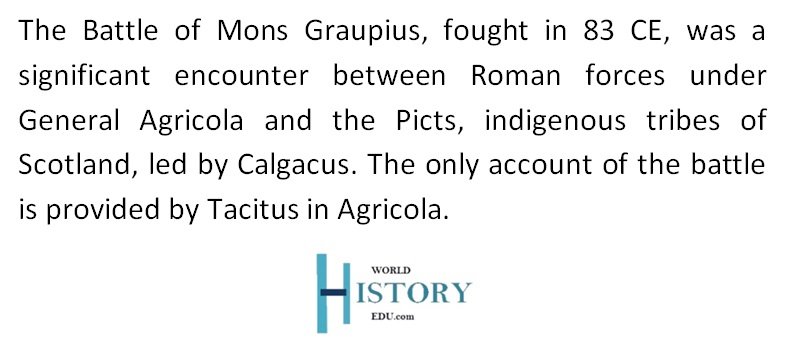
Where did the Battle of Mons Graupius take place?
The exact location is unknown, with over 29 sites proposed. One theory, suggested by Andrew Breeze, identifies Bennachie in Aberdeenshire, linking the name “Mons Graupius” to the Welsh word “crib” (ridge). Other scholars, such as Stuart McHardy, propose alternatives like the Paps of Fife, but no archaeological evidence confirms these theories.
How did Agricola prepare for the battle?
Agricola began his campaigns in Britain around 79 CE, advancing north and fortifying the Clyde-Forth region by 82 CE. He led an army of 11,000 men into Caledonia to face a Pictish force of 30,000 at Mons Graupius.
What role did Calgacus play in the battle?
Calgacus, the Pictish leader, rallied his tribes with a speech condemning Roman imperialism and emphasizing the fight for freedom. Though the speech is likely Tacitus’ invention, it reflects the themes of resistance and critique of Rome.
How did the battle unfold?
The battle started with a missile exchange. The disciplined Romans held their formation, countering the Picts’ chaotic charge. Agricola’s forces, including Batavian and Tungrian cohorts, used close combat tactics to exploit the Picts’ unwieldy weapons. Roman cavalry pursued the fleeing Picts, turning the retreat into a rout.
What were the reported casualties of the battle?
Tacitus claims 10,000 Picts were killed, compared to 360 Romans. However, these figures are likely exaggerated to glorify the Roman victory and diminish their losses.
What was the aftermath of the battle for the Romans?
Although the battle was a tactical victory, its long-term value was limited. Agricola did not advance further into Caledonia, retreating south due to the late season. Rome later abandoned the Gask Ridge fortifications and failed to secure lasting control over Scotland.
How did the Romans address future Pictish resistance?
The Romans built Hadrian’s Wall (122 CE) and the Antonine Wall (142 CE) as defensive barriers. However, these fortifications failed to prevent Pictish raids, highlighting the difficulty of subduing the mobile and guerrilla-trained Picts.
What is Tacitus’ perspective on the battle?
Tacitus uses Agricola to honor Agricola, critique Domitian’s regime, and explore imperialism’s moral implications. He portrays the Picts as valiant and resourceful, contrasting their independence with Roman decadence. His famous line, “They create a desolation and call it peace,” critiques Rome’s exploitation.
What is the legacy of Mons Graupius?
The battle marked the height of Roman efforts in northern Britain but underscored the limits of Roman power. Agricola’s retreat and the continued resistance of the Picts highlighted their adaptability and the ineffectiveness of Rome’s methods against unconventional enemies. Tacitus’ narrative reflects the enduring struggle for freedom against imperial domination.







I think that the official account of the Battle of Mons Graupius is wrong. I can present a more plausable version of events based on the account by Tacitus. I would appreciate the chance to discuss with anyone who would challenge my version of events. Massacre and treachery are the basis of what happened. I read the account with an open mind. There were so many inconsistencies that I realized that it could not be true. Once you accept that the battle did not happen it is easy to work out what really happened and why the Scots sued for peace within a year.