Obelisk of Montecitorio: History and Major Facts
The Obelisk of Montecitorio, also known as the Solare, is an ancient Egyptian monument crafted from red granite. Originally erected in Heliopolis during the reign of Pharaoh Psamtik II (595–589 BCE), it was later transported to Rome by Emperor Augustus in 10 BCE. This obelisk serves as a remarkable example of the cultural fusion between Egypt and Rome, carrying significant historical, symbolic, and artistic importance.
Historical Origins
The obelisk was quarried in Aswan and transported to Heliopolis, a major religious center dedicated to Ra, the sun god. It was inscribed with hieroglyphics honoring Psamtik II, celebrating his divine favor and role as a ruler who united Egypt under his reign. The Pyramidion at its apex bore additional inscriptions that reinforced these themes of eternal life, health, and power granted by the gods.
In 10 BCE, Augustus ordered the obelisk to be transported to Rome as a symbol of Egypt’s conquest and integration into the Roman Empire. Along with the Flaminio Obelisk, it was placed in the Campus Martius, an open area used for public and ceremonial purposes. The obelisk became the centerpiece of the Solarium Augusti, a monumental sundial constructed to commemorate Augustus’s reign and achievements.
The Solarium Augusti
The Solarium Augusti was an innovative sundial designed by the mathematician Facondius Novus. Spanning a travertine platform of 160 by 75 meters, the sundial used the obelisk as its gnomon (shadow-casting pointer). Markers on the platform denoted hours, months, seasons, and zodiac signs.
The obelisk’s shadow aligned with the Ara Pacis (Altar of Peace) on September 23, Augustus’s birthday, coinciding with the autumnal equinox. This alignment symbolized Augustus’s role as a peacemaker, sanctifying his divine right to rule. It reinforced the connection between his reign and Pax, the Roman goddess of peace, showcasing his commitment to stability and prosperity.
Despite its ingenious design, the sundial ceased to function properly within 30 years, likely due to foundational shifts or changes in the Earth’s axial tilt. Nonetheless, the obelisk remained a prominent feature of the Campus Martius, retaining its symbolic significance.
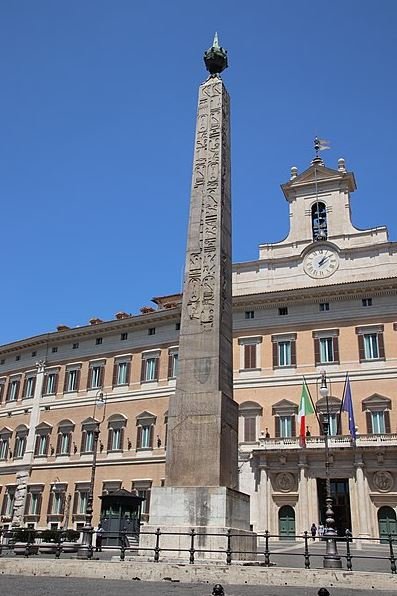
Image: The Obelisk of Montecitorio in Rome once served as a giant sundial, the famous Horologium Augusti.
Later History
Between the 9th and 11th centuries, the obelisk collapsed due to natural disasters such as earthquakes or fires. Over time, it became buried and fragmented. Efforts to recover the obelisk began during the Renaissance. In 1748, remnants of the original meridian were discovered beneath Piazza del Parlamento, providing valuable insight into the obelisk’s original placement and function.
From 1789 to 1792, Pope Pius VI oversaw the restoration of the obelisk, which was reassembled and re-erected in Piazza Montecitorio. Architect Giovanni Antinori led the restoration, incorporating granite from the Column of Antoninus Pius to complete the structure. The obelisk’s reinstallation highlighted its enduring cultural importance as a symbol of Rome’s imperial history.
In 1998, a new meridian was traced on the piazza to honor the Solarium Augusti. However, the obelisk’s shadow no longer aligns precisely with the meridian, rendering its gnomonic function purely symbolic.
Symbolism and Cultural Significance
The Obelisk of Montecitorio epitomizes the intersection of Egyptian and Roman traditions. Originally a religious monument to Ra, it was repurposed in Rome to emphasize Augustus’s divine association and achievements. This cultural blending illustrates the Roman practice of appropriating foreign symbols to bolster imperial authority.
The obelisk symbolized Augustus’s role as a ruler chosen by the gods and a peacemaker who brought stability to the Roman Empire. By aligning the obelisk’s shadow with the Ara Pacis, Augustus reinforced his divine legitimacy and his dedication to ensuring peace and prosperity for Rome.
As the centerpiece of the Solarium Augusti, the obelisk represented Roman ingenuity and their mastery of large-scale public works. It also reflected the Romans’ fascination with Egyptian monuments, which they viewed as timeless symbols of power and religious devotion.
The Obelisk of Montecitorio inspired later Roman rulers to erect additional obelisks, each serving unique ceremonial or symbolic purposes. Its presence in the heart of Rome also influenced Renaissance and Baroque architects, who sought to incorporate ancient monuments into their designs.
Frequently Asked Questions
Who commissioned the construction of the obelisk, and what was its original purpose?
Pharaoh Psamtik II (595–589 BCE) commissioned the obelisk to honor Ra, the sun god, and it was erected in Heliopolis as a religious monument.
What role did Emperor Augustus play in the history of the obelisk?
Augustus brought the obelisk to Rome in 10 BCE to serve as the gnomon (shadow-casting pointer) of the Solarium Augusti, a massive sundial symbolizing his authority and dedication to peace.

Image: Bust of Augustus.
What is the Solarium Augusti, and how did the obelisk function in it?
The Solarium Augusti was a giant sundial in the Campus Martius. The obelisk cast shadows on a travertine platform marked with hours, seasons, and zodiac signs, aligning with the Ara Pacis on Augustus’s birthday.
Why did the Solarium Augusti stop functioning as intended?
The sundial ceased to work properly within 30 years, likely due to shifts in the Earth’s axis or foundational instability.
What caused the obelisk to collapse, and when was it rediscovered?
The obelisk likely collapsed between the 9th and 11th centuries due to earthquakes, fires, or conflicts. Fragments were rediscovered in the Renaissance and during excavations in 1748.
Who restored the obelisk, and when was it re-erected in its current location?
Pope Pius VI restored the obelisk between 1789 and 1792, re-erecting it in Piazza Montecitorio under the direction of architect Giovanni Antinori.
Does the obelisk still function as a sundial today?
No, due to misalignment and changes in its placement, the obelisk no longer serves as a functional sundial. The current meridian on the piazza pavement is a symbolic tribute.
What inscriptions are found on the obelisk, and what do they signify?
The obelisk features hieroglyphs praising Psamtik II as a divinely chosen ruler and inscriptions celebrating Augustus’s achievements, including Egypt’s integration into the Roman Empire.
What is the obelisk’s legacy in terms of cultural and historical significance?
The Obelisk of Montecitorio symbolizes the blending of Egyptian and Roman cultures. It represents Augustus’s reign, imperial ambitions, and the enduring artistry of ancient Egyptian craftsmanship.





