Who was Arsinoe III of Egypt?
Arsinoe III Philopator was born around 246/245 BC into the prominent Ptolemaic dynasty, a lineage of Macedonian Greek rulers who controlled Egypt following the conquests of Alexander the Great. She was the daughter of Ptolemy III Euergetes and Berenice II, both of whom were influential monarchs.
From an early age, Arsinoe was groomed for a life of political significance, being part of a dynasty that heavily intertwined familial relationships with governance to maintain power. Her early life likely involved education in statecraft and royal customs, typical of Ptolemaic royal women who were expected to play roles in both political and cultural arenas.
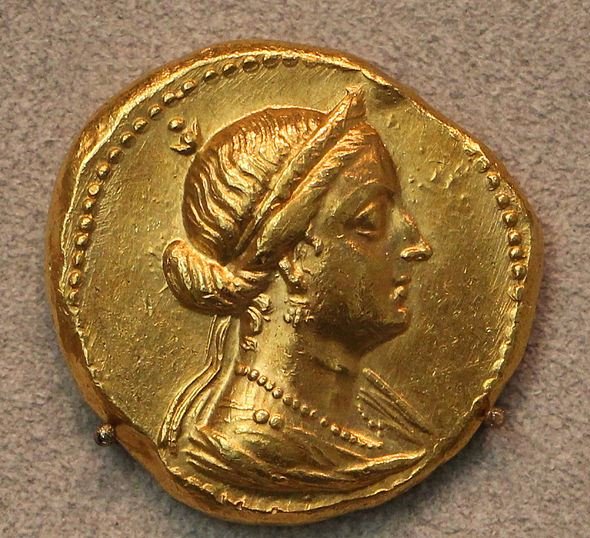
Arsinoe III Philopator (246/245–204 BC) was Queen of Ptolemaic Egypt from 220 to 204 BC, daughter of Ptolemy III and Berenice II. Image: Golden coin depicting Arsinoe.
Marriage and Its Significance
In late 220 BC, Arsinoe married her younger brother, Ptolemy IV Philopator, a union in line with the Ptolemaic tradition of sibling marriage. This practice reinforced dynastic legitimacy and centralized power within the family, ensuring that foreign influence or rival claims to the throne were minimized.
The marriage also symbolized a continuity of divine rule, as the Ptolemies styled themselves as descendants of gods. While the practice of sibling marriage was controversial among outsiders, it was deeply entrenched in the dynasty’s strategy of maintaining cohesion.
Married to her brother, Ptolemy IV, Arsinoe III was the first Ptolemaic queen to bear a child by her sibling, adhering to the dynasty’s tradition of sibling marriage.
Arsinoe’s marriage to Ptolemy IV was not merely ceremonial but politically consequential. As queen, she was expected to support her husband’s rule and maintain public loyalty to the monarchy. However, the marriage faced significant challenges due to the influence of powerful courtiers such as Sosibius, Ptolemy IV’s chief minister, who wielded considerable control over the administration. Sosibius’s dominance in court affairs limited Arsinoe’s direct involvement in governance, but she nonetheless sought to assert her presence within the political sphere when opportunities arose.
Role During the Reign of Ptolemy IV
Arsinoe III played an active role during her husband’s reign, particularly in moments of crisis. One of the most defining episodes of her life was her participation in the Battle of Raphia in 217 BC. This battle, part of the Fourth Syrian War, was a decisive confrontation between Ptolemaic Egypt and the Seleucid Empire under Antiochus III the Great. Accompanying Ptolemy IV to the battlefield in Palestine, Arsinoe demonstrated exceptional courage and leadership.
Although ancient records vary in detail, some accounts suggest that Arsinoe commanded a section of the infantry phalanx, a highly unusual role for a queen in ancient warfare. When the battle initially turned against the Egyptians, Arsinoe intervened dramatically by addressing the troops directly. In an impassioned speech, she exhorted them to fight for their families and promised a reward of two minas of gold to each soldier if they secured victory. Her actions reinvigorated the army’s morale, leading to a decisive Egyptian victory.
The success at Raphia preserved Egypt’s control over important territories in the Levant and solidified Arsinoe’s reputation as a bold and capable queen. Her visible role in the battle also symbolized her commitment to the defense of Egypt, further strengthening her public image. Despite this triumph, however, her political influence within the court remained constrained by Sosibius and other powerful factions.

Image: Coinage of Ptolemy IV
Political Challenges and Court Intrigue
Arsinoe III’s relationship with the court was fraught with tension. Sosibius, who held significant power during Ptolemy IV’s reign, was wary of Arsinoe’s potential influence. She was a popular figure, and her active involvement in the Battle of Raphia likely boosted her standing among both the military and the general population. This popularity, combined with her familial ties and assertive personality, made her a potential threat to Sosibius and his allies, who sought to maintain their dominance over Ptolemaic governance.
Renowned for her political influence and familial devotion, Arsinoe III’s reign was marked by internal court intrigues and the broader challenges faced by the declining Ptolemaic empire.
Over time, Arsinoe found her political involvement increasingly limited by these power dynamics. Sosibius and his ally Agathocles, another influential courtier, worked to marginalize her influence, ensuring that Ptolemy IV’s reign was marked by the dominance of palace officials rather than the royal family itself. This growing marginalization laid the groundwork for further conflict after Ptolemy IV’s death.
The Death of Ptolemy IV and Arsinoe’s Tragic End
In the summer of 204 BC, Ptolemy IV died unexpectedly, creating a power vacuum in the court. As the mother of Ptolemy V Epiphanes, who was a young child at the time, Arsinoe was a natural candidate to serve as regent. Her position as both queen and the boy king’s mother gave her a legitimate claim to oversee the kingdom during his minority.
However, Sosibius and Agathocles viewed Arsinoe’s potential regency as a direct threat to their control. To secure their dominance, they orchestrated a palace coup and had Arsinoe assassinated before she could act. The murder, carried out by a courtier named Philammon, ensured that the regency fell into the hands of Sosibius and his allies. This betrayal marked a tragic and violent end to Arsinoe’s life, depriving her of the chance to protect her son’s interests or continue her political legacy.
Children of Arsinoe III
Arsinoe III had one known child with Ptolemy IV: Ptolemy V Epiphanes, who became king after his father’s death. Ptolemy V ascended the throne as a young boy, inheriting a kingdom plagued by internal instability and external threats. The loss of his mother left him vulnerable to the machinations of court officials, who sought to manipulate the regency for their gain.
Ptolemy V’s reign was marked by challenges, including rebellions within Egypt and military conflicts with neighboring powers. Although Arsinoe did not live to see her son grow up or rule, her efforts during the Battle of Raphia and her broader role as queen contributed to the preservation of the Ptolemaic dynasty during a precarious period.

Image: A golden coin depicting Ptolemy V Epiphanes.
Legacy of Arsinoe III
Despite her tragic death, Arsinoe III left a lasting legacy as a significant figure in Ptolemaic history. Her active participation in governance and her role at the Battle of Raphia set her apart from many other queens of the era. She demonstrated not only loyalty to her kingdom but also exceptional bravery and leadership in times of crisis.
Arsinoe’s life also inspired later cultural and historical recognition. The famed scholar Eratosthenes wrote a manuscript titled Arsinoe, which served as a memoir of her life and achievements. Although this work has been lost to history, it was widely referenced by ancient scholars, highlighting the lasting impression Arsinoe made on her contemporaries. Furthermore, physical depictions of Arsinoe, though rare, exist in the form of a marble bust and a bronze bust, offering glimpses of her appearance and preserving her memory in visual form.
As the mother of Ptolemy V, Arsinoe’s legacy extended into the next generation of Ptolemaic rulers.
Arsinoe’s murder underscored the brutal and often treacherous nature of Ptolemaic politics, where power struggles frequently resulted in the elimination of potential rivals. Nevertheless, her contributions to Egypt’s military and political history, as well as her devotion to her family, ensured her place as a notable and impactful queen.
Conclusion
Arsinoe III of Egypt lived a life of both achievement and tragedy. Born into the powerful Ptolemaic dynasty, she fulfilled her role as queen by marrying her brother, Ptolemy IV, and contributing to the governance of the kingdom. Her leadership during the Battle of Raphia demonstrated her courage and ability to inspire loyalty, securing a key victory for Egypt during a time of regional conflict. However, her life was cut short by the machinations of court officials, who viewed her as a threat to their control.
Frequently Asked Questions
Who did Arsinoe III marry, and why was this significant?
She married her younger brother, Ptolemy IV, in 220 BC. This was a customary practice in the Ptolemaic dynasty to consolidate power.
What role did Arsinoe III play in the governance of Egypt?
Despite the dominance of the minister Sosibius, Arsinoe actively participated in governance, contributing to the extent allowed by the court’s power dynamics.
What significant battle did Arsinoe III participate in?
Arsinoe participated in the Battle of Raphia in 217 BC, a key conflict during the Fourth Syrian War against Antiochus III (Antiochus the Great).
How large were the forces in the Battle of Raphia?
The Egyptian army had 55,000 troops, while Antiochus III’s Seleucid forces numbered 68,000. Both sides used cavalry, war elephants, Macedonian phalanxes, and specialized troops.
What extraordinary role did Arsinoe III play during the Battle of Raphia?
Arsinoe is believed to have commanded a section of the infantry phalanx, an exceptional position for a queen in ancient warfare.
How did Arsinoe III inspire the troops during the battle?
When the battle turned against the Egyptians, she addressed the troops, urging them to fight for their families and promising each soldier two minas of gold if they won. Her intervention boosted morale, leading to victory.
What challenges did Arsinoe III face after the Battle of Raphia?
Her political influence diminished due to the dominance of Sosibius and Agathocles, who controlled the court and viewed her as a threat.
What happened to Arsinoe III after Ptolemy IV’s death in 204 BC?
She was murdered in a palace coup orchestrated by Sosibius and Philammon before she could secure the regency for her son, Ptolemy V.
Who was Arsinoe III’s child, and what was his significance?
Arsinoe III and Ptolemy IV had one child, Ptolemy V Epiphanes, who became king as a young boy and faced internal instability and external threats during his reign.
What manuscript was written about Arsinoe III, and by whom?
The scholar Eratosthenes wrote a manuscript titled Arsinoe, which served as a memoir of her life. Although the work is lost, it was widely referenced by ancient scholars.
Are there any surviving depictions of Arsinoe III?
Physical representations are rare but include a marble bust and a bronze bust, offering glimpses of her likeness.
What is Arsinoe III’s legacy in history?
Arsinoe III is remembered for her involvement in governance, her role in the Battle of Raphia, and her tragic death. She remains a significant yet often overshadowed figure in the history of Ptolemaic Egypt.





