
A quartzite statue of Nynetjer dressed in ceremonial attire for the Sed festival, housed at the Rijksmuseum van Oudheden.
Nynetjer, also known as Ninetjer or Banetjer, was the third pharaoh of the Second Dynasty of Egypt during the Early Dynastic Period. Recognized as the best-attested king of his dynasty, he succeeded Raneb and left a legacy marked by archaeological artifacts and significant developments. However, the period following his reign is shrouded in uncertainty, with evidence pointing to political fragmentation or administrative restructuring of the Egyptian state.
Dating and Duration of Reign
Dating Nynetjer’s reign remains challenging. Egyptologists generally agree that he ruled during the late 29th century BC to the early 27th century BC, with proposed reign lengths ranging from 43 to 50 years. While sources such as the Palermo Stone suggest a reign of approximately 40 years, other records, like the Turin Canon, offer exaggerated estimates, such as 96 years. Despite this, the majority of scholars credit him with a long and impactful rule.
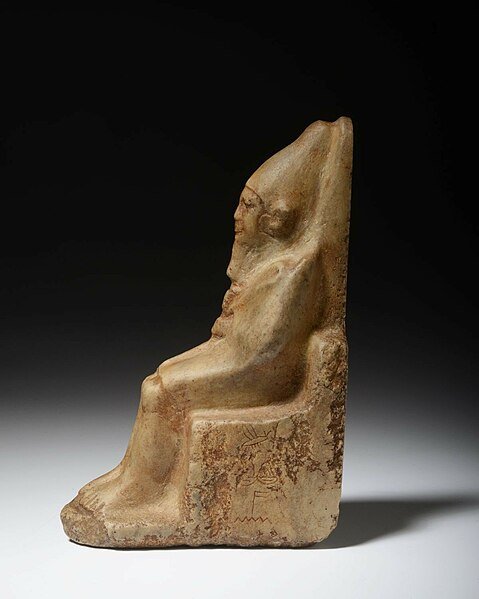
A statue of Nynetjer seated
Archaeological Attestations
Nynetjer’s name appears on numerous artifacts, including stone vessels, clay sealings, and rock inscriptions. Many of these were recovered from his tomb at Saqqara, Peribsen’s tomb at Abydos, and beneath the Step Pyramid of Djoser. Alabaster jars inscribed with his name were also found, some bearing black ink inscriptions believed to be from later periods. Scholars like Ilona Regulski suggest these items might have been reused during subsequent reigns.
A notable rock inscription near Abu Handal in Lower Nubia features Nynetjer’s serekh, with the god sign (“Netjer”) replacing the usual Horus falcon. This unique presentation, rendering his name as “The God N,” has led some historians to speculate about religious changes or disturbances during his reign.
Identity and Titulature
Nynetjer’s name is associated with several variations found in historical records, including Banetjer in the Abydos King List, Banetjeru in the Saqqara Table, and Netjer-ren in the Turin Canon. The Palermo Stone references a unique gold name, “Ren-nebu” (“golden offspring”), which some scholars see as a precursor to the Golden Horus name adopted in the Third Dynasty.
Chronological Context
Archaeological evidence positions Nynetjer as the third ruler of the Second Dynasty, following Hotepsekhemwy and Raneb. This sequence is supported by inscriptions on the statue of Hetepedief, a priest serving the mortuary cults of the first three kings, and by stone vessels that were reinscribed during Nynetjer’s reign. Historical records, such as the Turin Canon, also affirm this lineage.
Despite Nynetjer’s significant contributions, the lack of clear records and the fragmented nature of historical sources make his reign difficult to interpret fully.
The Palermo Stone provides detailed records of the first two decades of Nynetjer’s rule, including events and Nile flood levels. Estimates based on this and other sources suggest his reign lasted around 40 years, with Manetho attributing 47 years. Archaeological evidence, such as a statuette depicting Nynetjer in a sed festival robe, further supports the theory of a long reign.

Major Events During Nynetjer’s Reign
The Palermo Stone lists several significant events:
- Foundation Ceremonies: The 8th year of his reign included the “stretching the cords” ceremony, possibly related to constructing a structure named “Hor-Ren.”
- Festivals: Nynetjer celebrated multiple Sokar feasts and “Horus the Star” festivals, demonstrating the importance of religious and royal rituals during his reign.
- Nile Flood Records: The stone documents annual flood levels, indicating their significance for agriculture and administration.
- Destruction or Foundation of Cities: The controversial interpretation of the term “hoe” in records has sparked debates over whether Nynetjer destroyed or founded settlements like Shem-Re.
As a well-attested king of the Second Dynasty, Nynetjer oversaw administrative innovations, religious developments, and significant events.
Nynetjer likely introduced reforms to address the growing complexity of Egypt’s administration. These included innovations in resource collection, taxation, and census practices, such as the biennial “Following of Horus” journey. This event involved the king traveling across Egypt to assess resources and ensure efficient governance.
Religious Developments
During Nynetjer’s reign, sun worship and the cult of Ra gained prominence. The establishment of institutions like “Shem-Ra” (“The Sun Proceeds”) reflects this shift. This religious evolution foreshadowed the central role of Ra in subsequent dynasties. Additionally, the unique presentation of Nynetjer’s serekh in Nubia may hint at shifts in religious iconography.

End of Reign and Succession
The end of Nynetjer’s reign is characterized by uncertainty. Egypt may have experienced political unrest or economic challenges, leading to a division of the state. Some scholars, like Wolfgang Helck, propose that Nynetjer deliberately split Egypt between two rulers to improve administrative efficiency. Others, like Barbara Bell, suggest that economic hardships, such as famine, might have necessitated this division.
Historical records present conflicting accounts of Nynetjer’s successors. The Saqqara list and Turin Canon mention kings like Wadjenes, Senedj, and Neferkasokar, while the Abydos list skips these names and directly references Khasekhemwy. This discrepancy suggests possible fragmentation, with competing rulers in Upper and Lower Egypt.
Tomb and Burial
Nynetjer’s tomb, known as Gallery Tomb B, lies in North Saqqara. It was discovered in 1938 by Selim Hassan and further excavated in subsequent decades. The tomb’s location, near a natural wadi, provided practical access for construction and symbolized the transition to the afterlife.
The tomb’s superstructure, likely a mastaba, has not survived, but the subterranean chambers remain. These include:
- Main Chambers: A complex network of 157 rooms, potentially modeled after a royal palace.
- Storage Rooms: Containing jars of wine, beer, and other burial goods, some sealed with Nynetjer’s insignia.
- Artifacts: Tools, carved wood, and stone vessels, likely used in funerary rituals.
Frequently Asked Questions
What is notable about the evidence of Nynetjer’s reign?
He is the best-attested king of the Second Dynasty, with his name found on numerous artifacts, including stone vessels, seal impressions, and inscriptions from Saqqara, Abydos, and Djoser’s pyramid complex.
When did Nynetjer reign, and how long did he rule?
Nynetjer likely ruled between the late 29th and early 27th centuries BC. Egyptologists estimate his reign lasted between 43 and 50 years based on historical sources and archaeological findings.
What key administrative and religious developments occurred during his reign?
Nynetjer introduced significant administrative innovations, such as organizing state revenues and census systems, and he oversaw the development of the cult of Ra and sun worship.
What challenges marked the end of his reign?
Nynetjer’s rule may have concluded with civil unrest, administrative overreach, or economic strain, possibly leading to the division of Egypt into separate kingdoms.
What was the significance of Nynetjer’s tomb?
Located in North Saqqara, his tomb, known as Gallery Tomb B, showcased advanced royal mortuary architecture, including 157 chambers, and housed extensive burial goods like wine jars, tools, and ceremonial artifacts.
How is Nynetjer depicted in historical and archaeological records?
He is identified with various names in king lists and inscriptions. Artifacts show his involvement in ceremonies like the sed festival, while his name on vessels and monuments highlights his importance in early dynastic history.





