History of the Palermo Stone: What information does it preserve, and why is it significant?
The Palermo Stone is one of seven remaining fragments of an ancient stele known as the Royal Annals of Egypt. This stele provided a chronological record of Egyptian kings from the First Dynasty (c. 3150–2890 BCE) to the early Fifth Dynasty (c. 2392–2283 BCE). Likely created during the Fifth Dynasty, the stone is now housed in the Regional Archaeological Museum Antonio Salinas in Palermo, Italy, from which it derives its name.
The term “Palermo Stone” is often extended to all seven fragments of the Royal Annals, including those located in Cairo and London. Collectively, these fragments are sometimes called the “Cairo Annals Stone,” though this term is also used specifically for the fragments in Cairo.
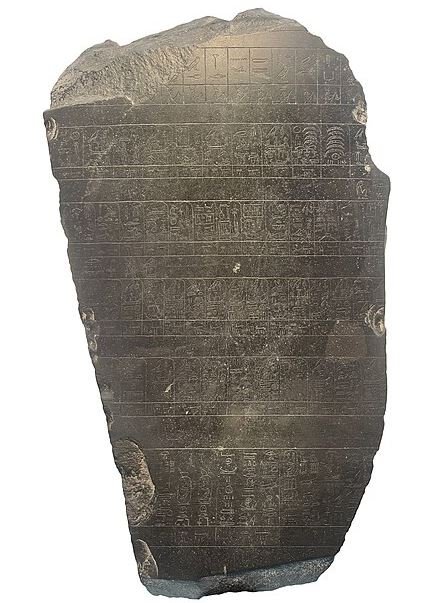
The Palermo Stone, housed in the Regional Archeological Museum Antonio Salinas, Italy.
Description of the Palermo Stone
The original Royal Annals stele, of which the Palermo Stone was a part, likely measured around 61 cm in height and 2.1 m in width, carved from a durable black stone, likely basalt. The Palermo Stone fragment itself is 43.5 cm high, 25 cm wide, and 6.6 cm thick, with an irregular shield-like shape.
The term “Palermo Stone” is often extended to all seven fragments of the Royal Annals, including those located in Cairo and London
The inscriptions on the “front” (recto) of the Palermo Stone consist of six horizontal registers of hieroglyphic text, arranged right to left. The first register lists predynastic kings of Lower Egypt, identifiable by their Red Crown (i.e. the Deshret). Subsequent registers chronicle the reigns of pharaohs from the First through Fourth Dynasties, documenting significant events for each year of their rule. For example, the second register begins with records from the end of a First Dynasty king’s reign, possibly Narmer (also known as Menes) or Aha, and continues with entries for his successor.
The “back” (verso) of the stone continues the annals through the Fifth Dynasty, ending with Neferirkare Kakai. The fragmentary nature of the inscriptions makes it uncertain whether the original stele extended beyond this point. Notably, the inscriptions also include the names of pharaohs’ mothers, such as Betrest (mother of Semerkhet) and Meresankh I (mother of Sneferu).
Content and Recorded Events
The Palermo Stone provides detailed insights into the lives and governance of early Egyptian rulers. Key information includes:
- Nile Flood Measurements: Precise annual flood heights were recorded, crucial for agriculture.
- Festivals and Ceremonies: Events such as Sed festivals, which celebrated a pharaoh’s reign and rejuvenation, are noted.
- Taxation and Economics: Tax records reflect the administration’s structure and priorities.
- Construction Projects: Monuments, temples, and sculptures are detailed.
- Military Campaigns: Records of warfare and territorial expansion are included.
These entries collectively illuminate the sociopolitical and religious dynamics of the Old Kingdom.
Archaeological History
The original location of the Royal Annals stele remains unknown. One fragment was reportedly found at Memphis, while others were discovered in Middle Egypt. The Palermo Stone itself surfaced in Sicily when it was acquired by a lawyer, Ferdinand Guidano, in 1859. The Guidano family donated it to the Palermo Archaeological Museum in 1877, where it remains today.
Other fragments are housed in different locations:
- Cairo Museum: Five fragments, four acquired between 1895 and 1914, and one purchased in 1963.
- Petrie Museum, London: A small fragment acquired by Sir Flinders Petrie in 1914.
The historical significance of the Palermo Stone was first recognized in 1895 by a French archaeologist, with its first full publication and translation by Heinrich Schäfer in 1902.
The Founding of Cairo and its significance during the medieval era
Uncertainties and Debates
Scholars debate whether the Royal Annals were inscribed contemporaneously with the events they describe or compiled later. While traditionally attributed to the Fifth Dynasty, some suggest they may have been created as late as the Twenty-fifth Dynasty (747–656 BCE). If the text is a later copy, it raises questions about the accuracy of the records, as errors or embellishments could have been introduced during the transcription process.
It is unclear whether all surviving fragments belong to the same stele or represent separate copies. Furthermore, doubts about the provenance of some fragments, especially those in Cairo, complicate efforts to authenticate and reconstruct the complete Royal Annals.
The fragments’ varied states of preservation make interpretation difficult. Missing or damaged portions leave gaps in the historical record, while deciphering hieroglyphs on worn surfaces adds complexity.
Significance of the Palermo Stone
The Palermo Stone and its associated fragments are invaluable for reconstructing early Egyptian history. They provide rare insights into the Old Kingdom’s rulers, administrative practices, and cultural traditions. Among the pharaohs mentioned are:
- Hor-Aha, Djer, Den, and Semerkhet (First Dynasty)
- Nynetjer and Khasekhemwy (Second Dynasty)
- Huni (Third Dynasty)
- Sneferu, Khufu, Djedefre, and Shepseskaf (Fourth Dynasty)
- Userkaf, Sahure, and Neferirkare Kakai (Fifth Dynasty)
The annals also record predynastic rulers of Lower Egypt, whose historicity remains debated. Some historians view these names as mythical or symbolic, preserved through oral tradition.
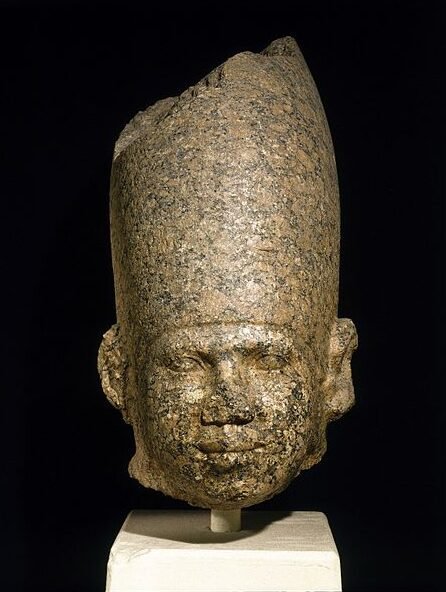
A sculpture work possibly depicting the head of Huni. Its located at the Brooklyn Museum in New York City, US.
Connection to Later Historical Sources
The Palermo Stone complements later Egyptian king lists, such as the Turin Canon and the Abydos King List. These documents, compiled in the New Kingdom, credit Menes (often identified with Narmer) as Egypt’s first king and the unifier of the Two Lands. However, the Royal Annals’ inclusion of predynastic rulers suggests a more complex prehistory.

Narmer Palette – front and back view.
Despite uncertainties about its dating, completeness, and provenance, the Palermo Stone’s value as a historical document is unparalleled.
The ancient historian Manetho, who compiled a history of Egypt in the third century BCE, may have used sources similar to the Royal Annals. While the surviving texts differ in format and detail, they collectively contribute to our understanding of early dynastic Egypt.
Predynastic Rulers on the Palermo Stone
The top register of the Palermo Stone lists nine predynastic rulers of Lower Egypt, including:
- Hsekiu (or Seka)
- Khayu
- Tiu (or Teyew)
- Thesh (or Tjesh)
- Neheb
- Wazner (or Wadjenedj)
- Mekh
Their inclusion raises questions about their historical versus mythical status. Some scholars interpret them as legendary figures symbolizing early tribal leaders, while others consider them fictitious constructs.
Frequently Asked Questions about the Palermo Stone
Where is the Palermo Stone located?
It is held at the Regional Archaeological Museum Antonio Salinas in Palermo, Italy, giving the stone its name.
What material is the Palermo Stone made of?
It is composed of hard black stone, likely basalt, and measures 43.5 cm high, 25 cm wide, and 6.5 cm thick.
What information does the Palermo Stone preserve?
It records events such as Nile flood measurements, festivals, taxation, building projects, and warfare, along with names of pharaohs and their mothers.
Why is the Palermo Stone significant?
It is one of the oldest historical texts from Ancient Egypt and provides a critical source for studying Old Kingdom history and chronology.
When was the Palermo Stone discovered?
It was purchased in 1859, transferred to the Palermo Museum in 1877, and its historical importance was recognized in 1895.
What uncertainties surround the Palermo Stone?
Its exact date of creation, whether it was updated over time, and whether all surviving fragments come from the same stele remain unclear.
What does the Palermo Stone say about predynastic rulers?
It lists nine predynastic kings of Lower Egypt, whose identities are debated as mythical, oral tradition, or fictional figures.
FACT CHECK: At World History Edu, we strive for utmost accuracy and objectivity. But if you come across something that doesn’t look right, don’t hesitate to leave a comment below.





