Pharaoh Sahure, also known as Sahura, meaning “He who is close to Re,” was a pivotal figure in ancient Egypt’s Fifth Dynasty. His reign, estimated to span approximately 13 years in the early 25th century BC during the Old Kingdom period, marked a significant era of political stability, economic prosperity, and cultural flourishing.
As the second ruler of the Fifth Dynasty, Sahure’s accomplishments laid foundational aspects for subsequent pharaohs and left an enduring legacy that influenced Egyptian architecture, administration, and religious practices for centuries.
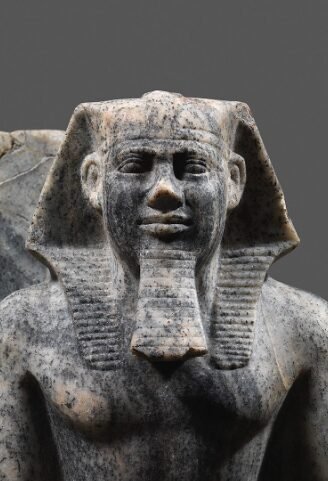
Sahure’s reign marked a period of significant political stability, economic expansion, and cultural flourishing within the Fifth Dynasty of ancient Egypt. Image: Head of a gneiss statue of Sahure in gallery 103 of the New York Metropolitan Museum of Art
Early Life and Lineage
Sahure was most likely the son of Pharaoh Userkaf and Queen Neferhetepes II. This familial relationship was solidified through archaeological discoveries made at Sahure’s pyramid complex in Abusir.
Reliefs found on the causeway linking the valley temple to the mortuary temple revealed that Sahure’s mother bore the title of “king’s mother,” directly associating her with Userkaf.
Additionally, the presence of Sahure’s cartouche within Userkaf’s mortuary temple at Saqqara suggests that Sahure may have continued or completed construction projects initiated by his father, reinforcing the direct lineage and ensuring a smooth succession within the royal family.

Likely son of Userkaf, Sahure elevated Egypt’s political and cultural stature, fostering significant trade with the Levant through naval expeditions to Lebanon for cedar, slaves, and exotic goods. Image: Head of Userkaf, recovered from his sun temple
Ascension to the Throne
Upon the death of Userkaf, Sahure ascended to the throne, inheriting a stable and prosperous kingdom. His succession was later confirmed by various historical records, including Manetho’s lost work, the Aegyptiaca, and corroborated by king lists such as the Abydos king list and the Saqqara Tablet.
These sources collectively place Sahure’s reign firmly within the early Fifth Dynasty, highlighting a period characterized by continuity and consolidation of power within the royal lineage.
Foreign Relations and Trade
One of Sahure’s most notable achievements was the establishment and expansion of Egypt’s foreign relations, primarily focused on economic exchanges rather than military conquests. His reign saw the initiation of several significant naval expeditions that underscored the sophistication and reach of the Egyptian navy.
Expeditions to the Levant
Sahure launched naval expeditions to the Levantine coast, particularly modern-day Lebanon, to procure valuable resources such as cedar trees, slaves, and exotic goods. These voyages were not only economic ventures but also demonstrated Egypt’s maritime capabilities, including the use of high-seas vessels and specialized racing boats. The successful acquisition of cedar wood, essential for construction and shipbuilding, indicated a thriving trade network that extended Egypt’s influence and secured vital materials for its burgeoning infrastructure projects.
The Land of Punt
In addition to expeditions to the Levant, Sahure dispatched the earliest documented mission to the legendary land of Punt, likely located along the Somali coast. This expedition, recorded on the Palermo Stone, returned with substantial quantities of myrrh, malachite, electrum, and possibly ebony staves.
The acquisition of these materials not only enriched Egypt’s economic reserves but also highlighted Sahure’s ability to engage in long-distance trade, enhancing Egypt’s connections with distant regions and contributing to its wealth and cultural diversity.
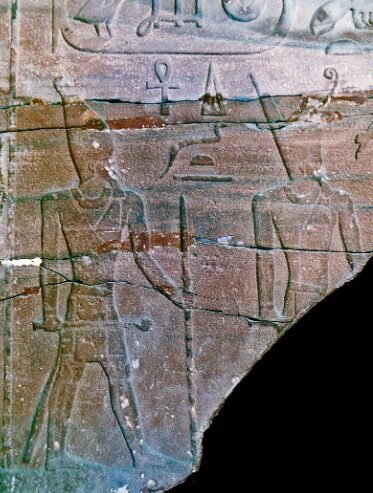
Pharaoh Sahure initiated voyages to Punt, obtaining myrrh and malachite, and exploited Sinai’s turquoise and copper mines. Militarily, Sahure subdued Libyan tribes, enhancing Egypt’s livestock reserves. Image: Relief of Sahure from the Wadi Maghareh, Sinai Peninsula, Egypt
Trade with Byblos
Sahure’s foreign policy also included robust trade relations with Byblos, a significant trading partner in the Levant. Evidence of this relationship is found in an alabaster bowl inscribed with Sahure’s name discovered in the temple of Baalat-Gebal.
Furthermore, stone vessels bearing Fifth Dynasty cartouches have been unearthed in Lebanon, attesting to the extensive exchange networks that flourished during Sahure’s reign. These trade relations facilitated the flow of goods, ideas, and cultural practices between Egypt and its neighbors, fostering a period of economic prosperity and cultural exchange.
Military Campaigns and Defense
While Sahure’s foreign engagements were predominantly economic, his reign was not devoid of military activities. Reliefs in his mortuary temple depict campaigns against Libyan chieftains in the Western Desert, showcasing Sahure’s prowess and authority in maintaining Egypt’s borders. These military endeavors were essential for securing livestock and resources, ensuring the stability and sustainability of the kingdom.
Campaigns Against Libyans
The military reliefs illustrate Sahure smiting Libyan chieftains, a standard royal iconography meant to exalt the king’s strength and divine favor. These campaigns not only demonstrated military might but also served to intimidate and subdue potential threats from neighboring regions.
However, the historical accuracy of these depictions is subject to debate, as similar scenes appear in later monuments, suggesting that they may draw from older templates rather than representing specific historical events.
Administrative Sophistication
Beyond direct military action, Sahure’s reign was marked by sophisticated administrative measures to manage and secure Egypt’s borders. Officials were appointed to oversee the Western Nile Delta and manage border traffic, indicating a well-organized bureaucracy aimed at regulating and protecting Egypt’s frontiers.
Sahure’s reign was marked by significant administrative advancements, reflecting a shift towards a more inclusive and sophisticated bureaucratic system.
Notable among these officials was Niankhsekhmet, the chief physician and the first known rhinologist, who commissioned a finely carved false door for his tomb. Other key officials included Khufuankh, Hetepka, Pehenewkai, Persen, Washptah, and Ptahshepses, each holding significant roles such as overseers, priests, and viziers.
Evolution of the Vizierate
During Sahure’s reign, there was a notable shift in the appointment of viziers. Previously, the position was exclusively held by royal princes, but Sahure continued the policy of appointing non-royal individuals to high offices. This transition marked the beginning of a more inclusive administrative system, allowing capable individuals outside the royal family to hold significant power and contribute to the governance of Egypt. Viziers like Sekhemkare and Werbauba exemplified this shift, with Werbauba being a non-royal vizier attested in Sahure’s mortuary temple.
Sahure appointed several high officials who played crucial roles in the administration and religious activities of the kingdom.
Expansion of the Bureaucracy
The administrative sophistication under Sahure’s rule was further demonstrated by the expansion of the bureaucracy to include more non-royal individuals. This inclusive approach promoted efficiency and allowed for a more dynamic and adaptable governance structure, capable of managing Egypt’s growing economic and political complexities.

Cartouche of Sahure on the Abydos king list
Architectural Innovations and Building Projects
Sahure’s architectural endeavors were among his most enduring accomplishments, reflecting both continuity with previous dynasties and innovative departures that set new standards for Egyptian architecture.
The Pyramid Complex at Abusir
Sahure chose Abusir as the site for his pyramid complex, a significant departure from the royal necropolises of Saqqara and Giza used by his predecessors. The pyramid, though smaller and constructed using less durable methods compared to the grand Fourth Dynasty pyramids, was part of a larger complex named Khaba Sahura. This complex included a mortuary temple, a valley temple, and a causeway adorned with intricate reliefs.
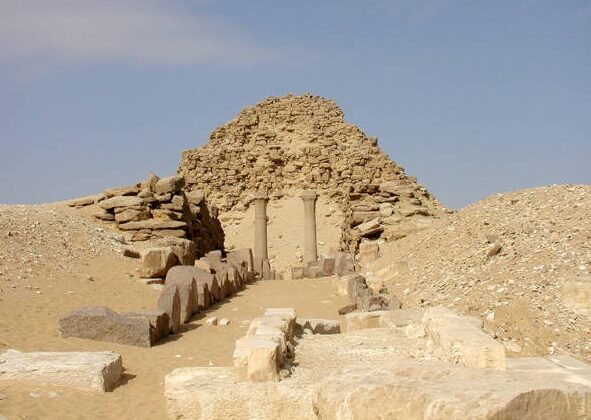
Architecturally, Sahure built his pyramid in Abusir, featuring intricate polychrome reliefs and introducing palmiform columns, which influenced future designs. Image: The ruined pyramid of Sahure. The excavations at the pyramid of Sahure in Abusir were led by archaeologists Miroslav Verner and Tarek El-Awady in the early 2000s.
The core of Sahure’s pyramid was made of roughly hewn stones organized in steps and held together with thick mud mortar, a construction technique that was cheaper and faster but less durable than previous stone-based methods.
As a result, the pyramid is now largely ruined, with only the debris and mortar remaining visible. The entrance was a short descending corridor lined with red granite, leading to the burial chamber reinforced by large limestone beams.
The mortuary temple of Sahure’s pyramid complex was a masterpiece of Old Kingdom architecture, covering an extensive area with an estimated 10,000 square meters of finely crafted reliefs.
These reliefs depicted diverse scenes, including Sahure tending a myrrh tree, hunting wildlife, and engaging in fishing and fowling, blending the king’s divine role with everyday activities.
The temple introduced palmiform columns, which became a distinctive feature of Egyptian architecture, and established a layout that became the standard for subsequent Old Kingdom mortuary complexes.

Sahure’s mortuary temple showcased unique artistic achievements. Posthumously, Sahure was venerated through a lasting funerary cult, later associated with the goddess Sekhmet, ensuring his legacy endured for nearly two and a half millennia. Image: A relief in Sahure’s mortuary temple depicts Egypt’s naval fleet returning from the Levant.
Sun Temple: Sekhetre
Sahure also constructed a sun temple named Sekhetre (“The Field of Ra”), dedicated to the sun god Ra. Although its exact location remains unknown, inscriptions and fragments found within Nyuserre Ini’s mortuary complex suggest that the temple was either incomplete or later dismantled for materials. The sun temples played a crucial role in state religion, facilitating the worship of Ra and reinforcing the divine nature of the pharaoh.
READ MORE: Sun God Ra’s Journey through the Underworld
Religious and Ceremonial Activities
Sahure was deeply involved in religious and ceremonial activities, reinforcing the central role of the pharaoh in maintaining Ma’at (order and justice) and ensuring the prosperity of Egypt.
Rituals and Ceremonies
The Palermo Stone records several of Sahure’s religious activities, including his journey to Elephantine fortress, likely symbolizing the submission of Nubian chiefs and reinforcing his dominion.
He also commissioned statues and participated in opening of mouth ceremonies, which were rituals intended to ensure the deceased’s afterlife.
Additionally, Sahure initiated the “driving of the calves” ceremony, an early element of the Osiris myth, which became a staple of Egyptian religious practice.
READ MORE: Field of Reeds in Ancient Egyptian Religion
Personal Titles and Involvement in Religion
Sahure introduced the title Nb írt-ḫt, possibly meaning “Lord of doing effective things,” signifying his personal involvement in maintaining Ma’at. This title underscored the pharaoh’s role not just as a political leader but as a divine figure actively engaged in religious duties to sustain the cosmic order.
Reorganization of Royal Cults
Sahure reorganized the cult of his mother, Neferhetepes II, enhancing her mortuary complex with new architectural elements, such as an entrance portico with four columns. This reorganization emphasized the importance of royal ancestor worship and integrated his family’s legacy into the broader religious framework of the kingdom.
Maritime Advancements
Sahure’s reign saw significant advancements in Egypt’s maritime capabilities, facilitating trade, military expeditions, and ceremonial activities.
The detailed nautical reliefs from Sahure’s mortuary temple depict large seagoing ships and specialized racing boats, indicating advanced shipbuilding techniques. These ships featured bipodal masts and specific rope configurations, showcasing sophisticated engineering skills. The depiction of men paddling in wave patterns suggests the use of oars and the potential for racing or ceremonial displays.
Sahure utilized naval power not only for trade but also for projecting military strength. The expeditions to the Levant and Punt required long-distance maritime navigation, demonstrating the Egyptians’ ability to construct and manage large fleets capable of sustained voyages. These naval activities were essential for securing trade routes, acquiring resources, and maintaining Egypt’s presence in distant regions.

Niankhsekhmet and his wife are depicted on their false door, carved and painted with Sahure present.
Economic Prosperity and Resource Management
Sahure’s expeditions to Lebanon secured essential materials like cedar wood, vital for construction and shipbuilding. The mission to Punt brought valuable resources such as myrrh, malachite, and electrum, which were crucial for religious ceremonies, crafting, and trade. Additionally, expeditions to the Sinai Peninsula targeted turquoise and copper mines, ensuring a steady supply of these precious materials for Egypt’s economic and military needs.
The robust trade networks established during Sahure’s reign connected Egypt with various regions, including the Levant, Byblos, and Punt. These networks facilitated the exchange of goods, ideas, and cultural practices, contributing to Egypt’s wealth and cultural diversity. The discovery of Sahure’s name on trade vessels and artifacts in foreign temples underscores the extensive reach of Egypt’s economic influence during his reign.
Enduring Cult and Posthumous Reverence

Silver cylinder seal of king Sahure, Walters Art Museum, Baltimore, Maryland
Sahure’s legacy extended beyond his reign through the establishment of an enduring funerary cult and his continued veneration in later periods.
From the time of his death, Sahure was the object of a dedicated funerary cult that continued until the end of the Old Kingdom. This cult was supported by agricultural estates and a network of priests who maintained offerings and rituals, ensuring the perpetuation of his divine status and the remembrance of his reign.
In the Middle Kingdom, Pharaoh Senusret I revered Sahure as a royal ancestor, commissioning statues and dedicating temples that emulated Sahure’s earlier works. This reverence continued into the New Kingdom, where Sahure was deified and associated with the goddess Sekhmet, resulting in the unique cult of “Sekhmet of Sahure.” This cult attracted devotees from across Egypt, highlighting Sahure’s enduring significance in Egyptian religious life.
Throughout the Third Intermediate Period, Late Period, and into the Ptolemaic era, Sahure’s monuments continued to be revered and occasionally restored or repurposed. Despite the dismantling of many of his structures for materials during later periods, the cult of Sekhmet of Sahure ensured that his memory and influence persisted.
In contemporary culture, Sahure remains a figure of historical interest, even appearing in modern media such as the 1983 Sesame Street special “Don’t Eat the Pictures,” where he is referenced as a princely figure from ancient Egypt.
Frequently Asked Questions

Sahure was an ancient Egyptian king of the Fifth Dynasty (c. 2477–c. 2325 BC) who ruled for around 13 years during the Old Kingdom’s early 25th century BC. Image: Statue of Sahure enthroned, commissioned by Senusret I of the 12th Dynasty
What significant familial relationship was uncovered through the reliefs found in Sahure’s pyramid complex?
The reliefs revealed that Sahure’s mother was Queen Neferhetepes II, the wife of Pharaoh Userkaf, thereby establishing Userkaf as Sahure’s likely father.
How does the discovery of Sahure’s cartouche in Userkaf’s mortuary temple at Saqqara contribute to our understanding of their relationship?
The discovery of Sahure’s cartouche within Userkaf’s mortuary temple suggests that Sahure may have completed construction projects initiated by his father, reinforcing the familial link between Userkaf and Sahure.
Which earlier theories about Sahure’s parentage were contradicted by the excavation findings, and what was the new understanding?
Earlier theories posited that Sahure was the son of Queen Khentkaus I, linked to the last ruler of the Fourth Dynasty, Shepseskaf. However, the excavations firmly place Sahure within the direct lineage of Userkaf, highlighting a stable succession in the early Fifth Dynasty.
Who succeeded Sahure, and what archaeological evidence supports this succession?
Pharaoh Sahure was succeeded by his son Neferirkare Kakai. This is supported by a relief found in 2005 depicting Sahure seated before his sons Ranefer and Netjerirenre, with Ranefer later identified as Neferirkare Kakai through inscriptions.
What do the titles of Ranefer and Netjerirenre suggest about their relationship and roles in the royal succession?
Both Ranefer and Netjerirenre are given the title “king’s eldest son”, suggesting they may have been twins. Ranefer likely ascended the throne first as Neferirkare Kakai, while Netjerirenre may have had a brief reign as Shepseskare.
How is the chronology of Sahure’s reign established, and what are the different sources that confirm it?
The chronology of Sahure’s reign is established through historical records, artifacts, and archaeological findings. Key sources include:
- Manetho’s Aegyptiaca (as referenced by later historians like Sextus Julius Africanus and Eusebius)
- Abydos king list and Saqqara Tablet
- Turin Canon and the Palermo Stone
These sources collectively place Sahure’s reign in the early 25th century BC within the Old Kingdom period, lasting approximately 13 years.
What were the primary focuses of Sahure’s foreign relations, and which regions did his expeditions target?
Sahure’s foreign relations primarily focused on economic exchanges rather than military conquests. His expeditions targeted:
- Levantine coast (modern-day Lebanon) for cedar trees, slaves, and exotic items
- Land of Punt (likely along the Somali coast) for myrrh, malachite, electrum, and ebony staves
- Sinai Peninsula for turquoise and copper mines
These activities highlight the sophistication and reach of the Egyptian navy during his reign.
What evidence exists of Sahure’s trade relations with Byblos, and what does it signify?
Evidence of Sahure’s trade relations with Byblos includes an alabaster bowl inscribed with his name found in the temple of Baalat-Gebal.
Additionally, stone vessels bearing Fifth Dynasty cartouches discovered in Lebanon further attest to robust trade connections, indicating a wide-reaching exchange network extending into the Levant.
What do the military reliefs in Sahure’s mortuary temple depict, and what debates surround their historical accuracy?
The military reliefs depict Sahure smiting Libyan chieftains, showcasing the king’s prowess in standard royal iconography. However, the historical accuracy of these depictions is debated, as similar scenes appear in later monuments, suggesting they might draw from older templates rather than represent specific historical events.
What religious and ceremonial activities was Sahure involved in within Egypt, as recorded on the Palermo Stone?
Sahure’s religious and ceremonial activities included:
- Journey to Elephantine fortress, symbolizing the submission of Nubian chiefs
- Commissioning statues and participating in opening of mouth ceremonies
- Creation of a divine barge possibly in Heliopolis
- Appointment of priests and establishment of precise offerings to deities such as Ra, Hathor, Nekhbet, and Wadjet
- Introduction of the title Nb írt-ḫt, meaning “Lord of doing effective things”
- Initiation of the “driving of the calves” ceremony, an early element of the Osiris myth
These activities underscored Sahure’s role in maintaining Maat (order and justice) and enhancing state religion.
How did Sahure’s architectural and artistic contributions influence subsequent generations in ancient Egypt?
Sahure’s architectural and artistic contributions had a lasting impact:
- Mortuary Temple Layout: Introduced a layout that became the standard for subsequent Old Kingdom mortuary complexes.
- Palmiform Columns: First used in his temple, these columns became a distinctive feature of Egyptian architecture.
- Reliefs: The 10,000 square meters of finely crafted reliefs set a high standard for artistic sophistication, with unique depictions such as Sahure tending a myrrh tree and detailed representations of daily and ceremonial activities.
- Artistic Legacy: Later generations emulated Sahure’s reliefs in their own tombs and temples, ensuring his innovations were perpetuated for centuries.

Pharaoh Sahure’s temple introduced palmiform columns, which became a hallmark of Egyptian architecture.





