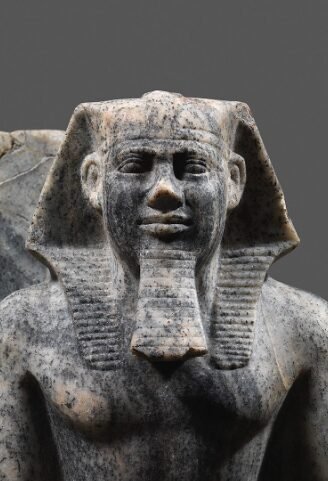
Early Life and Lineage
The exact details of Userkaf’s parentage and early life remain uncertain, but his familial connections to the Fourth Dynasty are widely acknowledged.
Some Egyptologists propose that he was the son of Menkaure, a prominent pharaoh of the Fourth Dynasty, while others suggest he was the offspring of Neferhetepes, believed to be a daughter of Djedefre and Hetepheres II. Neferhetepes is also speculated to have been Userkaf’s consort, further intertwining his lineage with the preceding dynasty.

Userkaf, founder of Egypt’s Fifth Dynasty (c. 2435–2306 BC), elevated the cult of the sun god Re to state prominence. Likely descended from Redjedef, he consolidated his rule by marrying Khentkaues, a royal heiress, thus resolving dynastic disputes. Image: Quartzite head of Djedefre from Abu Rawash, Musée du Louvre
Another theory posits that Khentkaus I, potentially Menkaure’s daughter, may have been either his mother or wife. These ties to the Fourth Dynasty indicate that Userkaf’s accession was likely intended to unify or reconcile different factions within the royal family, solidifying his claim to the throne.

Likely linked to the Fourth Dynasty royal family, Pharaoh Userkaf’s parentage is unclear, though he may have been the son of Khentkaus I. With his consort Neferhetepes, he had at least one daughter and a probable son, Sahure, who succeeded him. Image: Khentkaus depicted on her tomb
Religious Reforms
One of the defining features of Userkaf’s reign was the elevation of Ra, the sun god, to the position of state god. This transition was a significant departure from the earlier emphasis on the divine king as the primary focus of worship.
By establishing sun god Ra’s supremacy, Userkaf shifted the religious framework of the Old Kingdom, creating a duality in which the king was both a mortal ruler and the son of Ra, the creator deity. This theological innovation emphasized the separation of the king’s mortuary cult from the broader solar cult, paving the way for the construction of dedicated sun temples.
Userkaf himself likely held the position of high priest of Ra before ascending the throne, which may have influenced his deep devotion to the sun god. His establishment of Ra as the state god aligned with broader societal trends that emphasized the cosmic order and the sun’s role in maintaining harmony in the world. This focus on Ra’s worship continued throughout the Fifth Dynasty, influencing not only religious practices but also the architectural and artistic expressions of subsequent rulers.
Ra’s Sun Boat in Ancient Egyptian Mythology: Meaning and Significance
The Sun Temple Nekhenre
Userkaf’s most significant architectural contribution was the construction of the Nekhenre, his sun temple located near Abu Gurab. This temple, whose name translates to “The Fortress of Ra,” was a groundbreaking structure dedicated solely to the sun god. The temple marked a departure from traditional mortuary temples by emphasizing Ra’s creator role and his relationship with the king, separate from the king’s afterlife. The Nekhenre established a precedent for subsequent pharaohs of the Fifth Dynasty, who continued to construct sun temples, reinforcing Ra’s status as the state god.
The temple featured innovative architectural elements, including a large open courtyard for solar worship and a high pedestal for a central obelisk symbolizing the sun’s rays. Over time, the temple underwent multiple phases of construction and expansion, with later rulers adding obelisks and other features that enhanced its symbolic and functional significance. The temple served not only as a site for religious rituals but also as a focal point for royal propaganda, emphasizing the king’s divine connection to Ra.
Mortuary Complex and Pyramid at Saqqara
Userkaf chose Saqqara, a site associated with earlier dynasties, as the location for his mortuary complex. His pyramid, though smaller than those of the Fourth Dynasty, was notable for its innovative layout and decoration. The decision to build his pyramid near Djoser’s famous step pyramid may have been a deliberate attempt to align himself with the legacy of the early Old Kingdom rulers. Unlike the monumental pyramids of his predecessors, Userkaf’s pyramid prioritized intricate decorations and symbolic architecture over sheer size.
Userkaf’s reign marked the construction of the first temple to Re at Abusir and his pyramid at Saqqara, smaller than Fourth Dynasty pyramids.
The mortuary temple associated with Userkaf’s pyramid featured a unique placement on the southern side of the pyramid, likely due to the surrounding topography and pre-existing structures. This deviation from the traditional eastern placement may also reflect religious considerations, such as ensuring optimal sunlight exposure. The temple was richly adorned with painted reliefs depicting scenes of nature, hunting, and royal rituals, setting a precedent for artistic themes in later Old Kingdom mortuary complexes.

Userkaf, known in Ancient Greek as Οὐσερχέρης (Usercherês), was the founder of Egypt’s Fifth Dynasty and reigned for about seven years in the early 25th century BC during the Old Kingdom. Image: The ruined pyramid of Userkaf at Saqqara
Neferhetepes and the Adjacent Queen’s Pyramid
Close to Userkaf’s mortuary complex was a smaller pyramid believed to have been constructed for his consort, Neferhetepes. This pyramid, though modest in scale, followed the architectural principles of the period and underscored the importance of royal women in maintaining dynastic continuity.
Neferhetepes is also thought to have played a crucial role in the succession, as the mother of Sahure, who succeeded Userkaf as king. The proximity of her pyramid to Userkaf’s highlights the interconnectedness of royal funerary practices and the broader ideological framework of the time.
Trade and Military Activities
Userkaf’s reign also saw evidence of external trade and military expeditions. Artifacts bearing his name have been discovered on the Greek island of Kythira, indicating early trade links between Egypt and the Aegean world. These connections reflect the expanding reach of Egypt’s influence during the Old Kingdom and suggest a burgeoning network of maritime and overland trade routes.
Additionally, records from Userkaf’s reign hint at military campaigns in Nubia and the Eastern Desert, aimed at securing resources and asserting Egypt’s dominance in the region.
Tributes received from foreign lands during his reign included goods, workforce contributions, and possibly prisoners of war. These tributes not only bolstered the economic resources of the kingdom but also reinforced the perception of the king as a powerful and divinely sanctioned ruler.
Artistic and Cultural Contributions
The artistic achievements of Userkaf’s reign are exemplified by the statues, seals, and reliefs associated with his mortuary and sun temples. One of the most remarkable artifacts from his era is a colossal sphinx head found at his mortuary complex. This statue, carved from pink granite, represents one of the largest surviving examples of royal sculpture from the Old Kingdom, second only to the Great Sphinx of Giza. The youthful features depicted in his statues suggest that Userkaf may have been relatively young when he ascended the throne.
Userkaf also introduced naturalistic themes into the reliefs of his mortuary temple, depicting animals, plants, and hunting scenes with exceptional detail. These artistic innovations reflected broader cultural shifts during the Fifth Dynasty, emphasizing the king’s role as a harmonizer of nature and a guarantor of cosmic order.

Cylinder seal of Userkaf
Legacy and Long-Term Impact
Userkaf’s contributions to Egyptian society extended far beyond his lifetime. His establishment of the sun cult as a central element of state religion influenced the governance and ideological framework of the Fifth Dynasty. Subsequent rulers followed his example by constructing sun temples and emphasizing their divine connection to Ra. This alignment of royal and solar ideologies shaped the religious and political identity of the Old Kingdom.
Despite the decline of his official funerary cult after the Fifth Dynasty, Userkaf’s mortuary complex and sun temple continued to be restored and repurposed by later rulers. The prominence of his sun temple in particular underscored its enduring significance as a symbol of the sun god’s supremacy. In later periods, Userkaf’s contributions were remembered and celebrated in Egyptian art and literature, reflecting his enduring status as a transformative figure in ancient Egyptian history.

Posthumously, Userkaf’s cult waned, and his mortuary temple saw later renovations, including a large obelisk. Records suggest he engaged in trade with the Aegean and possibly led a military expedition to Canaan. He is also the earliest attested builder at the temple of Montu in El-Tod. Image: Relief from a Saqqara tomb dating to the Ramesside Period showing, from left to right, Djoser, Teti and Userkaf
Most Famous Pharaohs of Ancient Egypt
Conclusion
Pharaoh Userkaf’s reign was a pivotal moment in ancient Egyptian history, bridging the cultural and theological developments of the Fourth and Fifth Dynasties. His religious reforms, architectural innovations, and strategic use of art and propaganda established a new paradigm for kingship that balanced the king’s earthly role with his divine association with Ra. Through his sun temple, mortuary complex, and diplomatic endeavors, Userkaf laid the foundation for a dynasty that would continue to shape the Old Kingdom’s identity.
Frequently Asked Questions

Userkaf’s reign marked the rise of the cult of Ra as Egypt’s state religion. Formerly a high priest of Ra, he constructed the Nekhenre sun temple near Abu Gurab, setting a precedent for subsequent rulers. The temple, primarily a mortuary site for Ra, highlighted a growing separation between the sun god and the king. Image: Relief from Userkaf’s mortuary temple, originally painted