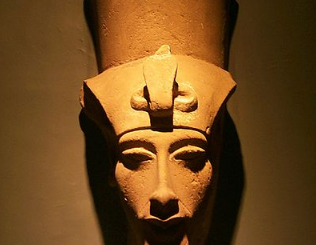
Pharaoh Shepseskaf of the Fourth Dynasty
Pharaoh Shepseskaf, the last ruler of Egypt’s Fourth Dynasty during the Old Kingdom, reigned during a time of transition. His rule marked the end of a lineage known for its monumental pyramid construction and ushered in changes that paved the way for the Fifth Dynasty.
While his reign was relatively short—lasting approximately four to seven years—Shepseskaf’s actions and decisions offer significant insights into the political, economic, and cultural shifts of ancient Egypt during his time.

Shepseskaf’s life and reign encapsulate a period of transition in ancient Egypt. While his short rule and choice of a mastaba over a pyramid have sparked debates, they reflect the broader political, economic, and cultural shifts of his time. Image: Pharaoh Shepseskaf’s cartouche on the Abydos King List
Life and Lineage of Shepseskaf
The precise lineage of Shepseskaf remains uncertain and is a subject of ongoing scholarly debate. The most widely accepted theory is that Shepseskaf was the son of Pharaoh Menkaure, based on evidence such as a decree indicating his involvement in completing Menkaure’s mortuary temple.
However, some argue that this decree does not definitively prove a father-son relationship, as successors often completed the projects of their predecessors regardless of familial ties.

Known by his Hellenized names Menkheres and Mykerinos, ancient Egyptian Pharaoh Menkaure was a ruler from the Fourth Dynasty of the Old Kingdom. Image: Greywacke statue of Menkaure Egyptian Museum, Cairo
Some scholars offer an alternative hypothesis, suggesting that Shepseskaf may have been Menkaure’s brother. This theory posits that Shepseskaf’s advanced age upon ascending the throne could explain his short reign. Another perspective suggests that Shepseskaf might not have been of royal birth, instead legitimizing his rule through marriage to Queen Khentkaus I.

Portrait of Khentkaus I from her tomb
The identity of Shepseskaf’s mother is even more ambiguous. If Menkaure was his father, his mother may have been one of Menkaure’s consorts, such as Khamerernebty II or Rekhetre. Alternatively, some Egyptologists propose that Queen Khentkaus I, a prominent figure whose tomb is located near Shepseskaf’s, might have been his mother or even his wife. Other theories suggest Neferhetepes, a daughter of Djedefre, as a possible maternal figure, though this lacks concrete evidence.
Reign and Governance
Shepseskaf’s reign, which likely occurred during the late 26th to mid-25th century BCE, represents a pivotal period in Egyptian history. He is generally accepted as the immediate successor of Menkaure, though some historical sources, such as the Aegyptiaca by Manetho, suggest the existence of an intermediary ruler named Thampthis. Archaeological evidence, however, does not support this claim, and inscriptions from tombs of officials who served during this era show a direct succession from Menkaure to Shepseskaf and then to Userkaf, the first king of the Fifth Dynasty.
One of Shepseskaf’s notable administrative achievements was the completion of Menkaure’s mortuary temple. When Menkaure died, his pyramid complex remained unfinished, and Shepseskaf ordered its completion using mudbrick rather than the originally planned granite. This pragmatic decision likely reflected the economic realities of the time or the limited resources available during his short reign.
Shepseskaf’s rule also marked the beginning of a gradual decentralization of power in Egypt. High administrative positions, once held exclusively by members of the royal family, began to be occupied by nobles of non-royal origin. This shift in governance laid the groundwork for the administrative reforms of the Fifth Dynasty.
The Mastabat al-Fir’aun: Shepseskaf’s Tomb
One of Shepseskaf’s most discussed accomplishments is the construction of his tomb, known today as the Mastabat al-Fir’aun (“Bench of the Pharaoh”) in South Saqqara. This structure represents a significant departure from the pyramid-building tradition established by his predecessors. The mastaba is a rectangular, flat-roofed tomb with sloping sides, and its design has sparked considerable debate among Egyptologists.
Several theories attempt to explain Shepseskaf’s decision to build a mastaba instead of a pyramid. One suggests that economic constraints or the brevity of his reign necessitated this choice. Constructing a mastaba required fewer resources and less time than a pyramid, making it a practical solution for a pharaoh with limited resources.

The Mastabat al-Fir’aun, his most enduring accomplishment, stands as a testament to his pragmatic and transitional rule. Image: Mastabat al-Fir’aun in Saqqara
Another theory proposes that the decision was motivated by political or religious reasons. The pyramid shape was closely associated with the solar cult of Ra, which gained prominence during the Fifth Dynasty. By rejecting the pyramid form, Shepseskaf might have sought to distance himself from this growing religious influence. However, it is also possible that Shepseskaf intended his mastaba to eventually become a pyramid but died before its completion.
Despite its modest size compared to the great pyramids of his predecessors, the Mastabat al-Fir’aun is architecturally sophisticated. It features a granite-lined burial chamber with a vaulted ceiling and an underground complex designed with precision. Unfortunately, evidence suggests that the tomb was incomplete at the time of Shepseskaf’s death, reinforcing the idea of a short reign.
Ra’s Sun Boat in Ancient Egyptian Mythology: Meaning and Significance
Transition to the Fifth Dynasty
The transition from the Fourth to the Fifth Dynasty was marked by significant cultural and political changes. While Shepseskaf is considered the last ruler of the Fourth Dynasty, his actions and policies facilitated a smooth shift to the new dynasty. The absence of evidence for major conflicts or disruptions during this transition suggests a period of relative stability.
One of the most significant changes during this period was the increasing prominence of the solar cult of Ra. The kings of the Fifth Dynasty, starting with Userkaf, emphasized solar temples and the worship of Ra, a departure from the mortuary-focused practices of the Fourth Dynasty. Shepseskaf’s decision to construct a mastaba rather than a pyramid may have reflected an early response to these shifting religious dynamics.
Pharaoh Shepseskaf, though often overshadowed by the grand achievements of his predecessors, played a critical role in the transition from the Fourth to the Fifth Dynasty.
The tale of the Westcar Papyrus, an ancient Egyptian story, offers a mythological perspective on this transition. The narrative foretells the end of Khufu’s line (founder of the Fourth Dynasty) and the rise of a new dynasty linked to Ra. This aligns with the historical emphasis on solar worship during the Fifth Dynasty.
Legacy and Funerary Cult
Shepseskaf’s legacy is modest compared to his predecessors, largely due to his short reign and the limited scope of his accomplishments. His state-sponsored funerary cult, which would have ensured his continued veneration after death, was relatively minor. By the mid-Fifth Dynasty, there is little evidence of its existence.
However, Shepseskaf’s memory endured in other ways. During the Middle Kingdom, his tomb became the center of a privately revived cult. Stelae and inscriptions from this period indicate that offerings were made to Shepseskaf’s cult, not as part of state-sponsored veneration but as a means of securing divine intercession for the deceased buried nearby. This practice underscores the ongoing significance of Shepseskaf’s role as a royal figure, even centuries after his death.
Significance of Shepseskaf’s Reign
While Shepseskaf’s reign may not have produced the grand monuments or extended rule of earlier pharaohs, it holds significant historical importance. His decisions, particularly the construction of the Mastabat al-Fir’aun and his pragmatic approach to completing Menkaure’s mortuary complex, reflect the changing priorities of the time. These choices offer insights into the economic and political realities of late Fourth Dynasty Egypt.
Moreover, Shepseskaf’s reign represents a bridge between two dynasties, embodying the continuity and gradual evolution of Egyptian state and society. The transition to the Fifth Dynasty was characterized by a decentralization of royal power and an increased emphasis on solar worship, developments that began during Shepseskaf’s time.
Frequently Asked Questions

Shepseskaf was a pharaoh of ancient Egypt and is considered the last ruler of the Fourth Dynasty. His role as a bridge between the monumental Fourth Dynasty and the innovative Fifth Dynasty ensures his place in Egyptian history as a ruler whose actions both adhered to tradition and foreshadowed future developments. Image: A statue head at Boston’s Museum of Fine Arts is thought to represent Shepseskaf or Menkaure.
What is the dominant theory regarding Shepseskaf’s lineage?
The dominant theory suggests that Shepseskaf was Menkaure’s son, based on his completion of Menkaure’s mortuary temple.
What alternative theories exist about Shepseskaf’s lineage?
Some theories propose that Shepseskaf was Menkaure’s brother, while others suggest he was of non-royal origin and legitimized his rule through marriage to Queen Khentkaus I.
Who are the potential candidates for Shepseskaf’s mother?
Potential candidates include Menkaure’s consorts Khamerernebty II or Rekhetre, Queen Khentkaus I, or Neferhetepes, a daughter of Djedefre.
What was Shepseskaf’s estimated reign length?
Shepseskaf’s reign is estimated to have lasted between four and seven years.
What evidence supports Shepseskaf’s succession of Menkaure?
Historical records like the Palermo Stone and inscriptions suggest Shepseskaf directly succeeded Menkaure.
What significant construction did Shepseskaf complete during his reign?
Shepseskaf completed Menkaure’s mortuary temple, using mudbrick instead of stone due to economic or logistical constraints.
What type of tomb did Shepseskaf build for himself, and where was it located?
Shepseskaf built the Mastabat al-Fir’aun, a flat-roofed mastaba located in South Saqqara.
Why did Shepseskaf opt for a mastaba instead of a pyramid?
Theories suggest this decision was due to economic constraints, his short reign, or a possible rejection of the solar cult associated with pyramids.
What was the significance of the Mastabat al-Fir’aun during the Middle Kingdom?
It became a necropolis for commoners, and a private cult associated with Shepseskaf was revived, serving as a means of intercession for offerings to the dead.
What changes occurred during the transition from the Fourth to the Fifth Dynasty?
Power became decentralized, with high administrative positions increasingly occupied by non-royal officials, and the solar cult of Ra gained prominence.
The tale of the Westcar Papyrus prophesies the rise of a new dynasty linked to Ra, aligning with the Fifth Dynasty’s emphasis on solar temples and the worship of Ra.