Pharaoh Menkaure: Life, Reign, and Accomplishments

Known by Hellenized names like Mykerinos and Menkheres, Pharaoh Menkaure is celebrated for his statue triads depicting him with the goddess Hathor and regional deities. Image: Greywacke statue of Old Kingdom pharaoh Menkaure with Hathor and Anput from the Egyptian Museum in Cairo
Pharaoh Menkaure, also known as Menkaura, stands as one of ancient Egypt’s most notable rulers from the Fourth Dynasty during the Old Kingdom. His reign lasted approximately between 2550 BC and 2503 BC.
As the son of Pharaoh Khafre and the grandson of the illustrious Pharaoh Khufu, Menkaure inherited a legacy of monumental architecture and strong centralized governance.
His reign is most celebrated for the construction of the Pyramid of Menkaure at Giza, the smallest yet exquisitely designed of the three principal pyramids on the Giza Plateau.
Menkaure’s contributions extended beyond architecture to familial alliances and the administration of a complex royal court, reflecting the intricate dynastic politics of ancient Egypt.
Family Lineage and Parentage
Menkaure was born into a dynasty renowned for its architectural and cultural advancements. His father, Khafre, is credited with building the second pyramid at Giza and the Great Sphinx, iconic symbols of ancient Egyptian engineering prowess.

Egyptian pharaoh Menkaure was the son of Khafre. He succeeded to the throne following the death of Khafre. Image: A funerary statue of Khafre made from diorite. Location – Egyptian Museum in Cairo
Menkaure’s grandfather, Khufu, is revered for constructing the Great Pyramid of Giza, one of the Seven Wonders of the Ancient World. This lineage placed Menkaure in a position of significant power and expectation, with his heritage deeply intertwined with Egypt’s monumental legacy.
Archaeological discoveries, such as a flint knife found in Menkaure’s mortuary temple, provide crucial evidence about his family. This artifact references Queen Khamerernebty I, suggesting she was Menkaure’s mother. This identification is further corroborated by titles and the tomb location of Khuenre, indicating his status as Menkaure’s eldest son. Thus, Menkaure was born to Pharaoh Khafre and Queen Khamerernebty I, positioning him firmly within the royal lineage of the Fourth Dynasty.
Wives and Children
Menkaure is believed to have had at least two wives, both instrumental in maintaining the royal lineage and forging alliances within the elite circles of ancient Egypt:
- Queen Rekhetre: Identified as the daughter of Pharaoh Khafre, Queen Rekhetre’s marriage to Menkaure solidified familial bonds within the royal family. This alliance likely served to strengthen the political stability and continuity of the dynasty.
- Queen Khamerernebty II: Daughter of Queen Khamerernebty I, Khamerernebty II’s marriage to Menkaure further intertwined the royal lineage, ensuring that the bloodline remained concentrated within a select group of elite families.
Menkaure’s progeny included several children, although historical records confirm only a few:
- Khuenre: Menkaure’s eldest son with Queen Khamerernebty II, Khuenre was designated as the heir apparent. Unfortunately, he predeceased Menkaure, which necessitated a change in succession plans. The tomb of Khuenre, discovered near Menkaure’s pyramid, indicates his significant role within the royal family, despite his early death.
- Shepseskaf: Following Khuenre’s untimely demise, Shepseskaf, a younger son of Menkaure, ascended to the throne. Although his reign was relatively short, Shepseskaf continued the lineage of the Fourth Dynasty, maintaining the dynasty’s continuity despite the challenges posed by Khuenre’s absence.
- Sekhemre: Known primarily from a statue discovered in Menkaure’s pyramid complex, Sekhemre is thought to have been another son of Menkaure. While less documented than his brothers, Sekhemre’s presence underscores the extent of Menkaure’s familial ties within the royal court.
- Unnamed Daughter: According to the historian Herodotus, Menkaure had a daughter who died in early adulthood. Her burial, described in detail, involved elaborate wooden and gold adornments, highlighting the importance placed on royal women even in their brief lives.
- Khentkaus I: Possibly another daughter of Menkaure, Khentkaus I’s relationship is inferred from archaeological evidence, although direct records are sparse. Her inclusion in royal records suggests her significance within the familial hierarchy.
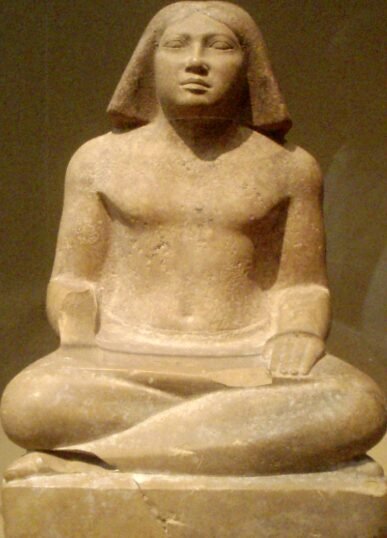
Statue of prince Khuenre, Boston, Massachusetts
Siblings and Court Officials
Menkaure’s reign was supported by several half-brothers who held significant administrative positions, contributing to the effective governance of Egypt’s vast resources:
- Nebemakhet, Duaenre, Nikaure, and Iunmin: These brothers served as viziers, the highest-ranking officials in the Egyptian administration. Their roles were crucial in managing the kingdom’s resources, overseeing monumental construction projects, and maintaining the administrative efficiency that defined the Fourth Dynasty.
- Sekhemkare: Potentially a younger brother, Sekhemkare may have succeeded his siblings as vizier after Menkaure’s death. His role would have been essential in continuing the administrative legacy and ensuring the stability of the royal court during transitions of power.
The presence of multiple viziers within the royal court indicates a well-organized bureaucracy capable of sustaining large-scale endeavors like pyramid construction. This administrative structure was instrumental in the successful execution of projects that have become emblematic of ancient Egypt’s grandeur.
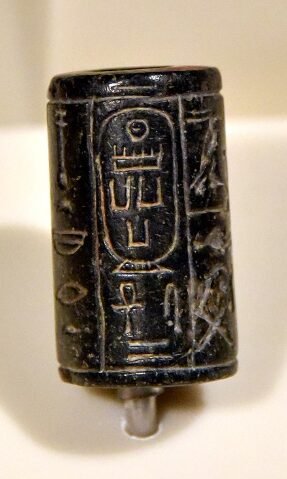
Menkaure had several half-brothers, including Nebemakhet, Duaenre, Nikaure, and Iunmin, who served as viziers—the highest-ranking officials in the Egyptian administration. Image: Basalt cylinder seal of pharaoh Menkaure, from Egypt. Neues Museum, Berlin
Reign and Succession
The duration of Menkaure’s reign has been a subject of scholarly debate. Ancient sources like Manetho attribute an exaggerated 63-year reign to him, a figure widely considered implausible by modern historians.
More credible evidence from the Turin King List, despite being damaged, suggests a reign of around 18 years. Additionally, a contemporary workmen’s graffito references the “year after the 11th cattle count.” Assuming the traditional biennial cattle count, this implies Menkaure ruled for approximately 22 years, a figure that aligns more closely with archaeological findings and historical records.
Menkaure’s legacy as a pharaoh of Egypt’s Fourth Dynasty is firmly established through his monumental architectural achievements, particularly the Pyramid of Menkaure at Giza, and his role within a powerful royal lineage.
Upon Menkaure’s death, his succession did not pass to his eldest son Khuenre, who had already died, but rather to Shepseskaf.
This transition underscores the complexities of royal succession, where younger sons could ascend the throne to maintain the dynasty’s continuity. Shepseskaf’s ascension, despite his shorter reign, ensured that the Fourth Dynasty persisted beyond Menkaure’s tenure, allowing for the continuation of monumental architectural projects and administrative practices.

Menkaure was succeeded to the throne by his son Shepseskaf. Image: Shepseskaf’s cartouche on the Abydos King List
Architectural Achievements: The Pyramid of Menkaure
Menkaure is best known for constructing the Pyramid of Menkaure at Giza, a testament to Egypt’s architectural prowess during the Old Kingdom. Although it is the smallest of the three main pyramids at Giza, the Pyramid of Menkaure is notable for its refined design and intricate details, reflecting Menkaure’s divine status and the advanced engineering techniques of the time.

The Pyramid of Menkaure – the smallest of three pyramids in the Giza plateau – served as the tomb of the Fourth Dynasty Egyptian Pharaoh Menkaure. The pharaoh was the son and successor of Pharaoh Khafre. Image: Standing at 65 meters in height, the Pyramid of Menkaure has a volume of 235,183 cubic meters (8,305,409 cu ft.)
Design and Construction
Measuring approximately 103.4 meters (339 feet) at the base and 65.5 meters (215 feet) in height, the pyramid showcases a meticulous construction process. Its limestone casing stones, some still intact, illustrate the Egyptians’ skill in quarrying, transporting, and precisely placing massive stone blocks. The Pyramid of Menkaure is also adorned with granite lower courses, adding to its structural integrity and aesthetic appeal.
Symbolism
The pyramid’s name, Netjer-er-Menkaure, meaning “Menkaure is Divine,” signifies the pharaoh’s divine status and his role as an intermediary between the gods and the people. The pyramid served not only as a tomb but also as a symbol of Menkaure’s eternal presence and divine authority.
Subsidiary Pyramids
Accompanying the main pyramid are three smaller subsidiary pyramids—G-IIIa (East), G-IIIb (Middle), and G-IIIc (West). These pyramids likely served as burial sites for Menkaure’s queens, such as Khamerernebty II. Archaeological discoveries within these structures, including statues and burial goods, suggest their use as supportive tombs for the royal consorts, emphasizing the importance of royal women in maintaining the dynasty’s legacy.
Did you know…?
In AD 1196, Al-Aziz Uthman, the Sultan of Egypt and son of Saladin, attempted to dismantle the Pyramid of Menkaure.
The sultan enlisted workmen who remained dedicated for eight months, but the endeavor proved costly and slow. Workers managed to remove only one or two stones daily, employing wedges and levers to shift the blocks and ropes to pull them down.
When stones fell, they often became buried in the surrounding sand, requiring significant effort to extract them. To facilitate removal, workers split the stones with wedges and transported the fragments using carts to the base of the escarpment, where they were left behind. Despite these persistent efforts, the pyramid was only partially damaged, resulting in a large vertical crack on its northern face.

The Pyramid of Menkaure is located in the Giza Necropolis, i.e. the Giza pyramid complex. Image: A large vertical gash in the north face of the Red Pyramid. The indentation is about 100 yard long.
Valley Temple and Mortuary Complex
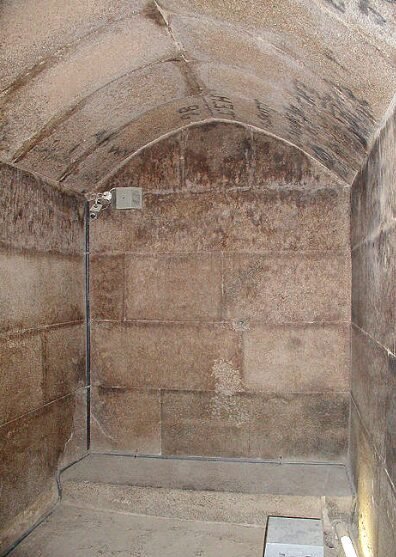
As archaeological research progresses, Menkaure’s contributions continue to be appreciated, highlighting the enduring legacy of one of Egypt’s notable pharaohs. Image: Menkaure’s burial chamber, lined with granite, features cut beams that create a visible barrel vault.
The Pyramid of Menkaure is part of a larger mortuary complex, which includes the Valley Temple and the Mortuary Temple:
Valley Temple
Primarily constructed of brick and later expanded during the Fifth or Sixth Dynasty, the Valley Temple housed statues of Menkaure alongside his queen and various deities. These statues, often in triadic form, depicted the pharaoh with the goddess Hathor and other regional deities, emphasizing the divine connection and authority of the king. The Valley Temple served as a site for religious ceremonies and the processing of the pharaoh’s body before burial.
Mortuary Temple
Located adjacent to the pyramid, the Mortuary Temple revealed additional statues and fragments during excavations. Notably, a fragment of a wand belonging to Queen Khamerernebty I was discovered, inscribed with the title “King’s Mother,” highlighting her significance in the royal lineage.

Coffin fragment inscribed with the name of the king Menkaure
Excavations in the main burial chamber uncovered a basalt sarcophagus and wooden coffin fragments bearing Menkaure’s name.
However, the sarcophagus was lost when the ship carrying it, the Beatrice, was wrecked after departing from Malta in 1838. The remaining materials, including bone fragments, were eventually housed in the British Museum, providing valuable insights into Menkaure’s burial practices and royal funerary customs.

Colossal alabaster statue of Pharaoh Menkaure at the Boston Museum of Fine Arts
Royal Court and Administrative Roles
Menkaure’s reign was characterized by effective governance, supported by his brothers who served as viziers. These viziers were responsible for overseeing the construction of monumental projects, managing resources, and maintaining the administrative efficiency of the kingdom. The presence of multiple viziers within the royal court indicates a well-organized bureaucracy capable of sustaining large-scale endeavors like pyramid construction.
Viziers’ Responsibilities
The viziers played a crucial role in ensuring the smooth operation of the kingdom’s administrative functions. They managed agricultural production, overseen labor forces, organized trade, and supervised the construction of monumental architecture. Their leadership was vital in maintaining the stability and prosperity of Egypt during Menkaure’s reign.
Sekhemkare’s Role
Potentially a younger brother, Sekhemkare may have succeeded his siblings as vizier after Menkaure’s death. His role would have been essential in continuing the administrative legacy and ensuring the kingdom’s resources were efficiently managed, particularly during the transition of power to Shepseskaf.
Cultural and Religious Significance
Menkaure’s pyramid complex was not only a burial site but also a center for religious activities, reflecting the integration of religious worship with royal authority. The presence of multiple statues and inscriptions within the Valley Temple underscores the pharaoh’s divine role in ensuring the prosperity and eternal life of Egypt.
Statues and Iconography
Statues of Menkaure often depicted him alongside the goddess Hathor and other regional deities, symbolizing the pharaoh’s connection to the divine and his role as a mediator between the gods and the people. These statues served both religious and propagandistic purposes, reinforcing the pharaoh’s divine status and legitimacy.
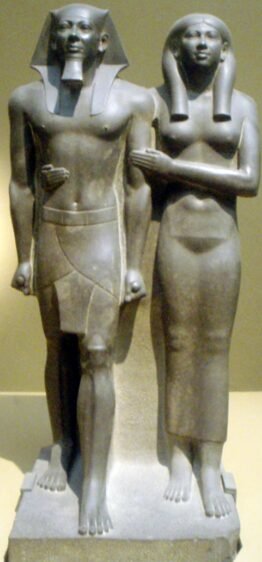
Greywacke statue of Menkaura and Queen Khamerernebty II at the Boston Museum of Fine Arts.
Religious Practices
The pyramid complex facilitated various religious ceremonies aimed at securing Menkaure’s successful journey to the afterlife and his continued influence over the kingdom. Rituals performed within the complex were integral to the ancient Egyptian belief in the afterlife, where the pharaoh’s spirit would sustain Egypt’s eternal prosperity.
Historical Records and Herodotus’s Account
Ancient historians like Herodotus provide additional insights into Menkaure’s reign, though their accounts are often embellished and require careful corroboration with archaeological evidence.
Herodotus’s Narrative
According to Herodotus, Menkaure was the son of Khufu and sought to mitigate the hardships imposed by his father’s reign. Herodotus recounts tales of Menkaure’s personal tragedies, including the death of his daughter, and his defiance against an oracle that predicted a short reign. These stories portray Menkaure as a ruler facing personal and political challenges, striving to uphold his father’s legacy while contending with divine and mortal adversities.
Semi-Legendary Status
While Herodotus’s accounts are valuable, they are considered semi-legendary and should be corroborated with archaeological findings. His narratives often blend historical facts with mythical elements, reflecting the oral traditions and storytelling practices of his time.
Modern Discoveries and Research
In recent years, archaeological excavations have continued to shed light on Menkaure’s reign and legacy, enhancing our understanding of his contributions to ancient Egypt:
- In 2013, a fragment of Menkaure’s sphinx was discovered at Tel Hazor, an ancient city in modern-day Israel. This finding indicates the far-reaching influence of Egyptian art and culture, suggesting diplomatic or trade connections between Egypt and neighboring regions.
- Ongoing research into the construction techniques, subsidiary pyramids, and associated mortuary temples provides deeper insights into the architectural innovations of the Fourth Dynasty. Studies of the Pyramid of Menkaure reveal sophisticated engineering methods and artistic refinements that distinguish it from its larger counterparts at Giza.
- The numerous statue triads found within the Valley Temple and Mortuary Temple, depicting Menkaure alongside deities like Hathor, are subjects of extensive study. These statues offer valuable information about the religious beliefs, artistic styles, and symbolic representations prevalent during Menkaure’s reign.
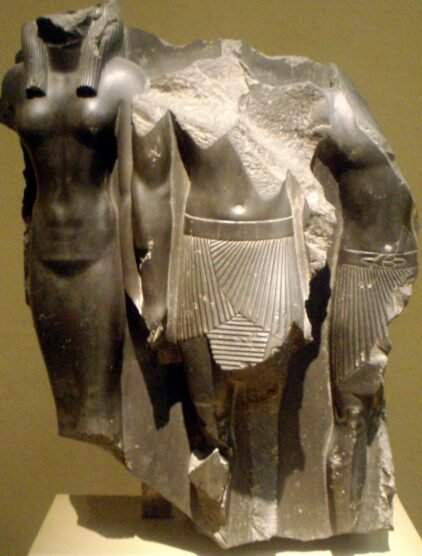
Fragmentary statue triad of Menkaura flanked by the goddess Hathor (left) and a male nome god (right), Boston Museum of Fine Arts.
Conclusion
Pharaoh Menkaure’s legacy as a ruler of Egypt’s Fourth Dynasty is firmly established through his monumental architectural achievements, particularly the Pyramid of Menkaure at Giza, and his role within a powerful royal lineage. His reign, though not as extensively documented as those of his father Khafre or grandfather Khufu, represents a period of continued architectural innovation and administrative efficiency within the Old Kingdom. The familial connections, succession dynamics, and cultural significance of his reign offer valuable insights into the complexities of ancient Egyptian society and governance.
Menkaure’s contributions extend beyond the construction of pyramids to the strengthening of familial alliances and the effective administration of a vast kingdom. His efforts ensured the continuation of the Fourth Dynasty’s architectural and cultural legacy, leaving an indelible mark on Egypt’s history.
Frequently Asked Questions
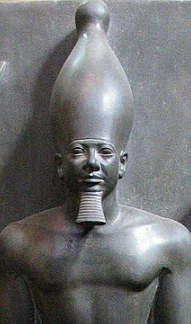
Menkaure (c. 2550–2503 BC) was a pharaoh of Egypt’s Fourth Dynasty during the Old Kingdom. He is renowned for constructing the Pyramid of Menkaure at Giza, the smallest of the three famous pyramids. Image: Greywacke statue of Menkaure Egyptian Museum, Cairo, Egypt
Who were Menkaure’s father and grandfather, and what are they renowned for?
Menkaure was the son of Pharaoh Khafre and the grandson of Pharaoh Khufu. Khafre is famous for constructing the second pyramid at Giza and the Great Sphinx, while Khufu is celebrated for building the Great Pyramid, one of the Seven Wonders of the Ancient World.
What archaeological evidence suggests that Khamerernebty I was Menkaure’s mother?
A flint knife discovered in Menkaure’s mortuary temple bears a mention of Queen Khamerernebty I, indicating her role as Menkaure’s mother. This finding, along with familial titles and the placement of Khuenre’s tomb, supports the identification of Khafre and Khamerernebty I as Menkaure’s parents.
How many wives is Menkaure believed to have had, and what were their names?
Menkaure is thought to have had at least two wives: Queen Rekhetre, who was the daughter of Khafre, and Queen Khamerernebty II, the daughter of Khamerernebty I. These marriages helped maintain the royal lineage and strengthen alliances within the elite.
Who was Khuenre, and what was his significance in Menkaure’s succession?
Khuenre was Menkaure’s eldest son with Queen Khamerernebty II and was designated as the heir apparent. However, he predeceased Menkaure, which necessitated a change in succession plans, leading to his younger brother Shepseskaf ascending the throne.
Which of Menkaure’s sons succeeded him as Pharaoh, and what is known about his reign?
Shepseskaf, a younger son of Menkaure, succeeded him as Pharaoh. Shepseskaf continued the lineage of the Fourth Dynasty, although his reign was relatively short-lived compared to his predecessors.
What is known about Menkaure’s daughter mentioned by Herodotus?
Herodotus records that Menkaure had a daughter who died in early adulthood. Her burial involved an elaborately decorated hall at Sais, featuring a wooden zoomorphic burial structure shaped like a kneeling cow, adorned with red decoration and gold-covered horns and neck area.
Who was Khentkaus I, and what is her possible relationship to Menkaure?
Khentkaus I is possibly another daughter of Menkaure, inferred from archaeological evidence. However, direct records confirming her relationship are sparse, leaving her exact role within the royal family somewhat uncertain.
What is the estimated duration of Menkaure’s reign, and what evidence supports this estimate?
The length of Menkaure’s reign is debated among scholars. While ancient sources like Manetho claim he reigned for 63 years, this is likely an exaggeration. More credible evidence from the damaged Turin King List suggests a reign of around 18 years. Additionally, a workmen’s graffito referencing the “year after the 11th cattle count” implies he ruled for approximately 22 years, aligning better with archaeological findings.
What are the subsidiary pyramids associated with Menkaure’s pyramid, and what is their likely purpose?
Accompanying Menkaure’s pyramid are three subsidiary pyramids labeled G-IIIa (East), G-IIIb (Middle), and G-IIIc (West). These smaller pyramids likely served as burial sites for Menkaure’s queens, such as Khamerernebty II. Archaeological finds within these pyramids, including statues and burial goods, support their use as tombs for royal consorts.
What was discovered in Menkaure’s Valley Temple and Mortuary Temple?
In the Valley Temple, numerous statues of Menkaure with his queen and various deities were found, often depicted in triadic form with the goddess Hathor. The Mortuary Temple yielded additional statues and fragments, including a wand fragment belonging to Queen Khamerernebty I, inscribed with the title “King’s Mother.” Excavations also uncovered a basalt sarcophagus and wooden coffin fragments bearing Menkaure’s name, although the sarcophagus was lost when the ship carrying it was wrecked in 1838.
How did Menkaure’s brothers contribute to his reign and the administration of Egypt?
Menkaure’s brothers, such as Nebemakhet, Duaenre, Nikaure, and Iunmin, served as viziers, playing crucial roles in managing Egypt’s resources and overseeing monumental construction projects like pyramids. Their involvement ensured effective governance and the continuation of the Fourth Dynasty’s architectural and administrative legacy.
What does Herodotus’s account reveal about Menkaure’s personal life and challenges during his reign?
Herodotus portrays Menkaure as a son of Khufu who sought to alleviate the hardships caused by his father’s reign. He recounts Menkaure’s personal tragedies, including the death of his daughter, and his defiance against an oracle that predicted a short reign. Menkaure’s attempts to extend his life by reveling and seeking pleasure illustrate his resistance to fate, although these stories are considered semi-legendary and should be corroborated with archaeological evidence.





