Fourth Dynasty of Egypt: History, Major Facts and Accomplishments
The Fourth Dynasty of ancient Egypt (c. 2613–2494 BCE) represents a golden age in the Old Kingdom, marked by profound architectural achievements, centralized governance, and religious developments. This period is often referred to as the “Age of the Pyramids” due to the unparalleled advancements in constructing monumental tombs that symbolized the dynasty’s power and cultural sophistication. The rulers of this dynasty established a legacy that continues to captivate historians and archaeologists.
Below is an in-depth exploration of its history, key rulers, and their enduring accomplishments.
Historical Context and Significance

The Fourth Dynasty of ancient Egypt (c. 2613–2494 BCE) marked the pinnacle of the Old Kingdom and is often called the “Age of the Pyramids” due to its unparalleled achievements in monumental architecture, governance, and religious evolution. Image: Giza pyramid complex pyramids. From left to right: the Pyramid of Menkaure, Pyramid of Khafre, the Great Sphinx of Giza and Khufu’s Great Pyramid of Giza
The Fourth Dynasty emerged from the stability and prosperity of the Third Dynasty, which laid the groundwork for centralized administration and resource management. Egypt during this time was a unified state characterized by peace, economic wealth, and social organization. This stability allowed the rulers of the Fourth Dynasty to focus on monumental architecture, cultural refinement, and religious evolution.
One of the distinguishing features of this dynasty was its innovation in pyramid construction. Moving beyond the step pyramids of earlier periods, the Fourth Dynasty perfected the “true” pyramid design, symbolizing both technological prowess and divine kingship. These constructions not only served as tombs for pharaohs but also represented the centralized power and ideological control exercised by the monarchy.
Trade networks flourished during this period, extending Egypt’s influence to regions like Nubia, Libya, and the Sinai Peninsula. These interactions provided access to valuable resources such as copper, gold, and labor, which were essential for the dynasty’s grand architectural projects. Religious practices evolved as well, with increasing emphasis on the worship of Ra, the sun god, reflecting a shift in the conceptualization of divine kingship and the afterlife.
Major Rulers of the Fourth Dynasty
The Fourth Dynasty’s achievements, including advancements in architecture, administration, and religious thought, established it as a defining era in Egypt’s history.
Below are some notable rulers of the dynasty:
Sneferu (c. 2613–2589 BCE)

King Sneferu, founder of the dynasty, revolutionized pyramid construction. His experiments culminated in the Bent Pyramid and the Red Pyramid at Dahshur, the latter being the first successful “true” smooth-sided pyramid. Sneferu’s focus on stable, tall structures established a blueprint for the iconic pyramids of Giza, commissioned by his successors. Image: Limestone statue of Pharaoh Sneferu of the Old Kingdom
The founder of the Fourth Dynasty, Sneferu, was a transformative figure in Egyptian history. He is best known for his innovations in pyramid construction, transitioning from the step pyramid to the smooth-sided “true” pyramid.
Sneferu commissioned three major pyramids, each representing a significant step in the evolution of pyramid design. The Meidum Pyramid, initially designed as a step pyramid, was later modified into a smooth-sided structure but collapsed, demonstrating early experimentation. The Bent Pyramid at Dahshur represents another attempt, where a change in angle midway through construction resulted in its distinctive shape. Finally, the Red Pyramid, also at Dahshur, became Egypt’s first successful “true” pyramid, showcasing a stable and enduring design.
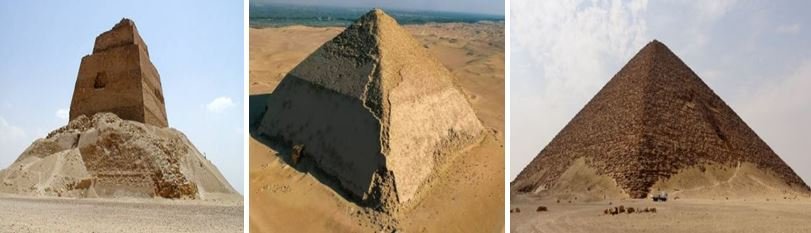
Pyramids built by Sneferu (Left to Right): Meidum Pyramid, the Bent Pyramid, and the Red Pyramid
Sneferu’s reign saw extensive military and trade expeditions. He launched campaigns into Nubia and Libya, securing labor forces and materials like timber and limestone for his construction projects. These expeditions also brought back cattle and prisoners, underscoring his control over surrounding territories.

Cartouche name Sneferu
Sneferu was the first pharaoh to associate himself with Ra, the sun god, setting a precedent for future rulers to emphasize solar worship. His titles and depictions reinforced his divine authority, blending traditional and evolving religious beliefs.
Khufu (Cheops) (c. 2589–2566 BCE)

Sneferu’s successor, Khufu (Cheops), remains famous for constructing the Great Pyramid of Giza, one of the Seven Wonders of the Ancient World.
Khufu, Sneferu’s successor, is renowned for commissioning the Great Pyramid of Giza, one of the Seven Wonders of the Ancient World.
Constructed with incredible precision, the Great Pyramid was the tallest man-made structure in the world for nearly 4,000 years. Its design reflects advanced engineering skills, with an estimated 2.3 million limestone blocks carefully positioned to form its structure. The pyramid’s mortuary complex included temples and causeways, demonstrating the integration of religious and architectural elements.

The Great Pyramid of Giza
Khufu’s reign is poorly documented outside of his architectural achievements. Ancient Greek historians like Herodotus portrayed him as a tyrant who enslaved his people to build the pyramid, though modern scholars dispute these claims, suggesting instead that skilled laborers and seasonal workers were employed.
Although records of Khufu’s political and military activities are sparse, the scale and precision of his pyramid cement his reputation as a builder of lasting monuments.
Khufu’s association with the Great Pyramid immortalized his name in history, overshadowing the limited records of his administrative or military activities.

Khufu’s mortuary complex, featuring now-lost temples, reflects the grandeur of his reign and underscores the dynasty’s emphasis on funerary practices. Image: Cartouche of Khufu
Djedefre (c. 2566–2558 BCE)

Djedefre was the first known Egyptian king to use the title “Son of Ra”
Djedefre, Khufu’s successor and possibly his son, reigned for a relatively short period and remains an enigmatic figure.
Unlike his predecessors, Djedefre chose to construct his pyramid at Abu Rawash, north of Giza. This decision has led to speculation about familial disputes or a strategic choice to align his tomb closer to Iunu (Heliopolis), the center of the solar cult. His pyramid is now heavily damaged, but it is believed to have originally included the first depictions of sphinx-like structures.

Khufu’s son, Djedefre, chose to construct his pyramid away from Giza. This sparked speculation about familial disputes or religious motivations. Image: The ruined pyramid of Djedefre at Abu Rawash
Djedefre emphasized the worship of sun god Ra, reinforcing the sun god’s growing prominence in royal ideology. His reign marked a deeper connection between kingship and solar deities, influencing the religious landscape of ancient Egypt.
Khafre (Chephren) (c. 2558–2532 BCE)

Khafre Enthroned statue – a funerary statue of Khafre made from diorite. Location – Egyptian Museum in Cairo
Khafre, often identified as Khufu’s son, continued the dynasty’s architectural and religious traditions.
Khafre’s pyramid at Giza is slightly smaller than Khufu’s but retains much of its original limestone casing. At the base of its causeway lies the Great Sphinx, believed to bear his likeness. The Sphinx is a testament to the artistic and symbolic innovations of the Fourth Dynasty.
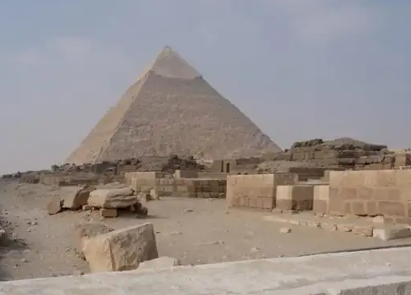
Built in the same area as his father’s pyramid (i.e. Khufu’s pyramid), Khafre’s pyramid stands at around 470 ft., which is about 30 ft. shorter than Khufu’s pyramid. Image: Khafre’s pyramid in the Giza necropolis
Khafre’s reign consolidated centralized governance, ensuring the efficient mobilization of resources for his construction projects. His association with both Ra and Horus emphasized the divine nature of kingship.

Khafre’s reign reinforced the dynasty’s architectural legacy and continued the centralized governance model, which ensured the smooth mobilization of labor and resources. Image: Cartouche name of Pharaoh Khafre in the Abydos King List
Menkaure (c. 2532–2503 BCE)

Known by his Hellenized names Menkheres and Mykerinos, ancient Egyptian Pharaoh Menkaure was a ruler from the Fourth Dynasty of the Old Kingdom.
Menkaure succeeded Khafre and is best known for constructing the smallest of the Giza pyramids.
Menkaure’s pyramid, though smaller, featured refined craftsmanship and a more intricate mortuary complex. It symbolizes a shift toward greater attention to detail and quality over sheer size.

The Pyramid of Menkaure – the smallest of three pyramids in the Giza plateau – served as the tomb of the Fourth Dynasty Egyptian Pharaoh Menkaure. The pharaoh was the son and successor of Pharaoh Khafre. Image: Standing at 65 meters in height, the Pyramid of Menkaure has a volume of 235,183 cubic meters (8,305,409 cu ft.)
His reign saw continued refinement in funerary customs, including mummification and the decoration of tomb interiors. Menkaure’s reign is often seen as a transitional period, blending traditional practices with emerging innovations.
Shepseskaf (c. 2503–2498 BCE)

Shepseskaf, the last king of the Fourth Dynasty, broke from tradition by constructing a rectangular tomb, the Mastabat al-Fir’aun, instead of a pyramid. This marked a shift in royal burial practices, emphasizing simpler, less monumental structures. Image: Pharaoh Shepseskaf’s cartouche on the Abydos King List
The last ruler of the Fourth Dynasty, Shepseskaf, marked a departure from the pyramid-building tradition.
Instead of a pyramid, Shepseskaf constructed a rectangular tomb at Saqqara known as the Mastabat al-Fir’aun. This change might reflect a shift in resources, ideology, or personal preference.
Shepseskaf’s reign bridged the Fourth and Fifth Dynasties, maintaining stability while introducing changes in royal burial practices.
READ MORE: 10 Major Events in the History of Ancient Egypt
Accomplishments of the Fourth Dynasty

Statue head of either Shepseskaf or Menkaure
The Fourth Dynasty perfected the art of pyramid construction, creating iconic monuments like the Great Pyramid of Giza and the Sphinx. These structures remain symbols of Egypt’s engineering and artistic excellence.
The dynasty established a highly organized administration, with viziers and officials overseeing large-scale projects and managing resources efficiently.
The Fourth Dynasty also witnessed significant religious transformations. Kings began identifying with the sun god Ra, a shift from the traditional association with Horus. This evolution aligned with changes in afterlife beliefs, which transitioned from a heavenly realm exclusive to kings to a more Earth-like afterlife accessible to many. These changes influenced tomb designs, mummification methods, and religious rituals, reflecting a more personalized approach to eternity.
Beginning during the reign of Fourth Dynasty pharaohs, the worship of the sun god Ra became central to royal ideology, influencing the construction of solar temples and aligning kingship with divine authority.
Fourth Dynasty pharaohs used extensive trade networks to secure valuable materials like copper, timber, and gold, ensuring the success of monumental projects.
Furthermore, innovations in sculpture, relief work, and tomb decoration reflected the dynasty’s artistic sophistication.
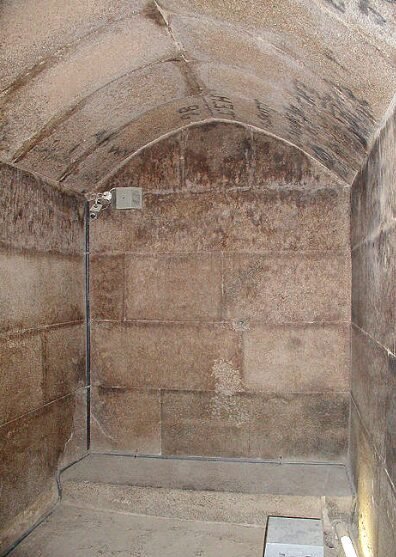
Fourth dynasty pharaohs and their priests promoted mummification techniques and elaborate tomb designs. This underscored the importance of the afterlife in Egyptian culture. Image: Burial chamber of Pharaoh Menkaure
READ MORE: Interpretation of the Afterlife in Ancient Egypt
Conclusion
The Fourth Dynasty of Egypt stands as a testament to the ingenuity, ambition, and cultural richness of the Old Kingdom. Through the monumental pyramids, sophisticated governance, and evolving religious practices, this era established a legacy of grandeur that has captivated humanity for millennia.
Frequently Asked Questions

The Fourth Dynasty is celebrated as the “golden age” of the Old Kingdom, marked by peace, prosperity, and cultural advancements, particularly in pyramid construction and governance.
Who founded the Fourth Dynasty, and what was his major contribution?
King Sneferu founded the Fourth Dynasty and revolutionized pyramid-building by transitioning from step-pyramids to smooth-sided “true” pyramids, such as the Bent Pyramid and Red Pyramid.
What are the iconic architectural achievements of the Fourth Dynasty?
The Fourth Dynasty is renowned for the construction of the Great Pyramid of Giza by Khufu, as well as the pyramids of Khafre and Menkaure, showcasing unmatched architectural expertise.
How did the stability of the Third Dynasty influence the Fourth Dynasty?
The relative peace and stability of the Third Dynasty allowed the Fourth Dynasty rulers to focus on ambitious architectural, artistic, and administrative advancements.
What role did centralized governance play during this period?
Centralized governance enabled efficient resource management and workforce mobilization, facilitating large-scale projects like pyramid construction.

Fourth dynasty pharaohs often embarked upon campaigns into Nubia and Libya, expanding Egypt’s influence and securing resources necessary for construction and sustenance. Image: Statue of Menkaure with Hathor and Anput from the Egyptian Museum in Cairo
What regions were involved in trade during the Fourth Dynasty?
Trade flourished with regions such as ancient Libya in the west, the Sinai Peninsula in the east, and Nubia in the south, contributing to the dynasty’s wealth and stability.
What is the significance of the discoveries in the cemeteries of Giza?
Artifacts and structures found in Giza provide valuable insights into the Fourth Dynasty’s administrative organization, artistic practices, and technological capabilities.
Why is the Fourth Dynasty considered the pinnacle of pyramid construction?
The dynasty perfected engineering and design techniques, producing monumental pyramids that remain architectural marvels and symbols of ancient Egyptian ingenuity.

Women of the royal family, such as Khentkaus I, played prominent roles. Khentkaus I may have ruled as king and bore titles suggesting she was both a monarch and the mother of future kings, as indicated by inscriptions on her tomb. Image: Khentkaus I of ancient Egypt
How did the rulers of the Fourth Dynasty influence future generations?
Their blend of artistic innovation and practical governance set a model for future Egyptian dynasties, emphasizing the importance of centralized power and monumental projects.
What lasting legacy did the Fourth Dynasty leave?
The dynasty’s contributions to architecture, governance, and trade established it as a defining era in Egyptian history, leaving enduring monuments and cultural achievements that continue to inspire.
READ MORE: Most Famous Ancient Egyptian Deities and their Roles





