Pope Alexander I of Alexandria
Alexander was a key opponent of Arianism, leading its condemnation at the council. He brought a delegation including his deacon Athanasius, who acted as his spokesman.
Early Life
Alexander I of Alexandria served as the 19th Pope and Patriarch of Alexandria during a period marked by significant theological and ecclesiastical challenges. While details about his early life remain scarce, it is known that Alexander experienced the brutal persecutions of Christians under Roman emperors Galerius and Maximinus Daia during his priesthood. These experiences shaped his dedication to the Church and prepared him for the trials he would face as patriarch.
Alexander I of Alexandria’s leadership during the Arian controversy and his contributions to the First Council of Nicaea solidified his place in ecclesiastical history.
Alexander ascended to the patriarchate following the death of Achillas of Alexandria, whose brief tenure had been marred by controversy over the reinstatement of Arius, a priest whose teachings would ignite one of the most divisive theological disputes in early Christian history. Alexander inherited this volatile environment, along with other pressing issues, such as the correct dating of Easter and the actions of Meletius of Lycopolis.
The Dating of Easter
One of the earliest controversies Alexander addressed as patriarch revolved around the proper timing of Easter. A schismatic group led by Erescentius challenged the prevailing practices, necessitating a response from Alexander. To resolve the issue, he authored a treatise that referenced earlier writings by Dionysius of Alexandria, emphasizing the importance of unity in the celebration of Easter.
While Alexander’s efforts helped to quiet local disputes, the controversy persisted across Christendom. It was only at the First Council of Nicaea, convened during Alexander’s tenure, that the matter was definitively settled, establishing a uniform method for determining Easter’s date.

A portrait of Pope Alexander I.
The Challenge of Meletius of Lycopolis
Meletius of Lycopolis posed another significant challenge for Alexander. Meletius had previously clashed with Achillas and continued to undermine Alexander’s authority by consecrating bishops without proper consent and spreading accusations against the patriarch. This schismatic activity threatened the unity of the Church in Egypt.
Meletius also aligned himself with Arius, further complicating matters. Despite the tensions, Alexander displayed remarkable diplomacy. At the Council of Nicaea, he permitted Meletius to return to the Church under specific conditions, effectively neutralizing the schism and breaking the alliance between Meletius and Arius. This act demonstrated Alexander’s commitment to reconciliation and ecclesiastical order.
The Arian Controversy
The most consequential issue of Alexander’s patriarchate was the rise of Arianism, a theological doctrine advanced by Arius, a charismatic priest in Alexandria. Arius rejected the co-eternity and consubstantiality of the Son with the Father, asserting that the Son was a created being and therefore not divine in the same sense as the Father.
Arius’ influence grew rapidly, aided by his appointment to a prominent church in Alexandria under Achillas’ tenure. When Alexander openly preached the unity of the Trinity, Arius accused him of Sabellianism, an already condemned heresy. The resulting conflict escalated quickly, dividing the Christian community in Alexandria and beyond.
Synods and Condemnations
To address the spreading heresy, Alexander convened a synod in 320, involving clergy from Alexandria and neighboring regions. The assembly, including 36 presbyters and 44 deacons, condemned Arianism and excommunicated Arius. Despite this decisive action, Arius continued to gain support, particularly in Mareotis, Libya, and Palestine, where influential bishops like Eusebius of Nicomedia and Eusebius of Caesarea championed his cause.
In 321, Alexander called a larger council, which drew approximately 100 participants. Arius reiterated his views, prompting the council to anathematize him until he recanted. This formal condemnation highlighted the growing polarization within the Church and underscored the need for a broader resolution.
Wider Implications and Constantine’s Involvement
The Arian controversy soon attracted the attention of Emperor Constantine I (also known as Constantine the Great), who sought to restore unity to the Church. Viewing the dispute as a threat to imperial stability, Constantine initially dismissed the theological debate as trivial and urged reconciliation. However, the persistence of the conflict, marked by violent clashes in Alexandria and the proliferation of Arius’ writings, compelled Constantine to take more decisive action.
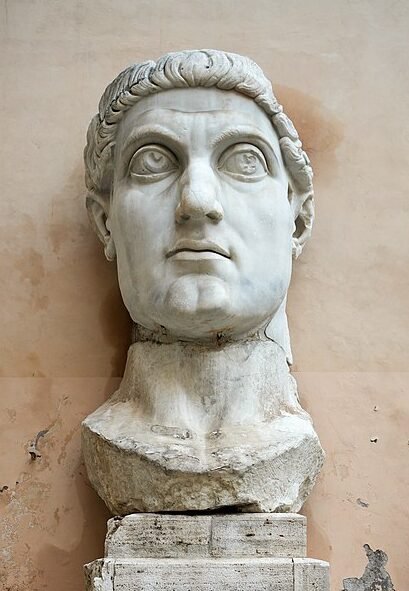
Head of the Colossus of Constantine at the Capitoline Museums in Rome, Italy.
At Alexander’s urging, Constantine convened the First Council of Nicaea in 325, inviting bishops from across the empire to settle the matter. Alexander attended the council with his deacon and protégé, Athanasius, who would later become one of the Church Fathers and a staunch opponent of Arianism.
Why did Roman Emperor Constantine the Great convert to Christianity?
First Council of Nicaea
The First Council of Nicaea marked a pivotal moment in Christian history. While Alexander was initially expected to preside over the council, he delegated this responsibility to Hosius of Cordova, focusing instead on presenting the case against Arius.
After extensive debate, the council condemned Arianism, affirming the doctrine of the Trinity and declaring the Son to be “consubstantial” (ἐνοούσιον, homoousios) with the Father. This decision was enshrined in the Nicene Creed, which became a cornerstone of Christian orthodoxy.
The council’s rulings extended beyond theological declarations. It granted Alexander the authority to determine the date of Easter, reinforced clerical celibacy in the Egyptian Church, and imposed conditions on Meletius and his followers, preserving unity within the Alexandrian diocese.
The victory at Nicaea represented a triumph for Alexander’s leadership and theological vision. However, the council’s decisions did not immediately quell the Arian controversy, which persisted for decades, requiring continued efforts by Alexander’s successor, Athanasius.
Alexander’s Writings and Legacy
Although many of Alexander’s writings have been lost, his surviving letters provide valuable insight into his theological stance and leadership. These include two letters addressing the Arian controversy and a homily, De anima et corpore (On the Soul and the Body), which survives in a Syriac version. Another significant work, the Encomium of Peter the Alexandrian, reflects his reverence for his predecessor and showcases the literary and theological sophistication of the time.
One of Alexander’s lasting contributions was his mentorship of Athanasius, who succeeded him as patriarch. Athanasius became a central figure in the defense of Nicene orthodoxy, building on Alexander’s legacy and ensuring the eventual triumph of the Nicene Creed.

Alexander mentored Athanasius, who succeeded him as Patriarch of Alexandria and became a key defender of Nicene orthodoxy. Image: Portrait of Athanasius of Alexandria
Death and Veneration
Alexander passed away in 326, shortly after the Council of Nicaea. Tradition holds that he named Athanasius as his successor on his deathbed, further cementing his commitment to the continuation of orthodox leadership.
Alexander I of Alexandria is honored as a saint in the Coptic Orthodox, Eastern Orthodox, and Catholic Churches, celebrated for his eloquence, piety, and dedication to the poor.
Alexander is venerated as a saint in the Coptic Orthodox Church, Eastern Orthodox Church, and Roman Catholic Church. His dedication to justice, charity, and theological clarity earned him a reputation as a model patriarch. The Roman Catholic Church describes him as “a man held in the highest honor by the people and clergy, magnificent, liberal, eloquent, just, a lover of God and man, devoted to the poor, good and sweet to all.”
History of the Catholic Church: How and When Did Catholicism Begin?
Frequently Asked Questions about Alexander I of Alexandria
What were the primary challenges Alexander faced during his patriarchate?
He dealt with controversies over the dating of Easter, opposition from Meletius of Lycopolis, and the rise of Arianism, which he opposed vehemently.
How did Alexander handle the issue of Arianism before the Council of Nicaea?
He convened local synods that condemned Arianism and wrote letters to other bishops, seeking support against Arius and his followers.
What was Alexander’s role in resolving the Easter controversy?
He wrote a treatise addressing the issue and referred to earlier decisions by Dionysius of Alexandria. The matter was ultimately resolved at Nicaea.
How did Alexander address Meletius of Lycopolis and his actions?
Alexander allowed Meletius to return to the Church at Nicaea but limited his episcopal authority to reduce his influence and end his alliance with Arius.
What writings are attributed to Alexander?
He authored letters on the Arian controversy, a homily on the soul and body, and an encomium on Peter of Alexandria. Only fragments of these survive.





