What are the Coffin Texts?
The Coffin Texts are a collection of 1,185 funerary spells written on coffins, tomb walls, and other burial objects during the First Intermediate and Middle Kingdom periods, democratizing access to the afterlife previously reserved for royalty.

The disassembled coffin of Khety, dating back to approximately 1919–1800 BCE, features Coffin Text spells intricately painted on its inner panels.
Summary
The Coffin Texts emerged during the First Intermediate Period (ca. 2100 BCE). They marked a significant shift in Egyptian funerary traditions, transitioning from exclusivity in royal contexts, as seen in the earlier Pyramid Texts, to accessibility for ordinary Egyptians who could afford coffins. These texts opened the concept of an afterlife to non-royal individuals, a democratization of religious beliefs that reshaped societal attitudes toward death and the beyond.
Unlike the Pyramid Texts, which were inscribed exclusively on the walls of royal tombs, the Coffin Texts appeared on various mediums, including coffins, canopic chests, stelae, and even papyri. Their portability and adaptability facilitated widespread use among the elite and wealthier commoners of the Middle Kingdom. This collection comprises approximately 1,185 spells, varying in length due to the constraints of different writing surfaces. Notably, some of these texts would later inspire portions of the Book of the Dead.
Content and Themes
A distinguishing characteristic of the Coffin Texts is their focus on the subterranean afterlife realm, the Duat, ruled by Osiris. This was a departure from the celestial emphasis of the Pyramid Texts. The texts provide vivid depictions of the Duat as a perilous landscape filled with traps, hostile entities, and transformative trials. The deceased is referred to as “the Osiris-[Name],” reflecting their connection to the god of the underworld and their aspiration to achieve an Osirian afterlife.
The concept of judgment after death gained prominence in these texts, introducing the idea that one’s deeds in life would be weighed by Osiris and his council. Early allusions to the balance or scales of judgment, which later became a central theme in the Book of the Dead, appear here. This ethical dimension resonated with societal concerns about fairness, responsibility, and moral conduct.
The Coffin Texts offer spells aimed at protecting the deceased from harm, ensuring their transformation into an akh (a transfigured spirit) and enabling them to traverse the challenges of the Duat. The texts also address practical concerns of the afterlife, such as spells to avoid undesirable tasks like manual labor, which reflected the fears and hopes of the living.
Detailed accounts of the afterlife’s geography and inhabitants are interwoven into the texts. These include references to places like the Sekhet Hotep (Field of Offerings), the paths of Rostau, and the abode of Osiris. Such descriptions not only guided the deceased but also painted an elaborate picture of their anticipated journey.
Examples of Coffin Texts
Coffin Text 1130
This spell captures a speech by the sun god Ra, emphasizing his benevolent acts for humanity:
“I made the four winds, that every man might breathe in his time… I made every man like his fellow; and I did not command that they do wrong. It is their hearts which disobey what I have said.”
This passage highlights the divine order established by Ra and humanity’s moral accountability.
Coffin Text 1031
In another spell, the deceased speaks of their journey through the afterlife:
“I shall sail rightly in my bark, I am lord of eternity in the crossing of the sky… I shall see light-land, I shall dwell in it.”
This spell portrays the deceased’s confidence in overcoming obstacles and attaining a blessed afterlife. It also assures the reader that mastery of the spell grants protection against the dangers of the Duat.
The Book of Two Ways
Among the Coffin Texts, a notable subset known as the Book of Two Ways stands out for its unique graphical and textual representations of the afterlife. Found in coffins from the Middle Egyptian necropolis of el-Bersheh, this collection is considered the first known map of the underworld.
The Book of Two Ways delineates two distinct routes—land and water—separated by a lake of fire, both leading to Rostau and the abode of Osiris. This depiction provided a visual and textual guide for navigating the treacherous terrain of the afterlife, predating similar maps found in the Book of the Dead.
Found on some coffins, the Book of Two Ways is the first known map of the underworld, depicting two routes—land and water—separated by a lake of fire, leading to Rostau and Osiris’s abode.
The Book of Two Ways not only laid the groundwork for later underworld texts but also showcased the evolving complexity of Egyptian religious thought. Its oldest copy, belonging to a woman named Ankh, demonstrates the accessibility of these ideas to individuals outside the royal sphere.
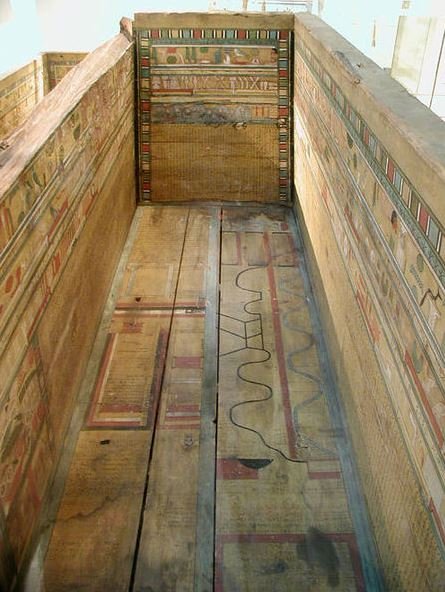
A coffin from the Middle Kingdom of Egypt adorned with Coffin Texts painted on its panels.
Ritual Functions and Practicality
The Coffin Texts served multiple purposes, blending ritual protection with practical guidance. They included:
- Protective Spells: To guard against dangers in the Duat, such as malevolent spirits and deadly traps.
- Transformative Spells: To enable the deceased to adopt desired forms or merge with divine entities.
- Navigational Instructions: Detailed routes and landmarks to help the deceased traverse the afterlife’s challenges.
Additionally, these texts reflected the personalization of funerary practices. Coffins bearing these spells often included the deceased’s name, integrating their individuality into the broader cosmological narrative.
Democratization of the Afterlife
The transition from the exclusivity of the Pyramid Texts to the broader accessibility of the Coffin Texts marks a pivotal moment in Egyptian religious history. By making the afterlife attainable for non-royal individuals, these texts reinforced the idea of a shared cosmic destiny and highlighted the importance of personal morality and preparation. This shift mirrored societal changes during the Middle Kingdom, as power and wealth became more widely distributed.
The Forty-Two Judges: Divine beings who decided whether a soul perished or not
Influence on Later Texts
The Coffin Texts played a foundational role in shaping subsequent funerary literature, including the Book of the Dead. Key themes, such as the weighing of the heart and detailed descriptions of the afterlife, originated here and were elaborated upon in later texts. The Coffin Texts thus represent a critical link in the evolution of ancient Egyptian religious and cultural practices.