Psamtik I: The First Pharaoh of the Twenty-Sixth Dynasty
Wahibre Psamtik I was the first pharaoh of Egypt’s Twenty-sixth Dynasty, ruling from circa 665 to 610 BC. Installed by the Neo-Assyrian Empire, he later unified Egypt, expanded its influence, and revived its cultural heritage.

Bust of Psamtik I, housed at the Metropolitan Museum of Art in New York City, USA.
Summary
Wahibre Psamtik I was the founding pharaoh of the Twenty-Sixth Dynasty of Egypt, marking the beginning of the Saite period. His reign, lasting from circa 665 to 610 BC, was a critical transitional era, as Egypt moved away from foreign domination and into a phase of relative independence and prosperity. Initially installed as a vassal by the Neo-Assyrian Empire, Psamtik I eventually consolidated his rule, unifying the country under his command. His reign was characterized by diplomatic maneuvers, military campaigns, and significant cultural developments.
Name and Titles
Psamtik I’s Egyptian name, pꜣ-sꜣ-n-mṯk, translates to “the man of Meṯek”, referring to an obscure deity. The Assyrians recorded his name as Pishamilki, while the Greeks called him Psammētikhos (Ψαμμήτιχος), and the Romans referred to him as Psammētichus. Additionally, the Assyrians bestowed upon him the title Nabu-shezibanni, meaning “O Nabu, save me!”, reflecting his status as a client ruler under their empire.
Political Background
Before Psamtik I’s rise to power, Egypt was under the rule of the Kushite Twenty-Fifth Dynasty, which had come into conflict with the Neo-Assyrian Empire. In 671 BC, the Assyrian king Esarhaddon invaded Egypt, overthrowing the Kushites and establishing an administration composed of twelve local rulers, known as the Dodecarchy. Among these, Necho I, ruler of Sais and father of Psamtik I, emerged as a leading figure.
In 665 BC, the Kushite king Tantamani launched a counter-offensive, defeating Necho I, who perished in battle. His son Psamtik I fled to Syria, only to return around 665 BC when the Assyrians, under Ashurbanipal, reconquered Egypt and installed him as the ruler of Sais and Memphis.
Consolidation of Power
For the initial years of his reign, Psamtik I ruled as one of many vassal kinglets within the Assyrian system. However, an oracle’s prophecy, predicting that the ruler who poured a libation from a bronze vessel would claim kingship, led to his expulsion from Memphis by rival rulers. Seeking refuge in the Nile Delta swamps, he received another prophecy from the goddess Wadjet of Buto, instructing him to recruit “bronze men from the sea.”
In 662 BC, Psamtik I forged an alliance with Gyges, the king of Lydia, who provided Greek and Carian mercenaries. With their help, he retook Memphis, defeated his rivals, and consolidated control over Lower Egypt. His mercenary forces were strategically stationed at Daphnae in the east and Elephantine in the south to counter any potential Kushite resurgence.
By 658 BC, Psamtik I had also secured an alliance with the influential Heracleopolitan shipping families, and by 657 BC, he had achieved full dominance over the Nile Delta.

A statue at the Louvre, depicting Psamtik I kneeling
Relationship with Assyria and Foreign Policy
Despite his consolidation of power, Psamtik I maintained a diplomatic stance with Assyria. Though Assyrian sources expressed discontent over his actions, particularly his revocation of their previous agreement, they did not actively challenge his rule. His cooperation with Arab tribes of the Sinai, who were Assyrian vassals, further demonstrated the absence of direct hostilities between the two powers.
The Lydian aid to Psamtik I was also not intended as an act of defiance against Assyria. Rather, Assyrian frustration stemmed from Gyges’ refusal to align with their empire, viewing his independent actions as arrogance rather than outright rebellion. The lack of Assyrian intervention during Psamtik I’s unification of Egypt suggests that his campaigns were directed only at his local rivals.
Unification of Egypt
By 656 BC, Psamtik I had fully unified Egypt. His most symbolic act was sending an expedition to Thebes, compelling Shepenupet II, the God’s Wife of Amun and daughter of the former Kushite ruler Piye, to adopt his daughter Nitocris I as her successor. This political maneuver was formalized in the Adoption Stela and signified the end of Kushite influence in Thebes.
In 654 BC, he engaged in a war against the Libyans, who had taken control of northern Egypt. Following his victory, he stationed Egyptian garrisons at Marea to prevent future incursions. By the end of his first decade of rule, Psamtik I’s authority extended across all of Egypt, marking the true beginning of the Saite Dynasty.
The Siege of Ashdod
Greek historian Herodotus recorded that Psamtik I conducted a 29-year siege of Ashdod, a major Philistine city. While the precise dating of this siege remains uncertain, it reflects Egypt’s military ambitions in the Levant. By 627 BC, following the death of Ashurbanipal, the Neo-Assyrian Empire began to decline, allowing Psamtik I to expand Egypt’s influence beyond its traditional borders.

Herodotus (c. 484 BC – c. 425 BC)
Encounter with the Scythians
Between 623 and 616 BC, Scythian forces, former vassals of the Assyrians, invaded the Levant, threatening Egypt’s interests. Psamtik I met the Scythians in battle but instead of engaging them, he bribed them with gifts, persuading them to withdraw without conflict. This strategic decision preserved Egypt’s strength while maintaining its regional dominance.
Linguistic Experiment
Herodotus also recounted Psamtik I’s famous linguistic experiment, conducted to determine the origin of human language. Two newborn children were raised in isolation, and their first spoken word, “bekós”, was believed to be Phrygian for “bread”. This led Psamtik I to conclude that Phrygian was the world’s oldest language, predating Egyptian. Though likely apocryphal, this story highlights the intellectual curiosity of the Saite period.
Psamtik I’s ability to balance diplomacy with military strength, combined with his support for Greek mercenaries and his reorganization of Egyptian institutions, set the foundation for the Saite Renaissance.
Did you know…?
In 2017, a 7.9-meter quartzite statue was unearthed in Heliopolis, Cairo. Initially believed to represent Ramesses II, inscriptions later confirmed it depicted Psamtik I. The statue, sculpted in a classical style reminiscent of the Middle Kingdom, was found in fragments, suggesting it was deliberately destroyed in antiquity.
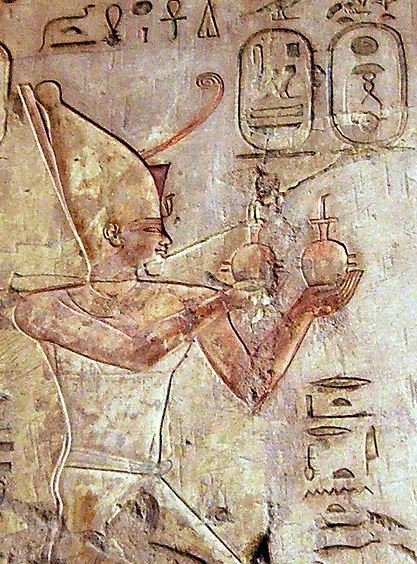
A relief depicting Psamtik I.
Family and Succession
Psamtik I was married to Mehytenweskhet, the daughter of Harsiese, High Priest of Re. Together, they had several children, including his successor, Necho II, as well as Merneith and Nitocris I, the Divine Adoratrice of Amun. His political alliances through marriage helped strengthen Saite authority over Egypt’s religious institutions.
FREQUENTLY ASKED QUESTIONS
How did Psamtik I come to power?
He was installed as ruler of Sais and Memphis by the Assyrians after their conquest of Egypt around 665 BC. He later overthrew rival kinglets, consolidating his rule over all of Egypt.
What role did foreign mercenaries play in his reign?
Psamtik I recruited Ionian Greek and Carian mercenaries from Lydia, using them to defeat rival rulers and secure his control over Egypt.
What was his relationship with the Assyrians?
Though initially a vassal of the Assyrians, Psamtik I gradually distanced himself, but never openly opposed them. His expansion was tolerated as long as it did not threaten Assyrian interests.
What is the significance of the Adoption Stela?
In 656 BC, Psamtik I secured control over Thebes by having his daughter Nitocris I adopted as the heir to the influential title of God’s Wife of Amun.
Psamtik I’s legacy endured through his son Necho II, who continued his expansionist policies, marking the high point of Egypt’s late period independence.

Statue of Necho II.
What was his linguistic experiment?
According to Herodotus, Psamtik I attempted to discover the world’s original language by raising two children in isolation, concluding that Phrygian was the oldest language.
What major conflicts did he engage in?
He waged wars against Libyan tribes, besieged the city of Ashdod for 29 years, and later intervened in the Levant to support the declining Assyrian Empire.

An illustration by Patrick Gray, depicting Psamtek I entering Ashdod.
What was the significance of the colossal statue found in 2017?
A massive statue of Psamtik I, originally thought to be of Ramesses II, was discovered in Heliopolis. It demonstrated Late Period Egypt’s artistic revival and was deliberately destroyed in antiquity.





