The Second Coming of Christ
The Second Coming, also known as the Second Advent or Parousia, is a central doctrine in Christian eschatology that refers to the future return of Jesus Christ to Earth. According to Christian belief, Jesus ascended to heaven after his resurrection, and his return will fulfill divine prophecies related to judgment, the establishment of God’s kingdom, and the ultimate victory over evil. This belief is a cornerstone of most Christian traditions and has influenced theological interpretations, historical movements, and cultural narratives across different faiths.
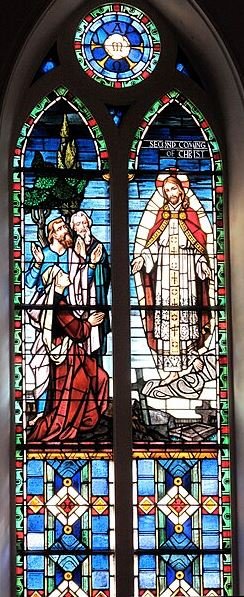
A stained glass window depicting Christ’s Second Coming adorns St. Matthew’s German Evangelical Lutheran Church in Charleston, South Carolina.
Terminology and Meaning
The Second Coming is referred to by different terms within Christian scriptures and theological discussions. The Greek term “Parousia” (παρουσία), which translates to “arrival” or “presence”, is frequently used in the New Testament to describe the anticipated return of Christ. Unlike a momentary event, “Parousia” implies an extended divine presence and reign.
Another term, “Epiphaneia” (ἐπιφάνεια), meaning “manifestation” or “glorious appearing,” is also used to signify Christ’s return. Additionally, the phrase “Day of the Lord” appears in various biblical passages, emphasizing a time of divine intervention in human history.
While Christianity predominantly associates this event with the return of Jesus, Islam, Bahá’í Faith, and other religious traditions hold alternative interpretations of a future divine arrival or leader.

Biblical Foundations of the Second Coming
Christian teachings on the Second Coming are based on numerous scriptural references found in both the Old and New Testaments.
Old Testament Prophecies
Many Christians interpret Messianic prophecies in the Old Testament as foreshadowing both the first and second comings of Jesus. Some of these passages include:
- Daniel 7:13-14 – Describes a “Son of Man” coming with the clouds to receive an everlasting kingdom.
- Zechariah 14:4-9 – Speaks of God standing on the Mount of Olives and establishing His rule over all the earth.
- Isaiah 11:1-10 – Depicts the Messiah bringing peace and justice to the world.
New Testament Teachings
The Second Coming is a consistent theme in the New Testament, particularly in Jesus’ own words and the writings of his apostles. Some key references include:
- Matthew 24:30-31 – Jesus predicts his return in glory, gathering his elect from all over the earth.
- Acts 1:9-11 – Angels tell Jesus’ disciples that he will return in the same way he ascended to heaven.
- 1 Thessalonians 4:16-17 – Describes believers being caught up to meet Christ in the air.
- Revelation 19:11-16 – Depicts Jesus returning as a conquering king to establish divine rule.
Christians believe that his Second Coming will fulfill all remaining biblical prophecies related to the Messiah’s rule, judgment, and the final restoration of creation.
Theological Interpretations and Controversies
Throughout history, Christian denominations have debated the nature and timing of the Second Coming. While all major branches of Christianity accept it as a future event, they differ on how and when it will unfold.
Imminence vs. Delay
Early Christians, including Jesus’ disciples, expected his return within their lifetimes, based on passages like Matthew 24:34, where Jesus said, “This generation will not pass away until all these things take place.” However, as the years passed without fulfillment, Christian theology adapted to a longer timeline. Some believe “generation” refers to the enduring people of faith rather than a literal time period.
Millennial Views
One of the most debated aspects of the Second Coming is its relationship to the Millennium, a thousand-year reign of Christ mentioned in Revelation 20:1-6. This has led to different theological perspectives:
- Premillennialism – Believes Jesus will return before the Millennium to establish his kingdom on Earth.
- Postmillennialism – Suggests Christ will return after a golden age of peace brought about by Christian influence.
- Amillennialism – Views the Millennium as symbolic of Christ’s spiritual reign rather than a literal future event.
The Role of the Antichrist
Many Christians associate the Second Coming with a period of great tribulation and the rise of the Antichrist, a figure described in 2 Thessalonians 2:3-4 and Revelation 13 as a false messianic leader who opposes God before Jesus’ return. Some traditions believe this refers to a specific future person, while others see it as symbolic of ongoing opposition to Christ’s teachings.
Second Coming in Different Christian Denominations
Christian denominations vary in their interpretations of the Second Coming.
Catholicism
The Catholic Church teaches that Christ’s return will be a single, sudden event, bringing the final judgment and the fulfillment of God’s kingdom. Unlike some Protestant groups, Catholicism does not emphasize a secret rapture or an earthly millennial reign. Instead, it teaches that the faithful should focus on spiritual readiness through faith, good works, and participation in the sacraments.

St. Peter’s Basilica, located in Vatican City, stands as the world’s largest Catholic church.
Eastern Orthodoxy
The Eastern Orthodox Church also affirms the Second Coming as a singular, dramatic event. Orthodox theology emphasizes the resurrection of the dead, the final judgment, and the restoration of creation rather than speculative predictions of Christ’s return.
Protestant Views
- Evangelicals often emphasize Premillennialism, believing in a literal rapture and a seven-year tribulation period before Christ’s return.
- Mainline Protestants (e.g., Lutherans, Anglicans, Methodists) focus on the moral and ethical implications of Christ’s future return rather than precise end-time timelines.
Jehovah’s Witnesses
Jehovah’s Witnesses believe Jesus’ “presence” (Parousia) began in 1914 invisibly and that Armageddon will soon bring God’s final judgment. They reject traditional Christian views of a visible Second Coming.
Latter-Day Saint (Mormon) View
The Church of Jesus Christ of Latter-day Saints (LDS Church) believes that Jesus will return to reign on Earth, establishing Zion in Missouri, USA, before ushering in the Millennium.
Non-Christian Perspectives on the Second Coming
Islam
In Islam, Jesus (Isa) is regarded as a prophet and the Messiah, but not divine. Islamic eschatology holds that Jesus will return near the end of time to defeat the Dajjal (Antichrist) and establish peace. This is a key belief among both Sunni and Shia Muslims, though interpretations vary.
Bahá’í Faith

One of the symbols of Baha’i Faith.
The Bahá’í Faith teaches that the return of Christ has already occurred in the person of Bahá’u’lláh, the founder of their religion. They interpret the Second Coming as a spiritual, not literal, event.
Judaism
Judaism rejects Jesus as the Messiah and, by extension, the concept of a Second Coming. Jewish eschatology anticipates a future Messiah who will fulfill biblical prophecies such as rebuilding the Temple and bringing global peace—tasks Christians attribute to Jesus’ future return.
Attempts to Predict the Second Coming
Despite Jesus’ statement in Matthew 24:36 that “no one knows the day or hour,” many individuals and religious groups have attempted to predict the Second Coming:
- 1844 – The Millerite Movement led to the Great Disappointment when Jesus did not return as predicted.
- 1914 – Jehovah’s Witnesses initially claimed Christ’s return had begun invisibly.
- 2011 – Preacher Harold Camping predicted multiple failed dates for Christ’s return.
These failures have reinforced mainstream Christian caution against date-setting, emphasizing instead the need for spiritual vigilance.
Whether seen as an imminent event or a distant promise, the expectation of Christ’s return remains central to Christian faith and eschatology.
The Second Coming in Culture and Art
The idea of Jesus’ return has inspired countless artistic works, from Michelangelo’s “The Last Judgment” to modern literature and film. Works such as C.S. Lewis’ “The Chronicles of Narnia” and the “Left Behind” series reflect this belief. Even secular films, like The Matrix, incorporate messianic return themes.
Frequently Asked Questions
What are the different interpretations of the Second Coming?
Christian denominations vary in their views; some expect a literal, visible return, while others interpret it symbolically. Preterism sees it as fulfilled in the past, while futurists believe it is yet to come.

Shrine of Baháʼu’lláh
How does the Second Coming relate to the Nicene Creed?
The Nicene Creed affirms that Jesus will return “to judge the living and the dead” and that his kingdom will have no end, reinforcing its central role in Christian eschatology.
Why did early Christians expect Jesus’ return within their lifetime?
Biblical passages like Matthew 24:34 led many early Christians to believe Jesus would return within a generation, but interpretations later shifted to a broader, spiritual fulfillment.
How do different Christian denominations view the Millennium?
Premillennialists believe Jesus will reign on Earth for a thousand years before final judgment, while postmillennialists and amillennialists see the Millennium as symbolic or already ongoing.
What is the Islamic perspective on Jesus’ return?
Islam teaches that Jesus will return as a just ruler, defeat the false messiah (Dajjal), and restore justice before dying a natural death. His role is distinct from Christian views of the Second Coming.

Islamic tradition holds that Jesus will descend near the end of time at the Umayyad Mosque in Damascus. Image: Umayyad Mosque.
How does the Bahá’í Faith interpret the Second Coming?
Bahá’ís believe the Second Coming was fulfilled spiritually through Bahá’u’lláh, who they see as the return of Christ, bringing new revelation for humanity.
What role does the Second Coming play in popular culture?
The concept has inspired numerous films, books, and TV shows, often exploring themes of prophecy, judgment, and redemption, sometimes with apocalyptic or satirical interpretations.
FACT CHECK: At World History Edu, we strive for utmost accuracy and objectivity. But if you come across something that doesn’t look right, don’t hesitate to leave a comment below.





