What caused the Ramstein Airshow Disaster in 1988?

The Ramstein Airshow Disaster highlighted the inherent risks of aerial displays and led to significant changes in safety regulations and emergency response planning for airshows worldwide.
The Ramstein Airshow Disaster is one of the deadliest airshow accidents in history, occurring on August 28, 1988, during an air display at the U.S. Ramstein Air Base near Kaiserslautern in West Germany (now Germany). The accident involved three jets from the Italian Air Force aerobatic team, the Frecce Tricolori (“Tricolor Arrows”), colliding mid-air while performing a complex maneuver, resulting in the deaths of 70 people and injuring over 1,000 spectators.
Background and Context
Ramstein Air Base and the Airshow
Ramstein Air Base, located in the Rhineland-Palatinate region of Germany, served as a significant military base for the United States Air Force (USAF) and NATO forces during the Cold War. The base hosted the Flugtag ’88, a large annual airshow, which was one of the most significant aviation events in Europe at that time. The airshow attracted around 300,000 spectators, including both military personnel and civilians, and featured aerobatic teams from various NATO countries, including the Italian Frecce Tricolori, renowned for their complex and high-risk maneuvers.
The Frecce Tricolori Aerobatic Team
The Frecce Tricolori is the aerobatic display team of the Italian Air Force, officially known as the “313° Gruppo Addestramento Acrobatico,” based in Rivolto, Italy. Formed in 1961, they are known for their synchronized flying, precision maneuvers, and the use of smoke trails in the colors of the Italian flag (green, white, and red). Their performances often involve daring aerobatic formations and are considered among the best in the world. The team typically flies the Aermacchi MB-339, a military jet trainer capable of impressive agility and speed.
The Disaster: August 28, 1988
The Planned Maneuver
On the day of the disaster, the Frecce Tricolori were scheduled to perform a maneuver called the “Pierced Heart,” also known as the “Cardioide” or “Herzformation” in German. This maneuver involves two groups of aircraft flying towards each other at high speed. The first group, consisting of five aircraft, flies in an upward and looping formation, creating the upper part of a heart shape. Simultaneously, a solo aircraft (known as “Pony 10”) flies from the opposite direction, intersecting the heart formation at its lower point to create a visual effect of a pierced heart.
The Collision
At approximately 3:45 PM local time, as the team began executing the “Pierced Heart” maneuver, something went terribly wrong. The solo aircraft, piloted by Lieutenant Colonel Ivo Nutarelli, entered the maneuver slightly ahead of schedule and at a lower altitude than intended. As it intersected the main formation, it collided with the leading aircraft of the formation, flown by Lieutenant Colonel Mario Naldini. The collision caused both aircraft to disintegrate mid-air.
A third aircraft, piloted by Captain Giorgio Alessio, was caught in the debris and was also struck, causing it to crash. The three planes spiraled out of control and fell toward the ground, with one of them crashing directly into the crowd of spectators and another into a parked helicopter used for medical evacuations.
Immediate Aftermath and Casualties
The Impact on the Ground
The immediate impact of the collision was catastrophic. Debris from the planes and the ensuing fireball, fueled by aviation fuel, spread into the crowd, causing severe burns and injuries. The area closest to the impact became a scene of chaos, with burning wreckage, smoke, and flames spreading rapidly. Many spectators suffered severe burns, while others were hit by debris or were trampled in the panic that followed.
Casualties and Injuries
In total, 70 people lost their lives in the disaster, including all three pilots involved in the collision. Among the fatalities, 67 were spectators, including 16 children. More than 1,000 people were injured, with around 346 suffering from severe burns or other critical injuries. The scale of the injuries overwhelmed local hospitals and medical services, which were unprepared for a disaster of this magnitude.
Emergency Response
Challenges Faced by Rescue Teams
The response to the disaster was hindered by several factors:
- Delayed Access: The crash site was crowded with thousands of spectators, making it difficult for emergency vehicles to reach the injured. Many vehicles were stuck in traffic, and the site lacked adequate evacuation routes.
- Inadequate Medical Facilities: The airshow had a limited number of medical staff and ambulances on-site, which were quickly overwhelmed. Local hospitals were unprepared for the sudden influx of burn victims and other severely injured patients.
- Communication Failures: There were significant communication breakdowns between emergency services, both at the scene and in coordinating with nearby hospitals. The chaos and confusion led to delays in the initial rescue efforts.
- Lack of Emergency Plans: At the time, airshow safety regulations were less stringent, and comprehensive disaster response plans were not in place. The lack of coordination among military, local authorities, and medical services contributed to the difficulties in managing the disaster effectively.
Heroic Efforts and Medical Response
Despite these challenges, many individuals displayed extraordinary heroism and quick thinking. Medical personnel, military staff, and volunteers worked tirelessly to assist the injured. Helicopters were quickly mobilized to transport burn victims to hospitals better equipped to handle such injuries, including facilities in Germany, the Netherlands, and the United States. Military personnel and off-duty medical professionals at the scene provided first aid and coordinated with local hospitals for additional support.
Investigation and Causes
Official Investigation
An investigation was launched by both Italian and German authorities, along with NATO representatives, to determine the cause of the accident. The investigation revealed that the main cause was a misjudgment in timing and positioning by the solo pilot, Lieutenant Colonel Ivo Nutarelli. He entered the maneuver at the wrong altitude and with a slight delay, leading to the collision with the main formation.
Factors Contributing to the Disaster
- Human Error: The primary factor identified was human error by the solo pilot. It was suggested that he may have experienced spatial disorientation or misjudged his speed and position relative to the other aircraft.
- High-Risk Maneuver: The “Pierced Heart” maneuver itself was inherently risky, involving high-speed crossings at low altitudes. While it was a hallmark of the Frecce Tricolori’s performances, the maneuver left little room for error.
- Lack of Adequate Safety Measures: The positioning of spectators at the airshow was too close to the flight path, which increased the risk to the public in case of an accident. The absence of sufficient barriers or protective measures contributed to the high number of casualties.
- Weather Conditions: While the weather on the day of the disaster was generally clear, some reports indicated that slight wind conditions could have affected the aircraft’s trajectories.
- Potential Technical Issues: While no definitive technical failures were identified in the aircraft, the possibility of minor mechanical issues affecting the pilots’ ability to control their planes was considered but ultimately not confirmed as a primary cause.
Repercussions and Impact
Changes in Airshow Regulations
The Ramstein Airshow Disaster had a profound impact on airshow safety regulations worldwide. Following the incident, several countries, including Germany, implemented stricter safety measures for airshows:
- Minimum Distance Between Spectators and Aircraft: Regulations were introduced to establish minimum safety distances between the flight paths of performing aircraft and spectator areas to reduce the risk of injury in case of an accident.
- Improved Emergency Planning: Airshow organizers were required to have detailed emergency response plans, including coordination with local hospitals, first responders, and military personnel to handle potential disasters more effectively.
- Restrictions on High-Risk Maneuvers: Many countries imposed restrictions or outright bans on specific aerobatic maneuvers deemed too dangerous to perform at public airshows. The “Pierced Heart” maneuver, in particular, was scrutinized and often excluded from future performances.
- Better Safety Briefings and Pilot Training: Pilots were required to undergo more rigorous training and safety briefings before participating in airshows. Special emphasis was placed on spatial awareness, timing, and emergency response during performances.
Psychological and Social Impact
The disaster had a lasting psychological impact on the survivors, witnesses, and families of the victims. Many suffered from post-traumatic stress disorder (PTSD) and other trauma-related conditions due to the harrowing experiences of the crash. The local community around Ramstein and the broader aviation enthusiast community mourned the loss and sought ways to memorialize those who had perished.
Memorials and Commemorations
In the years following the disaster, several memorials were erected to honor the victims. A prominent memorial was built near the crash site at Ramstein Air Base, featuring plaques and inscriptions dedicated to those who lost their lives. Annual commemorative events were held to remember the victims and reflect on the lessons learned from the tragedy.
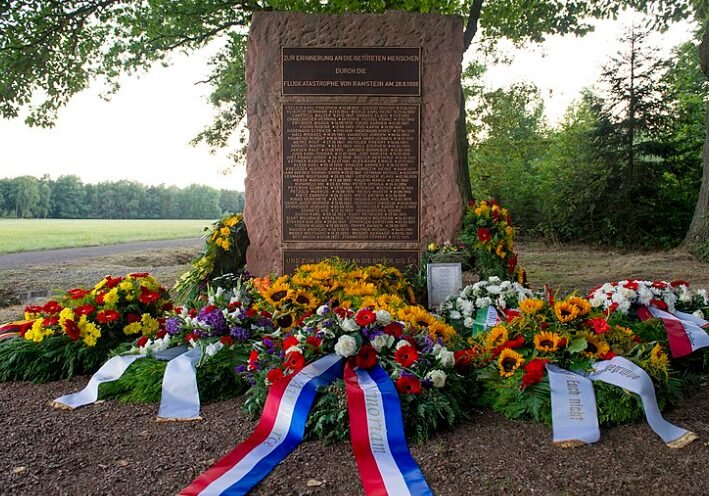
Memorial for the victims of the Ramstein air show disaster
Legacy of the Ramstein Airshow Disaster
The Ramstein Airshow Disaster of 1988 remains one of the deadliest airshow accidents in history. It serves as a stark reminder of the inherent dangers associated with aerial performances and the importance of stringent safety measures to protect both participants and spectators. The tragedy led to widespread changes in airshow regulations, making events safer for the public. It also fostered greater awareness about the need for thorough emergency preparedness and response planning.
In addition to its impact on airshow safety, the disaster underscored the importance of rapid medical response and coordination in managing large-scale emergencies. The lessons learned from the Ramstein disaster have influenced emergency planning and disaster management approaches in various fields beyond aviation, contributing to improved public safety standards worldwide.
Concluding Thoughts
The Ramstein Airshow Disaster was a tragic event that highlighted the risks of high-speed aerobatics and the need for effective safety measures at public events. While the disaster brought great sorrow, it also served as a catalyst for change, leading to improved safety regulations, better emergency preparedness, and a deeper understanding of the potential dangers associated with air displays.





