
Aureus of Vitellius, minted between January and April of 69 AD.
Aulus Vitellius was a Roman emperor who ruled for only eight months in the tumultuous Year of the Four Emperors (69 AD). His reign was marked by extravagance, military upheaval, and brutal conflict, ultimately leading to his violent downfall. Unlike some of his predecessors, Vitellius did not belong to a distinguished imperial lineage, yet his military support enabled him to briefly seize power.
Vitellius’ administration, though short-lived, was characterized by indulgence, political instability, and a desperate struggle to maintain authority in an empire on the brink of civil war.
Early Life and Family Background
Vitellius was born on September 24, 15 AD, in Nuceria Alfaterna, a city in Campania. He was the son of Lucius Vitellius, a prominent senator and consul who enjoyed favor under several emperors, including Tiberius, Caligula, and Claudius. His mother, Sextilia, came from an established Roman family. Despite his noble connections, the Vitellian family was not among Rome’s most prestigious dynasties, and Aulus Vitellius had to navigate his political career through alliances and opportunistic relationships.
During his youth, Vitellius was one of the noble companions of Emperor Tiberius during his reclusive years on the island of Capri. This allowed him to form relationships with influential figures in Rome. He later developed a close friendship with Caligula, bonding over their shared enthusiasm for chariot racing and gambling. This association helped Vitellius rise within the political sphere, earning him key positions in the imperial administration.
Political and Military Career
Vitellius’ career progressed steadily, and in 48 AD, he achieved the prestigious position of consul under Emperor Claudius. He later served as proconsul of Africa in either 60 or 61 AD. Unlike many governors of his time, he was known for his fair administration, which earned him a measure of respect. His political fortune took a dramatic turn in 68 AD when Emperor Galba unexpectedly appointed him as the commander of the legions in Germania Inferior.
This appointment puzzled many, as Vitellius was not considered a remarkable military leader. However, he quickly gained the loyalty of his troops through generosity and leniency. He abolished strict disciplinary measures, allowing soldiers greater freedom, which endeared him to the ranks but weakened military discipline. This approach proved instrumental when dissatisfaction with Galba’s rule spread among the legions.
Vitellius’s Rise to Power
By early 69 AD, unrest in Rome had escalated. Galba’s unpopularity led to his assassination, and Otho was proclaimed emperor. In Germania, however, the legions refused to recognize Otho’s authority and declared Vitellius emperor on January 2, 69 AD. His claim was bolstered by the support of key military leaders, including Fabius Valens and Aulus Caecina Alienus, who led his forces into Italy to confront Otho.
The decisive battle between Otho and Vitellius occurred at the First Battle of Bedriacum in April 69 AD. Vitellius’ forces emerged victorious, and Otho, recognizing the hopelessness of his situation, committed suicide. The Roman Senate officially acknowledged Vitellius as emperor on April 19, marking the beginning of his rule. However, his hold on power would soon face a severe challenge.
Rule as Emperor
Upon ascending to the throne, Vitellius chose to adopt the title Germanicus rather than the traditional Caesar, emphasizing his support from the German legions. His administration, however, was plagued by extravagance, mismanagement, and a lack of political foresight. He was criticized for his excessive indulgence in feasts, games, and spectacles, often at great expense to the state treasury. Historical accounts, particularly from Suetonius, describe Vitellius as a glutton who hosted lavish banquets, consuming vast amounts of food and drink while ignoring pressing matters of governance.
Vitellius’s rise to power was facilitated by military support, but his failure to consolidate authority and his indulgent lifestyle led to his swift downfall.
Despite his reputation for indulgence, Vitellius enacted several administrative reforms. He banned the corrupt practice of centurions selling leave and exemptions to soldiers, a measure that later emperors maintained. He also opened up imperial administrative roles to members of the equestrian class, broadening the pool of officials beyond freedmen. These policies, while beneficial, were overshadowed by his chaotic rule and inability to secure widespread loyalty.
Challenges to His Rule
Vitellius’ claim to the throne faced immediate opposition. In July 69 AD, the eastern provinces, led by the governor of Judea, Vespasian, declared their allegiance to him instead. Vespasian commanded strong military support from the legions in Egypt, Syria, and Pannonia, positioning him as a formidable rival.
Roman Emperor Vitellius’ reign, though brief, was emblematic of the instability that plagued Rome during the Year of the Four Emperors.
Vitellius’ attempts to counter Vespasian’s growing influence were hampered by internal betrayals. One of his top commanders, Aulus Caecina Alienus, defected to Vespasian’s side, leading to a weakening of Vitellius’ military strength. The decisive confrontation came in October at the Second Battle of Bedriacum, where Vitellius’ forces suffered a crushing defeat at the hands of Vespasian’s army.
Abdication and Death
Realizing that his support was dwindling, Vitellius considered abdicating in favor of Vespasian. He even attempted to deposit the imperial insignia in the Temple of Concord, signaling his willingness to step down. However, his loyal supporters, particularly the Praetorian Guard, refused to accept this outcome, leading to a violent struggle in Rome.
As Vespasian’s forces entered the city in December 69 AD, fierce urban combat ensued. Civilian supporters of Vitellius attempted to resist, leading to a brutal street battle that resulted in thousands of deaths. Parts of Rome were set ablaze, and the Temple of Jupiter Optimus Maximus suffered significant damage.
Vitellius, abandoned and desperate, hid in a doorkeeper’s lodge before being discovered. He was dragged through the streets, humiliated, and executed on the Gemonian Stairs on December 20, 69 AD. His body was desecrated and thrown into the Tiber, marking the violent end of his short-lived reign.
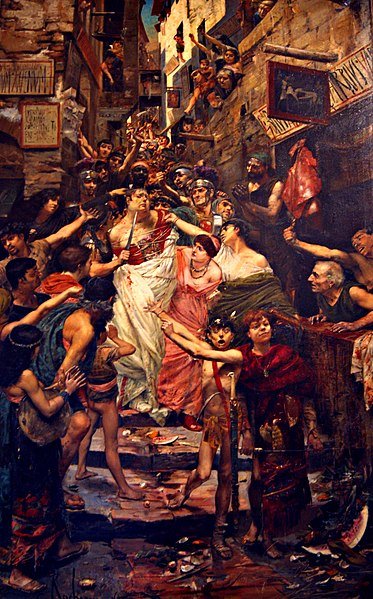
An 1883 painting by Georges Rochegrosse, depicting Vitellius being dragged through the streets of Rome.
Legacy and Historical Reputation
Vitellius is remembered largely through the writings of Suetonius, Tacitus, and Cassius Dio, who paint him as a figure of excess, incompetence, and cruelty. Suetonius, in particular, portrays him as an obese and gluttonous ruler who prioritized personal pleasure over the stability of the empire. His reliance on indulgence and lack of political acumen contributed to his downfall.
However, his administration was not entirely without merit. His reforms in military administration and civil service were steps toward greater efficiency. Moreover, his efforts to maintain stability amid civil war, albeit unsuccessful, demonstrated an understanding of the challenges facing the empire.
Vitellius in Art and Literature
Vitellius has been depicted in various forms of art and literature over the centuries. Busts of him often emphasize his large, heavy-set appearance, reinforcing his historical image as an overindulgent ruler. Painters such as Georges Rochegrosse and Paul-Jacques-Aimé Baudry have illustrated his dramatic fall in works that capture the brutality of his demise.
In literature, Vitellius appears in historical novels that explore the Year of the Four Emperors. Writers such as Simon Scarrow and Steven Saylor have included him in their narratives, often portraying him as a tragic or comedic figure whose rise and fall symbolize the volatility of Roman politics.
Frequently asked questions
How did Vitellius become emperor?
Vitellius was proclaimed emperor by his legions in Germania in January 69 AD, after Emperor Galba’s unpopularity led to his assassination. He defeated Otho at the First Battle of Bedriacum, securing recognition from the Senate.
What were Vitellius’ major policies as emperor?
Despite his reputation for excess, he banned the sale of military leave, expanded administrative positions to the equestrian class, and honored Emperor Nero’s memory to maintain public favor.
Why did he face opposition?
Vespasian, the governor of Judea, gained support from the eastern legions and was declared emperor. His forces, led by Marcus Antonius Primus, ultimately defeated Vitellius’ army at the Second Battle of Bedriacum.
What led to Vitellius’ downfall?
His defeat at Bedriacum and internal betrayals weakened his position. Despite considering abdication, his supporters resisted, leading to brutal street fighting in Rome as Vespasian’s forces stormed the city.
How did Vitellius die?
Vitellius was captured while hiding in Rome, publicly humiliated, and executed on the Gemonian Stairs on December 20, 69 AD. His body was desecrated and thrown into the Tiber River.
How is he remembered in history?
Ancient historians, particularly Suetonius and Tacitus, depict him as a gluttonous, incompetent ruler who prioritized personal pleasures over governance, though some of his reforms lasted beyond his reign.





