Saint Catherine’s Monastery
Saint Catherine’s Monastery, officially known as the Sacred Autonomous Royal Monastery of Saint Catherine of the Holy and God-Trodden Mount Sinai, is a historic Christian monastery located at the foot of Mount Sinai in Egypt’s Sinai Peninsula. Established between 548 and 565 by order of Byzantine Emperor Justinian I, it is the world’s oldest continuously inhabited Christian monastery.

Saint Catherine’s Monastery in 2008.
Over the centuries, Saint Catherine’s Monastery has become a revered site of religious, historical, and cultural significance for Judaism, Christianity, and Islam.
Historical Foundation and Early Development
The origins of monastic life at Mount Sinai trace back to at least the late fourth century, as evidenced by the travel journal of Egeria, a Christian pilgrim who visited the area between 381 and 386. Recognizing the site’s religious significance, Emperor Justinian I commissioned the construction of the monastery to protect the small monastic community residing near what is traditionally believed to be the site of the burning bush witnessed by Moses. Enclosed within the monastery’s walls, this bush continues to be a focal point of veneration.
The fortress-like monastery was designed to withstand invasions and harsh conditions. It also incorporated the Chapel of the Burning Bush, which was built earlier by Empress Helena, mother of Emperor Constantine the Great. The monastery’s longevity can be attributed to its strategic location and the strong fortifications that have preserved it from destruction throughout the centuries.
Why did Roman Emperor Constantine the Great convert to Christianity?
Christian Traditions and Sacred Relics
Saint Catherine’s Monastery is deeply intertwined with Christian traditions. It houses the relics of Saint Catherine of Alexandria, a Christian martyr who, according to tradition, was miraculously transported by angels to Mount Sinai after her death. Her remains were discovered by monks in a cave near the monastery, and since then, the site has been a major pilgrimage destination for Christians. The relics are kept in a revered shrine within the monastery’s church, and the Feast of Saint Catherine is celebrated with great devotion.
Another important feature of the monastery is the “Well of Moses,” where Moses is believed to have met his future wife, Zipporah. This well remains one of the monastery’s key sources of water. The spiritual significance of Saint Catherine’s Monastery is further enhanced by its association with the biblical Mount Sinai, where Moses is said to have received the Ten Commandments.
A Site of Interfaith Significance
Beyond its importance to Christianity, Saint Catherine’s Monastery is revered by Judaism and Islam.
Jewish tradition connects the site to Mount Horeb, the mountain where Moses encountered the burning bush.
Islamic tradition holds the monastery in high regard due to its association with Moses, and it is home to a mosque built within its walls. The monastery also possesses a copy of the Ashtiname of Muhammad, a document in which the Prophet Muhammad purportedly granted protection and privileges to the monastery and its Christian inhabitants.
This unique interfaith status has contributed to the monastery’s peaceful coexistence with surrounding communities throughout history. The monastery was recognized as a UNESCO World Heritage Site in 2002 for its exceptional religious and cultural significance.

The ancient bramble at the monastery is believed to be the biblical burning bush.
READ ALSO: Most Famous UNESCO World Heritage Sites
Medieval Period and Crusader Influence
During the medieval era, Saint Catherine’s Monastery flourished as a spiritual and scholarly center. European Christians took a keen interest in the site during the time of the Crusades (1095–1291). Pilgrims from various parts of Europe made their way to the monastery, supported by financial donations from Christian rulers.
The monastery maintained relations with various regions, including Egypt, Palestine, Syria, Crete, Cyprus, and Constantinople. Its monastic community included members of diverse ethnic backgrounds, such as Arabs, Greeks, Syrians, Slavs, and Georgians. However, following the Ottoman conquest, the monastery became predominantly Greek Orthodox, a status it retains today.
A significant event in the monastery’s history was the conversion of an existing chapel into a mosque during the Fatimid Caliphate (909–1171). Though it eventually fell into disuse, the mosque was restored in the early 20th century and is still used for special occasions.
Challenges and Preservation Efforts
Despite its longstanding resilience, the monastery has faced several challenges over the centuries. Bedouin raids, political instability, and regional conflicts have periodically threatened its security. In the early 16th century, Mamluk rulers struggled to protect the monastery from Bedouin attacks, leading to its temporary decline. European explorers, such as Martin Baumgarten in 1507 and Felix Fabri in the 15th century, documented the monastery’s conditions, highlighting its struggles and occasional rejuvenations.
More recently, the monastery experienced modern threats. In April 2017, an attack by the Islamic State group at a nearby security checkpoint resulted in casualties, emphasizing the monastery’s vulnerability amid regional unrest. However, due to its remote location and the respect it commands from local Bedouin tribes, it has remained relatively well-protected.
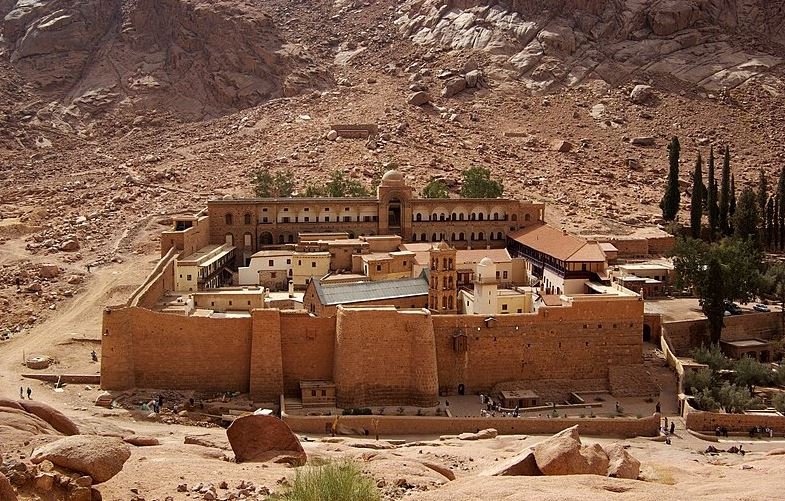
An aerial view of Saint Catherine’s Monastery in 2010.
The Monastery’s Rich Library and Manuscripts
Saint Catherine’s Monastery houses one of the world’s most important libraries, renowned for its extensive collection of ancient manuscripts. Established between 527 and 565, it is recognized as the world’s oldest continuously operating library. The collection contains over 6,000 manuscripts, with texts in Greek, Syriac, Arabic, Georgian, Armenian, Latin, and several other languages. The monastery holds the second-largest collection of early Christian codices, surpassed only by the Vatican Library.
One of the most famous manuscripts discovered at the monastery is the Codex Sinaiticus, a fourth-century Greek manuscript of the Christian Bible. This manuscript, one of the oldest and most complete copies of the Bible, was uncovered by German biblical scholar Constantin von Tischendorf in 1844 and later taken to Russia. It was sold to the British Museum in 1933 and is now housed in the British Library in London.
Another significant discovery was the Syriac Sinaiticus, an early palimpsest manuscript of the Gospels found in 1892 by Agnes S. Lewis. This and other documents from the library have provided scholars with invaluable insights into early Christianity and biblical texts.
Works of Art and Iconography
The monastery is a treasure trove of religious art, particularly its collection of icons. It houses some of the earliest surviving Christian icons, many of which date back to the sixth century. These include the renowned Christ Pantocrator icon, which is considered the oldest known depiction of Christ in this form. The monastery’s isolation helped preserve these artworks from Byzantine Iconoclasm, ensuring their survival to the present day.
Other significant icons include the Enthroned Virgin and Child with Saints and Angels, The Last Judgment, and Saint George and David IV of Georgia. The monastery also contains exquisite mosaics, ancient chalices, reliquaries, and intricately designed church doors. Its collection represents a fusion of Byzantine, Crusader, and local artistic influences.
Modern Preservation and Digital Access
Recognizing the monastery’s immense historical and religious value, various preservation efforts have been undertaken. One major project is the Sinai Palimpsests Project, launched in 2011, which utilizes multispectral imaging technology to recover erased texts from palimpsests—manuscripts that were scraped and rewritten over centuries due to parchment scarcity. Scholars have uncovered lost texts in ancient languages, including Caucasian Albanian and Christian Palestinian Aramaic.
To make its manuscripts more accessible to researchers worldwide, the monastery has partnered with institutions like the UCLA Library to digitize and publish its texts online. The library underwent extensive renovations and reopened in 2017, allowing visitors and scholars to explore its invaluable contents in a more structured setting.

Frequently Asked Questions about Saint Catherine’s Monastery
Who built the monastery and why?
The Byzantine Emperor Justinian I ordered its construction between 548 and 565 to enclose what is believed to be the biblical burning bush seen by Moses.

Mosaic depicting Eastern Roman emperor Justinian I
Why is the monastery named after Saint Catherine?
It was renamed after Saint Catherine of Alexandria, whose relics were said to have been miraculously discovered in the area and brought to the monastery.
What is the religious significance of the monastery?
The site is sacred to Judaism, Christianity, and Islam, as it is traditionally associated with Moses, the burning bush, and early Christian monasticism.

What makes the monastery’s library significant?
It is the world’s oldest continuously operating library, preserving a vast collection of early manuscripts, including the Codex Sinaiticus and the Syriac Sinaiticus.
What role did the monastery play in Christian pilgrimage?
It became a major pilgrimage site due to its association with Moses, Saint Catherine’s relics, and its unique religious and historical heritage.

A map of Egypt, showing the location of Saint Catherine’s Monastery (marked in red).
What architectural features make the monastery unique?
It has massive fortifications, the world’s oldest surviving roof truss, and a well-preserved chapel enclosing the site of the burning bush.
How has the monastery interacted with different ruling powers?
It received protection from Islamic rulers, including the Ashtiname of Muhammad, and was patronized by both Byzantine emperors and Crusader kings.
What important artworks are housed in the monastery?
It holds an invaluable collection of early Christian icons, including the oldest known depiction of Christ Pantocrator, as well as mosaics and liturgical objects.
How is the monastery governed today?
It is under the autonomous Church of Sinai, linked to the Greek Orthodox Church, and its archbishop is traditionally consecrated by the Patriarch of Jerusalem.





