11 Major Ottoman wars in Europe
The Ottoman Empire, one of the most powerful empires in history, engaged in numerous military conflicts across Europe from the 14th century to the early 20th century. These wars were primarily aimed at expanding Ottoman influence and countering European resistance. The conflicts shaped the geopolitical landscape of the Balkans, Central Europe, and the Mediterranean, influencing regional power dynamics for centuries.
In the article below, World History Edu explores the major Ottoman wars in Europe, detailing their causes, key battles, and outcomes.

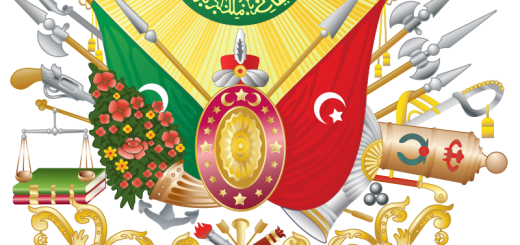
Coat of arms of the empire between 1844 and 1922.
Byzantine-Ottoman Wars (Late 13th–15th Century)
The Byzantine-Ottoman Wars marked the Ottoman Empire’s first military campaigns in Europe. The Ottomans, initially a small Turkish state in Anatolia, began expanding westward into Byzantine-controlled territory. By the mid-14th century, they had crossed into Europe via Gallipoli, a critical foothold that enabled further conquests. The fall of Constantinople in 1453 under Sultan Mehmed II (also known as Mehmed the Conqueror) was the culmination of these wars, effectively ending the Byzantine Empire and solidifying Ottoman dominance in southeastern Europe.
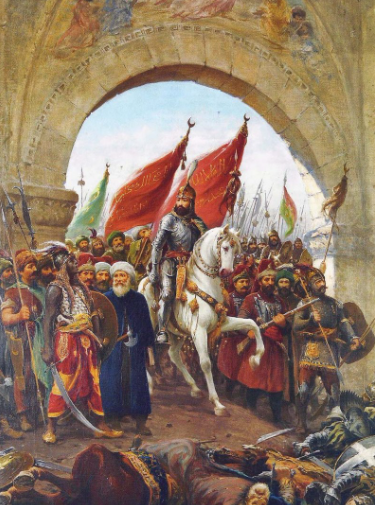
The entry of Sultan Mehmed II into Constantinople. This painting was created by Italian painter Fausto Zonaro (1854–1929)
READ ALSO: Who were the greatest military generals of the Byzantine Empire?
Bulgarian-Ottoman Wars (14th–15th Century)
The Ottomans faced significant resistance from the Second Bulgarian Empire. The Battle of Maritsa (1371) weakened Bulgaria’s hold over its territories, leading to Ottoman dominance in Thrace and Macedonia. The decisive Battle of Nicopolis (1396), fought between a European crusader alliance and the Ottomans, resulted in a crushing defeat for the Christian forces. By 1396, Bulgaria was fully absorbed into the Ottoman realm, marking the end of its independence.
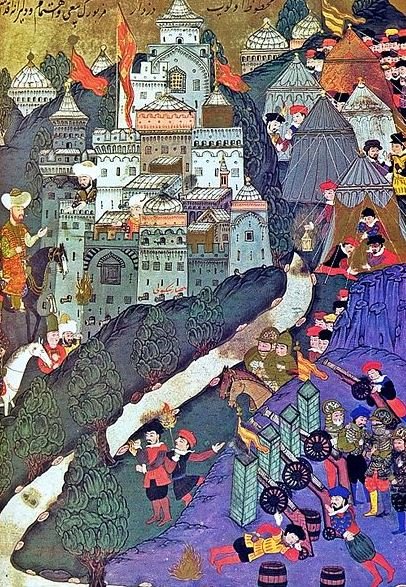
This illustration depicts the Battle of Nicopolis. It was created by Turkish miniaturist Nakkaş Osman.
Serbian-Ottoman Wars (14th–15th Century)
Serbia was another major opponent of Ottoman expansion. The Battle of Kosovo (1389) was a significant conflict that ended in mutual destruction for both the Serbian and Ottoman leadership but ultimately left Serbia weakened. Although some Serbian territories briefly regained independence, the final conquest of Smederevo in 1459 marked the definitive end of Serbian sovereignty under Ottoman rule.

Painting of the Battle of Kosovo by Serbian painter Adam Stefanović.
Albanian-Ottoman Wars (15th Century)
Albania resisted Ottoman incursions under the leadership of Gjergj Kastrioti Skanderbeg, who led a 25-year-long rebellion. His forces achieved several victories, such as the Battle of Torvioll (1444) and Battle of Albulena (1457). However, after Skanderbeg’s death in 1468, Albanian resistance crumbled, leading to complete Ottoman control by 1501.
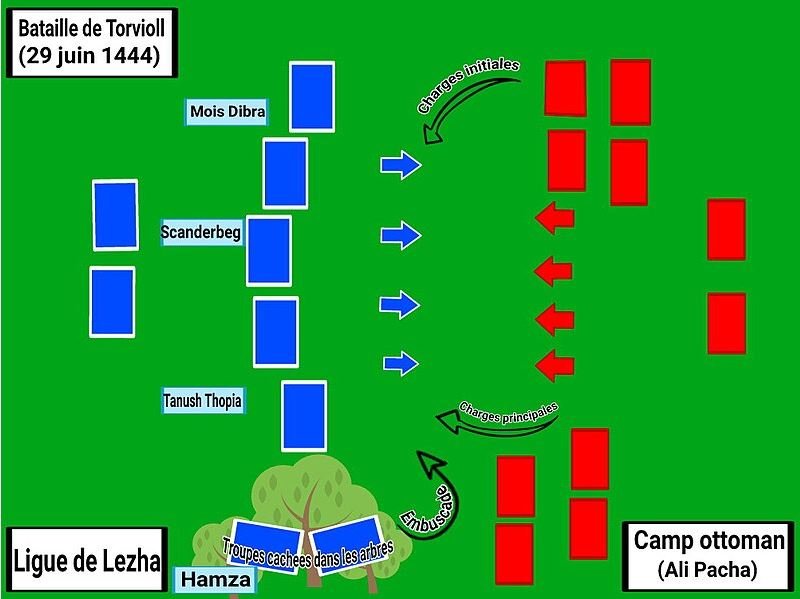
Battle of Torvioll – Plan
Ottoman-Venetian Wars (15th–18th Century)
The Republic of Venice was a major naval and commercial rival of the Ottomans, leading to multiple wars over four centuries. Notable events include:
- Fall of Negroponte (1470) – Ottomans seized the Venetian-controlled island in the Aegean.
- Battle of Lepanto (1571) – A coalition of European powers defeated the Ottoman navy in one of the largest naval battles of history, temporarily halting Ottoman maritime expansion.
- Siege of Candia (1648–1669) – The longest siege in European history, ending in Ottoman victory and the annexation of Crete. Despite setbacks, Venice continued to contest Ottoman power in the Mediterranean, regaining the Morea (Peloponnese) in the 1680s, only to lose it again in 1715.
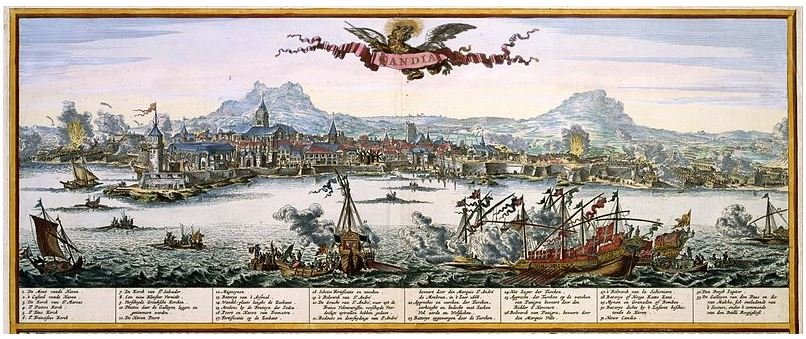
An illustration by Dutch artist N. Visscher, depicting the Siege of Candia.
Ottoman-Hungarian Wars (15th–16th Century)
Hungary bore the brunt of Ottoman military campaigns in Central Europe. The Battle of Mohács (1526) was a turning point, resulting in the death of the Hungarian king and the fragmentation of Hungary. This battle allowed the Ottomans to occupy large parts of the kingdom, and by 1541, Buda was fully under Ottoman rule, making Hungary an Ottoman province.

Hungarian painter Bertalan Szekely’s depiction of the Battle of Mohács
Great Turkish War (1683–1699)
By the late 17th century, European states began forming coalitions against Ottoman expansion. The Great Turkish War began with the Siege of Vienna (1683), where the Ottomans suffered a decisive defeat. The subsequent formation of the Holy League (Austria, Poland, Russia, and Venice) led to Ottoman territorial losses in Hungary and Transylvania. The war concluded with the Treaty of Karlowitz (1699), which marked the first major territorial retreat of the Ottoman Empire in Europe.

Russo-Turkish Wars (17th–19th Century)
The Ottoman Empire and Russia fought a series of wars over control of the Black Sea, the Balkans, and the Caucasus. Key conflicts include:
- Russo-Turkish War (1768–1774) – Russia secured Crimea, weakening Ottoman control in the northern Black Sea region.
- Russo-Turkish War (1828–1829) – Resulted in Greek autonomy and further Russian gains in the Balkans. These wars gradually eroded Ottoman influence, leading to increasing instability within the empire.
Greek War of Independence (1821–1832)
Greek nationalists, inspired by revolutionary movements across Europe, launched a war against Ottoman rule in 1821. With assistance from Britain, France, and Russia, the Greeks achieved victory at Navarino (1827). The war concluded with the Treaty of Adrianople (1829), recognizing Greece as an independent kingdom.
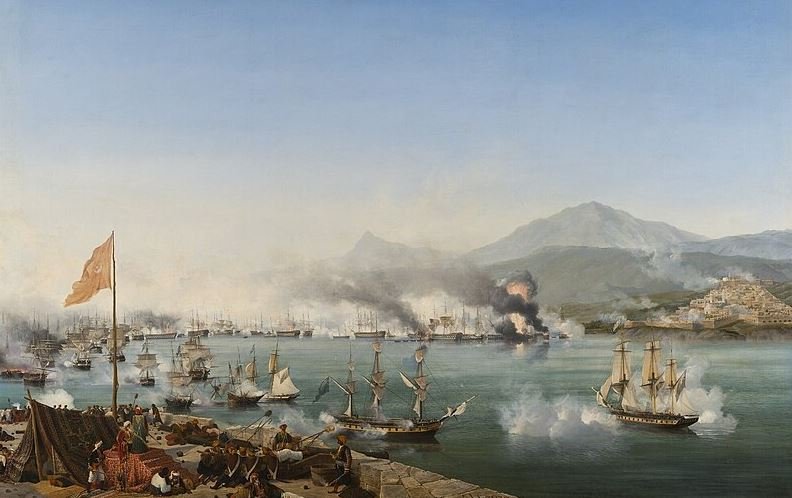
Ambroise Louis Garneray’s painting of the Battle of Navarino.
Balkan Wars (1912–1913)
The Balkan League (Serbia, Greece, Montenegro, and Bulgaria) waged war against the Ottomans, successfully reclaiming nearly all remaining Ottoman territories in Europe. The Treaty of London (1913) significantly reduced Ottoman landholdings, leaving only Eastern Thrace under Ottoman control.
World War I and the End of Ottoman Rule in Europe
The Ottoman Empire sided with the Central Powers in World War I, suffering defeat by 1918. The empire was partitioned under the Treaty of Sèvres (1920). The subsequent Turkish War of Independence (1919–1922) led to the establishment of the Republic of Turkey, officially ending Ottoman rule in Europe.
The fall of the empire in the early 20th century marked the end of Ottoman influence in Europe, giving rise to new nation-states and altering the balance of power in the region.
Frequently Asked Questions
What was the first major conflict between the Ottomans and European states?
The Byzantine–Ottoman wars in the late 13th century marked the beginning of Ottoman expansion.
How did the Ottomans enter Europe?
The Ottomans crossed into Gallipoli around 1356, using it as a base for European conquests.
Which battle marked the fall of Serbia to the Ottomans?
The Battle of Kosovo (1389) led to Serbia becoming an Ottoman vassal state.
When did Constantinople fall to the Ottomans?
The city fell in 1453 after a decisive siege by Mehmed II.
What was the significance of the Battle of Lepanto (1571)?
It was a major naval defeat for the Ottomans against the Holy League, though it did not halt Ottoman expansion.
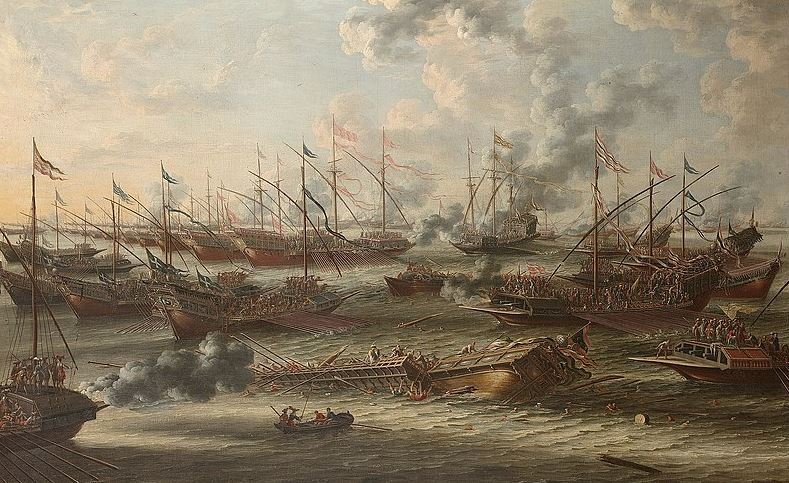
A depiction of the Battle of Lepanto by Flemish painter Laureys a Castro.
Which European power fought the Ottomans for four centuries?
The Republic of Venice, engaging in several wars from 1423 to 1718.
What event triggered the Great Turkish War (1683–1699)?
The Ottoman siege of Vienna (1683), which ended in a decisive Ottoman defeat.
What treaty marked the end of Ottoman expansion into Central Europe?
The Treaty of Karlowitz (1699) forced the Ottomans to cede Hungary and Transylvania.
Which Balkan nations gained independence in the 19th century?
Serbia (1817), Greece (1832), Romania (1878), and Bulgaria (1878) gradually freed themselves from Ottoman rule.
What was the main result of the Russo-Turkish War (1877–1878)?
The Treaty of Berlin (1878) significantly reduced Ottoman control in the Balkans.
What role did the Balkan Wars (1912–1913) play in Ottoman decline?
They resulted in the loss of nearly all Ottoman European territories except Eastern Thrace.
How did World War I affect the Ottoman Empire?
Ottoman defeat led to its partitioning under the Treaty of Sèvres (1920).
When did the Ottoman Empire officially end?
In 1922, with the abolition of the Sultanate, followed by the Treaty of Lausanne (1923).
What major empire replaced the Ottomans?
The Republic of Turkey, established by Mustafa Kemal Atatürk in 1923.