Sicilian Archaic Temples: History and Significance
Sicilian temples, as part of the broader tradition of Greek architecture, represent some of the most spectacular monuments of the ancient world. These temples, located primarily in the ancient Greek colonies of Sicily, were designed with a meticulous application of Greek metrology—the study and application of measurements—reflecting the Greeks’ mathematical precision, architectural sophistication, and cultural ideologies.
The Greek Colonization of Sicily
Greek settlements in Sicily began in the 8th century BC, driven by a combination of economic opportunities, political conflicts, and population pressures in mainland Greece. Colonies such as Syracuse, Selinus (modern Selinunte), and Akragas (modern Agrigento) became prosperous centers of Greek culture, trade, and power. The wealth accumulated in these cities facilitated the construction of monumental temples, showcasing both their devotion to the gods and their civic pride.
Characteristics of Sicilian Temples
Sicilian temples exhibit the hallmarks of Greek architecture, including the Doric order, while also showcasing distinctive regional adaptations. These differences arose from the availability of local resources, specific religious practices, and unique cultural developments in the colonies.
Use of Local Materials
Unlike mainland Greece, which primarily used marble, Sicilian temples were constructed from local limestone. This material, though more accessible, was less durable than marble. To compensate, the Greeks often applied a stucco coating to the limestone to improve its appearance and resilience.
Monumental Scale
The temples of Sicily are renowned for their impressive scale. For example, the Temple of Olympian Zeus at Akragas, though never completed, was one of the largest Doric temples ever conceived. This monumentalism reflected the ambition and wealth of the Sicilian city-states.
Regional Adaptations
While adhering to the Doric order, Sicilian temples often modified traditional proportions. Columns in these temples were typically thicker and more widely spaced than those on the mainland, possibly due to local aesthetic preferences or structural considerations related to the quality of available materials.
Greek Metrology in Temple Design
Greek metrology, rooted in mathematical principles, was central to the design and construction of Sicilian temples. Ancient Greek architects employed precise systems of measurement to achieve harmonious proportions and structural integrity. Key aspects of metrology in Sicilian temples include:
Modular Design
Greek architects used a modular system based on the diameter of the columns, known as the “module” (metron). This unit determined the proportions of various architectural elements, ensuring consistency and balance. For instance, the height of a column, the spacing between columns, and the dimensions of the entablature were all derived from the module.
Golden Ratio
The Golden Ratio (approximately 1:1.618) played a significant role in Greek architectural design. Though its application in Sicilian temples is debated, some scholars argue that elements such as column spacing and temple dimensions align with this ratio, reflecting the Greeks’ pursuit of aesthetic perfection.
Precision Tools
Greek architects and builders used advanced tools for measurement and alignment, including plumb lines, levels, and goniometers. These tools enabled the precise placement of massive stone blocks, ensuring the stability and symmetry of the temples.
Notable Sicilian Temples and Their Metrological Features
Several temples in Sicily stand out for their architectural brilliance and metrological sophistication:
Temple of Concordia (Akragas)
- Design and Proportions: This temple is one of the best-preserved Doric temples in the Greek world. Its dimensions and column spacing exhibit the precise application of modular design.
- Optical Refinements: The temple incorporates entasis (a slight curvature of columns) and a subtly curved stylobate (platform) to correct optical distortions, showcasing the Greeks’ advanced understanding of visual perception.
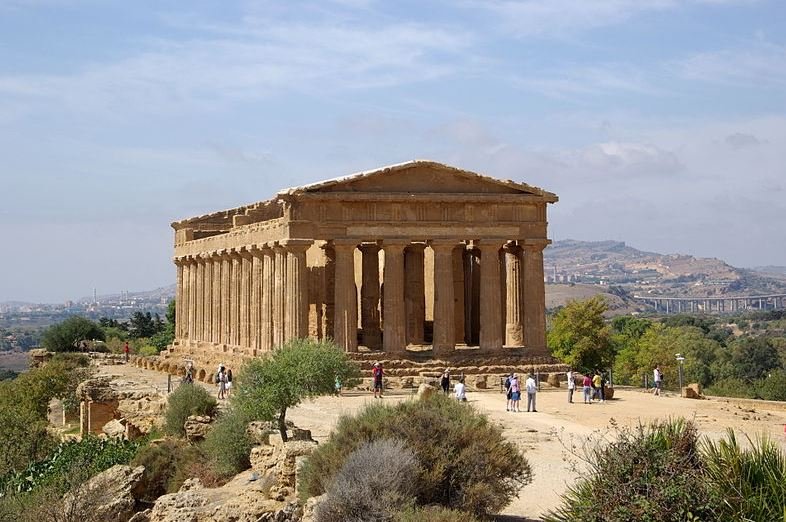
Image: Temple of Concordia.
Temple E (Selinus)
- Complex Metrology: Temple E, dedicated to the goddess Hera, features intricate proportions derived from a carefully calculated module. The alignment and spacing of its columns exemplify the Greeks’ attention to mathematical harmony.
- Innovative Features: The temple includes decorative elements such as sculpted metopes, which required precise measurements for integration into the overall design.
Temple of Olympian Zeus (Akragas)
- Massive Scale: This colossal temple was designed to measure 113 meters by 56 meters, with columns over 20 meters high. Its scale demanded precise engineering and metrological expertise.
- Telamons: Unique to this temple are the telamons, massive human-like figures used as structural supports. The dimensions and placement of these sculptures reflect meticulous planning and measurement.

Image: Temple of Olympian Zeus
The Cultural and Symbolic Role of Measurement
Metrology in Greek temple architecture was not merely a technical exercise but also carried profound cultural and symbolic significance:
Reflection of Cosmic Order
Greek temples were designed to embody the harmony and order of the cosmos. By applying precise measurements and ratios, architects sought to create spaces that mirrored the universe’s inherent balance.
Religious Devotion
The meticulous design of temples reflected the Greeks’ reverence for the gods. The effort and resources invested in achieving architectural perfection were seen as offerings to the divine.
Civic Pride
For the Sicilian city-states, the construction of grand temples was a statement of their power, prosperity, and cultural sophistication. The application of advanced metrology demonstrated their mastery of knowledge and technology.
Challenges and Innovations
Building monumental temples in Sicily presented several challenges, which the Greeks overcame through innovation and adaptation:
Transportation of Materials
Moving massive stone blocks from quarries to construction sites required ingenious solutions, including the use of sledges, rollers, and cranes.
Structural Stability
The softer limestone used in Sicilian temples posed structural challenges. To enhance stability, architects developed techniques such as metal clamps to join stone blocks and reinforced foundations to distribute weight.
Adaptation to Local Conditions
Sicilian architects adjusted traditional designs to suit the island’s climate and seismic activity, incorporating features that enhanced durability and resilience.
Legacy and Influence
The temples of Sicily remain enduring symbols of Greek architectural achievement. Their innovative application of metrology influenced subsequent architectural traditions, including Roman and Renaissance architecture. Modern scholars and architects continue to study these structures to gain insights into ancient engineering and design principles.
Questions and answers about the Sicilian Temples
What distinguishes Sicilian Archaic temples from their mainland counterparts?
Sicilian Archaic temples showcase unique architectural features, reflecting regional innovation influenced by local materials, cultural preferences, and technological advancements. These differences highlight the independent evolution of Greek temple design in Sicily.
How did local materials contribute to the construction of Sicilian Archaic temples?
The abundant and easily workable limestone in areas like Syracuse, Megara Hyblaea, and Selinunte enabled the construction of monumental stone temples earlier than in mainland Greece. This material facilitated the development of large-scale architectural components and distinct spatial arrangements.
What is a peristasis, and how did it evolve in Sicilian temples?
The peristasis is a colonnaded hall surrounding the cella, common in Greek temple design. In Sicilian temples, it often included a prominent propteron, an extended front hall emphasizing the temple’s frontal aspect, setting these temples apart from their mainland equivalents.
What role did the propteron play in Sicilian Archaic temples?
The propteron, influenced by Ionic dipteroi, served as an extended front hall that highlighted the temple’s frontal orientation. This feature was built before the cella and influenced the overall proportions of the structure.
How did Sicilian architects address the corner conflict in Doric temples?
Early Sicilian architects displayed less concern for the corner conflict, which arises from aligning the triglyph-metope frieze with column spacing. Unlike mainland Greece, where corner contractions were common, early Sicilian temples such as the Olympieion and Temple C often left this irregularity unresolved. By the late Archaic period, double corner contractions became a solution in some temples.
What is the significance of varying intercolumniations in early Sicilian temples?
Early Sicilian temples often featured uneven column spacings, particularly between long and narrow sides. This lack of standardization, seen in the Olympieion and Temple of Apollo, reflects the experimental nature of early designs. Over time, column spacing became more uniform in temples like Selinunte’s Temples F and G.
What internal features were common in Sicilian Archaic temples?
Sicilian temples typically included a pronaos (entry hall), a naos (central chamber), and an adyton (a small rear chamber for sacred objects). The emphasis on the adyton and propteron created a more frontal orientation, diverging from the symmetry-focused designs of mainland Greek temples.

The Temple of Apollo in Syracuse features a stylobate measuring 21.57 x 55.36 m, a double colonnade within the cella, and an adyton. Its column proportions (6 x 17) and lack of corner contraction reflect early design experimentation.
What architectural advancements are seen in the Olympieion in Syracuse?
The Olympieion features a stylobate of 22.04 x 62.02 m, columns approximately 8 m high, and a distinct adyton. The absence of corner contractions and proportional adjustments underscores a less rigid approach to symmetry during its construction.
What makes Temple G at Selinunte unique among Sicilian Archaic temples?
Temple G is one of the largest Archaic temples in Sicily, with a stylobate of 49.97 x 109.12 m and column proportions of 8 x 17. It features double colonnades in the cella, a pronaos with four columns in antis, and single corner contraction on the west side.
How did Sicilian temple architecture evolve during the Archaic period?
The Archaic period saw a progression from experimental proportions and irregular layouts to more standardized forms. By the late Archaic period, innovations like double corner contractions and uniform column spacing became prevalent, while regional features such as the propteron and adyton were retained.
Why are Sicilian Archaic temples significant in the broader context of Greek architecture?
Sicilian Archaic temples reflect a fusion of innovation and adherence to Greek architectural principles. Their unique adaptations provide valuable insights into the evolution of Greek temple design in the Western Mediterranean, highlighting the cultural and architectural achievements of ancient Sicily.





