Siege of Boston in the American Revolutionary War
The Siege of Boston, which spanned from April 19, 1775, to March 17, 1776, marked the beginning of the American Revolutionary War. This intense and strategic confrontation between American Patriot forces and the British Army initiated the long conflict for American independence. The British, under the command of General Thomas Gage, were besieged by Colonial forces, who managed to cut off the city of Boston from the surrounding countryside, severely limiting the British army’s ability to move and resupply. This siege would culminate in the British evacuation of the city after nearly a year of struggle, and it set the stage for future revolutionary successes.

A map showing activities and regions during the Siege of Boston.
READ ALSO: Committees of Correspondence in Early American History
Background to the Siege
The origins of the Siege of Boston lie in growing tensions between the American colonies and the British government. By 1775, the British had imposed various taxes and duties on the colonies, a move that sparked widespread protest in the absence of American representation in Parliament.
The Boston Tea Party of 1773, in particular, had escalated tensions, and the British response was swift.
In 1774, General Thomas Gage was appointed as the commander of British forces in North America and tasked with maintaining order in Massachusetts, which had become the focal point of revolutionary activity.
In response to the British occupation of Boston and the growing tensions, the Massachusetts Provincial Congress began organizing militias. On April 19, 1775, the situation exploded into violence when British troops were sent to seize military supplies in Concord.
The Battles of Lexington and Concord ensued, resulting in American militia forces engaging and defeating British troops in a running battle back to Boston. By the end of the day, the Americans had inflicted heavy casualties on the British, marking the beginning of the Revolutionary War.
Early Phase of the Siege
Following the events of April 19, 1775, the surrounding militia units formed a loose siege around Boston, effectively cutting it off from the mainland. General Gage found his position inside the city precarious as he had limited options for resupply or reinforcements. While the British controlled the harbor and had access to naval supplies, land access was blocked, and the Patriots slowly began to gather larger forces from the New England colonies. General Gage had slightly over 3,800 British soldiers to defend the city.
One of the first actions taken by the Continental forces was to fortify key positions around Boston, such as the Charlestown Peninsula. The only land access to Boston was through the Boston Neck, and the Patriots concentrated their forces there, preventing any British troops from leaving or entering the city by land. British forces were left to depend on the harbor for supplies, but even this was limited due to the activities of American privateers, who harassed British supply lines.
Fortification of Key Positions
The British strategy within Boston was defensive, as they focused on securing key locations within the city and fortifying the surrounding area.
One notable event early in the siege was the British occupation of Bunker Hill and Breed’s Hill in June 1775. These hills, which overlooked the town of Boston and the surrounding harbor, were critical strategic positions. The British forces attacked and seized these heights after a fierce battle on June 17, 1775, known as the Battle of Bunker Hill. Although the British achieved their objective, the victory came at a heavy cost, with nearly 1,000 casualties compared to fewer than 500 for the Americans. The Battle of Bunker Hill, despite being a British victory, demonstrated the resolve and fighting capabilities of the Continental forces.
In response, the Americans continued to fortify positions in the area, focusing on building defenses along the Boston Neck and around Charlestown. The British, under the command of General Gage and later General Howe, were increasingly pressed to defend their positions while being constrained in their movements.
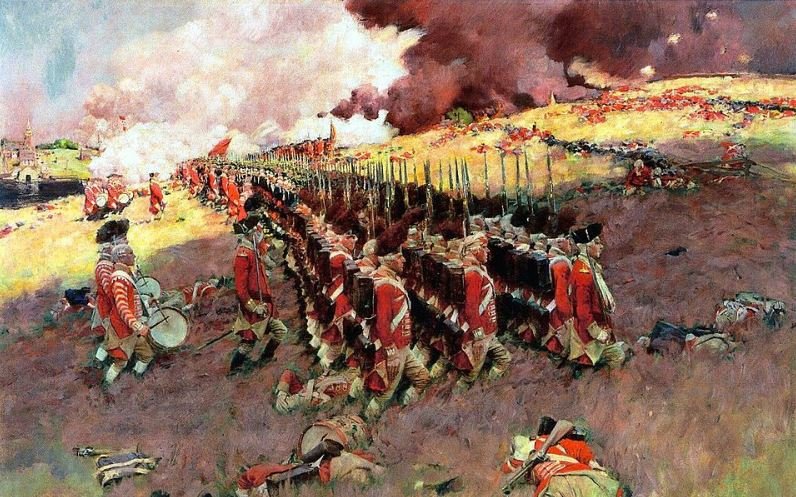
A painting depicting the Battle of Bunker Hill. Artwork by American painter Howard Pyle.
Leadership and Strategy Shift
On July 3, 1775, George Washington assumed command of the Continental Army. Washington arrived at Cambridge, just outside Boston, with the challenge of organizing and molding a diverse array of militia units into a cohesive fighting force. The Continental Army was composed of various militia units, many of which had little experience with formal military discipline. Washington’s first task was to instill order and discipline, which was necessary for effective operations during the siege.
The fortification of Dorchester Heights and the arrival of artillery from Fort Ticonderoga ultimately forced the British to abandon Boston, a significant early victory for the Continental Army.
Washington’s leadership brought significant changes to the siege strategy. He recognized the importance of the fortification of key positions and directed efforts to improve American defenses, especially those at Dorchester Heights, which overlooked the British position in Boston. Washington also had to contend with challenges such as the lack of sufficient supplies, poor morale, and desertion among the troops. However, his ability to adapt to these challenges and provide a sense of unity and purpose was crucial to the eventual success of the siege.
The Role of Heavy Artillery
One of the most significant turning points during the siege was the arrival of heavy artillery from Fort Ticonderoga in January 1776. The artillery had been captured by the Americans under the leadership of Benedict Arnold and Ethan Allen earlier in 1775. The cannons were transported over difficult terrain to reach Cambridge, where Colonel Henry Knox oversaw their arrival. This artillery, once placed on Dorchester Heights, gave the Continental Army a significant advantage, as it threatened to cut off the British supply lines from the sea.
The British had long relied on their naval superiority to maintain their position in Boston. However, with the American cannons now in position on Dorchester Heights, the British faced the prospect of being unable to resupply their forces. The British, under General Howe, realized that their position in Boston was untenable and that an evacuation was imminent.

The Final Stages of the Siege
By March 1776, the situation for the British forces had become dire. The American artillery at Dorchester Heights began bombarding British positions in Boston, and the British forces responded with their own cannon fire. Despite the British efforts to hold their ground, it was clear that the American forces now had the advantage, particularly with their artillery threatening the British fleet in the harbor.
In early March 1776, a severe snowstorm struck, and the British were forced to reconsider their position. On March 17, General Howe ordered the evacuation of Boston. The British forces, along with Loyalists who had remained in the city, were evacuated by sea to Halifax, Nova Scotia. The American forces did not interfere with the British departure, allowing them to leave without further conflict. This marked the end of the Siege of Boston.
The heroic display of the Continental Army during the Siege of Boston demonstrated that the British, despite their superior military training and resources, could be effectively challenged by the growing American resistance.
Aftermath of the Siege
The American victory at the Siege of Boston was a significant early success in the Revolutionary War. It demonstrated that the Continental Army, under Washington’s leadership, could successfully challenge the British Army. The British withdrawal from Boston also provided the Americans with an important morale boost and established Washington as a capable and respected military leader.
The British evacuation of Boston did not mark the end of the conflict, however. The British soon shifted their focus to other regions, particularly New York and the southern colonies. For Washington and the Continental Army, the victory in Boston provided much-needed momentum, but the road to independence was still long and fraught with challenges.

A painting portraying the evacuation of Boston.
Frequently Asked Questions
What was the Siege of Boston?
The Siege of Boston was the first major military engagement of the American Revolutionary War, where American Patriot forces surrounded the British Army in Boston from April 19, 1775, to March 17, 1776, preventing them from moving by land.
What sparked the Siege of Boston?
The siege began after the Battles of Lexington and Concord on April 19, 1775, when the Massachusetts militias blocked the British Army’s access to the city, and the Continental Congress formed the Continental Army.
What was the significance of Bunker Hill?
In June 1775, the British seized Bunker Hill and Breed’s Hill after a bloody battle, but their heavy casualties and limited gains demonstrated the strength of the Continental Army and did not break the siege.
How did the Continental Army fortify their position during the siege?
The Continental Army strengthened defenses around Boston, including strategic hills and the Dorchester Heights, which later threatened British supply lines and forced them to evacuate.
What role did George Washington play in the siege?
After taking command of the Continental Army in July 1775, George Washington organized and disciplined the militias, strengthened defenses, and coordinated efforts to blockade the British while preparing for further action.
How did the Americans acquire heavy artillery for the siege?
In late 1775, Henry Knox led an operation to bring cannons from Fort Ticonderoga to Cambridge, which were used to fortify Dorchester Heights and threaten British supply routes.

What led to the British evacuation of Boston?
The British evacuation occurred after the Americans fortified Dorchester Heights in March 1776, positioning artillery that could destroy the British fleet in the harbor, making the British position untenable.
What was the impact of the Siege of Boston on the Revolutionary War?
The siege ended in an American victory, boosting morale and proving that the Continental Army, under Washington’s leadership, could challenge British forces and forcing the British to reconsider their strategies in North America.





