The Dolmens of Sicily
In the rugged landscape of Sicily, surrounded by the whispers of ancient civilizations and layered histories, lie enigmatic monuments that predate even the classical world that would later dominate the island. These are the dolmens—megalithic tombs crafted from massive stone slabs, whose presence on this Mediterranean island has puzzled archaeologists and historians for centuries.
The dolmens of Sicily are not just isolated prehistoric anomalies; they are windows into a time when human ritual, cosmology, and social organization were profoundly different, and perhaps, far more interconnected across regions than we might assume today.
To understand the dolmens of Sicily is to delve into a mystery that stretches back to the third millennium BCE. These stone structures—silent, weathered, and often remote—hold secrets about the people who built them, their beliefs about death and the afterlife, their networks of migration and exchange, and their knowledge of architecture and the environment. But they also raise questions about identity, cultural influence, and the diffusion of ideas in the ancient world.
Were these dolmens the creation of an indigenous culture, developed independently of continental Europe? Or are they signs of broader megalithic traditions that swept across the Mediterranean from Western Europe or North Africa?
The Nature of Dolmens: Structure and Function
Before we narrow our focus to Sicily, it is helpful to understand what exactly constitutes a dolmen. The term “dolmen” is derived from the Breton words taol (table) and men (stone), roughly translating to “stone table.” In archaeological terms, a dolmen is a type of single-chamber megalithic tomb, typically consisting of two or more vertical megaliths supporting a large, flat horizontal capstone. These monuments were often covered by earth or smaller stones to form a barrow or cairn, though in many cases, the mound has long since eroded away, leaving only the skeletal stone structure.
Dolmens were primarily used for burial, often collective, and may have been the sites of ritual activity. Their orientation, construction methods, and distribution suggest a high degree of symbolic meaning, likely tied to cosmological beliefs, ancestral veneration, or territorial markers. While dolmens are found throughout Europe, the Middle East, and parts of Asia, their appearance in Sicily is rare and seemingly isolated, making their existence there especially intriguing.
The Sicilian Dolmen Landscape
Sicily is home to only a handful of dolmens, yet each is of immense importance. The best-known examples include the dolmens of Cava dei Servi in the Iblei Mountains, Cava Lazzaro in the Ragusa region, and the Dolmen of Avola in southeastern Sicily. Another notable dolmen has been identified at Monte Bubbonia, near Gela in the province of Caltanissetta. These structures vary in size and preservation, but they share key architectural elements with dolmens found elsewhere in Europe and the Mediterranean.
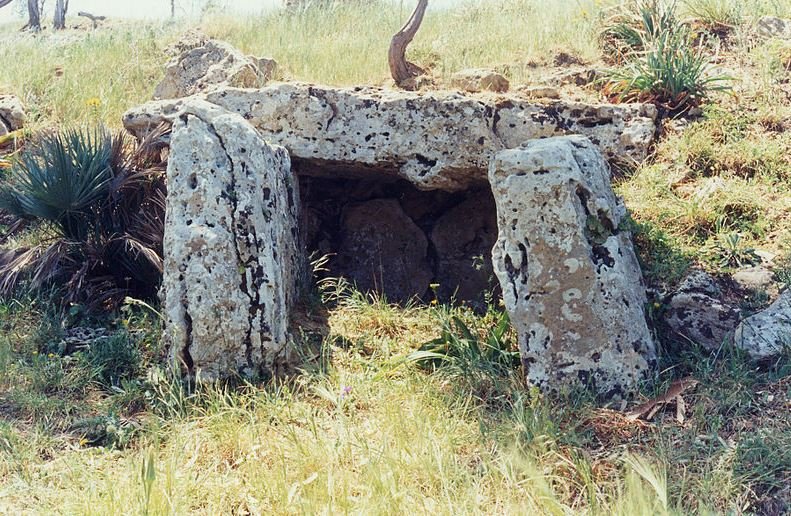
For instance, the Dolmen of Cava dei Servi, discovered in the 1960s, consists of several large orthostats forming a chamber, capped by a massive slab. This dolmen’s orientation suggests an intentional alignment, possibly astronomical, though definitive conclusions remain elusive. The Avola dolmen, uncovered during road construction in the 20th century, was initially dismissed as a natural formation before subsequent studies confirmed its human origin. It too displays a classic trilithon structure—two upright stones supporting a horizontal capstone.
Despite their limited number, the dolmens of Sicily are striking for their similarity to megalithic structures found in regions as far-flung as Brittany, Ireland, and southern Spain. This begs the question: how did such architectural forms arrive in Sicily, and what do they tell us about the island’s prehistoric inhabitants?

Dolmen of Avola
Chronological Context: Dating the Dolmens
Dating dolmens presents a considerable challenge. The lack of organic material and the frequent disturbance of archaeological layers make radiocarbon dating difficult. Nevertheless, scholars generally place Sicilian dolmens in the Late Neolithic to Early Bronze Age, approximately between 3000 and 2000 BCE. This dating aligns with the broader timeline of megalithic activity across the western Mediterranean, particularly the Iberian Peninsula and parts of southern France.
Interestingly, this period in Sicilian prehistory corresponds to the Castelluccio culture, a Bronze Age society known for its distinctive pottery and organized settlement patterns. However, the Castelluccio people are not typically associated with megalithic construction. This discrepancy fuels debate about whether dolmens represent an indigenous innovation, the result of external influence, or the legacy of an earlier, now poorly understood population.
Theories of Origin: Indigenous or Imported?
One of the central debates surrounding Sicilian dolmens concerns their origin. Are these structures the product of indigenous development, emerging organically from local burial practices and architectural experimentation? Or are they the cultural imports of migrating or seafaring peoples from mainland Europe or North Africa?
Proponents of the indigenous theory argue that the dolmens fit within a broader continuum of Sicilian prehistory. They point to native rock-cut tombs, such as those found in Pantalica and the Necropolis of Cava d’Ispica, as evidence of a sophisticated funerary tradition that might naturally have evolved to include megalithic forms. Moreover, the apparent isolation of dolmens in Sicily—without a dense surrounding network as seen in Brittany or Ireland—suggests they may not be part of a massive diffusion wave but rather sporadic local developments.
On the other hand, the diffusionist school of thought posits that megalithic architecture spread from Western Europe through maritime routes across the Mediterranean. According to this theory, the dolmens of Sicily are part of a larger megalithic phenomenon that includes sites in Sardinia, Malta, North Africa, and even the Levant. The presence of dolmens along the North African coast, particularly in Tunisia and Algeria, supports the idea that seafaring communities could have transmitted architectural knowledge to Sicily. The Mediterranean, after all, was not a barrier but a corridor—one that allowed for trade, migration, and cultural exchange long before the rise of classical civilizations.
This theory is further supported by similarities in construction techniques and the symbolic use of large stone across these regions. While the exact nature of these contacts remains speculative, the possibility of a pan-Mediterranean megalithic tradition is tantalizing and suggests a more interconnected prehistoric world than traditionally assumed.
Symbolism and Function: Beyond the Tomb
Though generally assumed to be tombs, dolmens may have served additional or alternative functions. Their size and labor-intensive construction imply a ritual or ceremonial significance, possibly tied to notions of ancestor worship, territorial claims, or even astronomical observations.
The orientation of dolmens has long been a subject of study. In various parts of Europe, dolmens often face toward the rising sun, suggesting a symbolic connection to rebirth or the afterlife. In Sicily, some dolmens appear to be aligned with solar events, though the small sample size makes generalization difficult. The act of constructing these massive stone structures itself may have served as a communal rite, reinforcing social cohesion and collective memory.
It is also worth considering that dolmens might have functioned as liminal spaces, marking boundaries not only in physical territory but also between life and death, the known and the unknown. The tomb-chamber may have symbolized a return to the womb of the earth, a metaphor for rebirth or passage to another realm. This idea resonates with broader Indo-European and Mediterranean symbolic systems that tie stone and burial to cosmological order.
Did you know…?
Sicily’s prehistoric development was influenced by two major cultural streams—one from the European northwest and another from the Mediterranean with Middle Eastern roots.
Archaeological Challenges and Preservation
Despite their historical significance, the dolmens of Sicily have not received the same level of scholarly attention as their European counterparts. Many remain in fragile condition, threatened by natural erosion, vandalism, or the encroachment of modern development. The dolmen of Avola, for instance, was nearly lost during road construction, while others have been misidentified or poorly documented.
This lack of attention is partly due to the fragmentary nature of the archaeological record. Unlike Malta’s massive and richly adorned temples, Sicilian dolmens are relatively modest in scale and sparse in associated artifacts. Moreover, their ambiguous cultural attribution—neither wholly indigenous nor clearly foreign—places them in a kind of interpretive limbo.
Efforts at preservation and public education are slowly gaining momentum. Local heritage organizations and some academic institutions are beginning to include dolmens in broader narratives of Sicilian prehistory. However, more comprehensive surveys, excavations, and comparative studies are urgently needed to protect and understand these sites.
Cultural Significance in a Wider Context
Viewed within the wider cultural landscape of the Mediterranean, Sicilian dolmens underscore the fluidity of prehistoric identities. The simplistic model of isolated cultural development no longer holds up under scrutiny; instead, we are increasingly recognizing the complexity and dynamism of ancient societies. The dolmens may be evidence of shared symbolic languages, common cosmologies, and perhaps even overlapping trade or migration routes.
The dolmens of Sicily challenge us to consider a prehistoric world where ideas, symbols, and structures traveled farther and more fluidly than we often imagine.
Sicily, situated at the crossroads of Europe and Africa, has always been a melting pot of civilizations. The dolmens serve as early markers of this role, long before the arrival of Phoenicians, Greeks, and Romans. They testify to the island’s participation in ancient patterns of movement and meaning-making, reminding us that even in the depths of prehistory, human beings were building connections across vast spaces.
In this light, the dolmens of Sicily are more than stone relics—they are monuments of memory and movement, clues to a world in which the boundaries we take for granted today were far more porous. Their mystery lies not only in their origins but in what they reveal about humanity’s ancient and enduring impulse to shape the landscape with stone, to mark time with architecture, and to bind communities through shared acts of remembrance.

Questions and Answers
Where are dolmens found in Sicily?
Dolmens have been discovered both inland and along the coasts of Sicily, showing a widespread yet modest distribution across the island.
What is the typical structure of a Sicilian dolmen?
A typical Sicilian dolmen consists of two or more upright stones supporting a flat horizontal capstone, forming a chamber usually intended for burial.
What evidence confirms the use of dolmens as tombs in Sicily?
The dolmen at Cava dei Servi provided archaeological evidence such as human remains and pottery, confirming its use as a funerary structure.
How did geological conditions affect dolmen construction in Sicily?
Sicily’s harder stone types made construction more challenging compared to regions with softer rock, but builders adapted, resulting in at least five known dolmens.
How do Sicilian dolmens compare with those in other Mediterranean regions?
While smaller, Sicilian dolmens share architectural features with those found in the Balearic Islands, Sardinia, Apulia, and Malta, suggesting shared cultural practices.
What is significant about the dolmen at Monte Bubbonia?
Located near Gela on a 595-meter hill, the Monte Bubbonia dolmen features a rectangular chamber and northeast-facing entrance, possibly indicating ritual or astronomical importance.
Dolmen of Monte Bubbonia.
What sets the Cava dei Servi dolmen apart?
It features a unique false dome formed by slanted stones, and contained both bone fragments and Castelluccian pottery, confirming its Bronze Age origin and burial function.
How was the dolmen at Avola initially interpreted?
It was once thought to be a natural rock formation, but signs of human shaping suggest it was deliberately monumentalized, now considered a “pseudo-dolmen.”
What features of the Avola dolmen suggest human intervention?
Incisions, grooves, and the geometric shaping of the stone imply that natural features were enhanced for symbolic or ritual purposes.
What broader cultural pattern does the spread of dolmens in Sicily suggest?
Their distribution indicates Sicily’s role in prehistoric cultural exchange networks across the western and eastern Mediterranean.
What impact did the Bell Beaker culture have on Sicily?
Around 2550 BCE, the Bell Beaker culture arrived from Sardinia, introducing new ideas and helping establish Sicily as a trading hub with broader Mediterranean connections.
What does Sicily’s geography reveal about its role in prehistory?
Its central location made Sicily a vital point of contact and exchange between Europe, North Africa, and the eastern Mediterranean.
How is Malta connected to Sicily in megalithic traditions?
Malta’s Tarxien culture likely shared funerary practices with Sicily, and the presence of dolmens in both regions points to mutual cultural influence.
The Tarxien civilization may have collapsed due to a plague, after which a new population—possibly from Apulia—introduced simpler dolmenic forms.
What does the appearance of dolmens in both Malta and Sicily imply?
It suggests a broader network of prehistoric interaction and the transmission of architectural and ritual traditions across the central Mediterranean.