Regions that are considered the cradles of civilization
The concept of the “cradle of civilization” refers to regions in the world where human societies transitioned from a nomadic, hunter-gatherer lifestyle to settled, urbanized, and complex societies that laid the foundation for the modern world. This transition was marked by the development of agriculture, urbanization, written communication, and social hierarchies, which formed the backbone of early civilizations.
While civilizations developed independently across the globe, certain regions are widely acknowledged as the primary cradles of civilization due to their early and influential contributions to human development. These regions include Mesopotamia, Ancient Egypt, the Indus Valley, Ancient China, Mesoamerica, and the Andean region. Each of these areas fostered distinct cultures and innovations that shaped the course of human history.
In this exploration, World History Edu will discuss these six cradles of civilization, highlighting their unique contributions, geographical settings, and historical importance.
Mesopotamia: The Fertile Crescent and the Dawn of Civilization
Mesopotamia, often called the “Cradle of Civilization,” is located in the region between the Tigris and Euphrates Rivers, in present-day Iraq and parts of Syria, Turkey, and Iran. The name “Mesopotamia” literally means “between rivers,” signifying its unique geographical location that facilitated early agricultural development. The fertile soil of the region, created by the regular flooding of the Tigris and Euphrates, made it possible for the Sumerians, Akkadians, Babylonians, and Assyrians to cultivate crops and build stable societies.

A 1932 phot of the ruins of Babylon.
READ ALSO: The Sumerian mathematical system and its significance
Early Settlements and the Rise of Sumer
The earliest signs of civilization in Mesopotamia can be traced back to around 12,000 BCE, when the Natufian culture in the Levant began to transition from a hunter-gatherer lifestyle to a more sedentary, agricultural one. This trend spread to Mesopotamia by around 10,000 BCE, leading to the establishment of Neolithic settlements. By 5000 BCE, the region was home to advanced agricultural societies, with the Sumerians emerging as the dominant group by around 3500 BCE.
The Sumerians are credited with the development of one of the first true urban civilizations. They built impressive city-states like Ur, Uruk, and Eridu, which were characterized by large urban populations, monumental architecture, and advanced infrastructure. Sumerians also pioneered several key innovations, including the creation of the first known system of writing—cuneiform. Cuneiform was initially used for record-keeping and administrative purposes, allowing for the creation of written laws, economic transactions, and historical records.
READ ALSO: Conditions that gave rise to Mesopotamian cities
The Rise of Empires and Cultural Achievements
Over time, Mesopotamian civilization expanded beyond the Sumerians to include the Akkadians, Babylonians, and Assyrians, each of whom made significant contributions to the development of civilization. The Akkadians, led by Sargon the Great, were the first to establish an empire in 2334 BCE, unifying the region under one rule. The Babylonians, under King Hammurabi, created one of the earliest known legal codes, the Code of Hammurabi, which influenced legal systems for centuries. The Assyrians, known for their military prowess, built one of the first professional armies and established a vast empire that stretched from Mesopotamia to Egypt.
Mesopotamia also saw advances in science, mathematics, and astronomy. The Babylonians made important contributions to mathematics, developing a sexagesimal (base-60) number system that is still used today in measuring time and angles. The region’s astronomers were able to chart the movements of celestial bodies, leading to the development of an early calendar system. Additionally, the construction of ziggurats—massive stepped pyramids—demonstrated the Mesopotamians’ expertise in engineering and religious architecture.
Why Agriculture is generally considered the most important development in early human history
Ancient Egypt: The Nile and the Power of the Pharaohs

The Giza Plateau in Cairo, with Khafre’s pyramid in the background.
Ancient Egypt, another foundational cradle of civilization, developed along the banks of the Nile River in northeastern Africa. The Nile provided the Egyptians with a stable and predictable source of water, which allowed them to develop an advanced agricultural society. The annual flooding of the Nile deposited nutrient-rich silt on the land, making it ideal for farming and facilitating the growth of large populations.
The Unification of Egypt
Egyptian civilization is traditionally thought to have begun around 3100 BCE with the unification of Upper and Lower Egypt under the rule of King Narmer (also known as Menes). This unification marked the beginning of the Early Dynastic Period and the establishment of the Pharaoh as the divine ruler of Egypt. Over the centuries, Egypt became a powerful and centralized state, with a strong bureaucracy and an organized economy based on agriculture and trade.
Understanding the rise and achievements of early civilizations like ancient Egypt provides valuable insights into the roots of human culture and progress.
Achievements in Architecture, Religion, and Writing
One of Egypt’s most significant contributions to world history was its architectural achievements, particularly the construction of the pyramids. The Pyramids of Giza, built during the Old Kingdom (c. 2686–2181 BCE), are among the most recognizable symbols of ancient Egyptian civilization. These massive structures were built as tombs for the pharaohs and were designed to ensure their safe passage to the afterlife.
The Egyptians also developed a complex religious system centered around polytheism, with gods and goddesses representing various aspects of nature and society. The concept of the afterlife was central to Egyptian religion, and the belief in an eternal soul led to the practice of mummification, which preserved the bodies of the deceased for the journey to the next world.
In addition to their architectural and religious achievements, the Egyptians are known for their advancements in writing. Hieroglyphics, the system of writing used by the Egyptians, was employed for religious texts, royal decrees, and monumental inscriptions. The development of papyrus, a plant-based writing material, enabled the Egyptians to create scrolls and preserve their writings for future generations.
The Decline of Egypt and its Influence on Later Cultures
The power of ancient Egypt declined over time, particularly after the New Kingdom (c. 1550–1070 BCE), which saw the rise and fall of various pharaohs and foreign invasions. Despite this decline, the cultural and technological achievements of Egypt influenced many neighboring civilizations, particularly in the Mediterranean and the Near East. Greek and Roman scholars, for example, drew heavily on Egyptian knowledge of mathematics, engineering, and medicine.
The Indus Valley Civilization: A Forgotten Cradle
The Indus Valley Civilization, also known as the Harappan Civilization, was one of the earliest urban cultures in South Asia. It flourished around 3300 BCE to 1300 BCE in the Indus River Valley, which stretches across modern-day Pakistan and northwest India. The civilization is notable for its well-planned cities, advanced drainage systems, and impressive architecture.

Dholavira, located in Gujarat, India, was one of the major cities of the Indus Valley Civilization.
Urban Planning and Infrastructure
The Indus Valley Civilization is unique in that its cities, such as Harappa, Mohenjo-Daro, and Dholavira, were meticulously planned with grid-like streets, sophisticated drainage systems, and large public baths. The use of baked bricks in construction and the presence of standardized weights and measures suggest a highly organized society with centralized control.
The people of the Indus Valley engaged in agriculture, primarily growing wheat, barley, and cotton, and they were known for their trade networks, which extended as far as Mesopotamia and Central Asia. Evidence of this trade is found in the form of seals, pottery, and other artifacts.
The Decline and Mystery of the Indus Valley Civilization
Despite its advanced urban planning and thriving trade networks, the Indus Valley Civilization declined around 1900 BCE. The reasons for this decline remain a mystery, though theories include environmental factors, such as a shift in the course of the Indus River or a drying up of the region’s monsoon rains, as well as internal social and political unrest. The civilization’s decline marked the end of a significant chapter in South Asian history, and much of the Indus Valley’s written script remains undeciphered.
Despite its decline, the legacy of the Indus Valley Civilization can be seen in the development of later South Asian cultures, including the Vedic civilization that emerged after the collapse of the Indus Valley.
Ancient China: The Beginning of Chinese Civilization
Ancient China, one of the longest continuous civilizations in history, developed along the Yellow River (Huang He) in northern China. The region’s fertile soil, enriched by the river’s periodic flooding, allowed for the growth of early agricultural societies.

A bronze water vessel of the Shang dynasty.
The Rise of Dynasties and the Development of Writing
Chinese civilization can be traced back to the Shang Dynasty (c. 1600–1046 BCE), the first Chinese dynasty for which there is both archaeological and written evidence. The Shang Dynasty is known for its advances in bronze metallurgy, the development of writing, and the establishment of a centralized state. The earliest known Chinese writing, the oracle bone script, was used for divination and record-keeping during the Shang period.
Following the Shang, the Zhou Dynasty (c. 1046–256 BCE) established the “Mandate of Heaven,” a concept that would shape Chinese political philosophy for millennia. The Zhou introduced feudalism and expanded China’s territory, setting the stage for the later Qin and Han dynasties.
Philosophical and Technological Contributions
China’s contributions to civilization extended beyond politics and writing. Philosophical traditions such as Confucianism and Daoism emerged during the Eastern Zhou period, profoundly influencing Chinese society and governance. Additionally, ancient Chinese innovations in technology, including papermaking, printing, gunpowder, and the compass, would have a lasting impact on global history.

Mesoamerica: The Olmec and the Rise of Complex Societies
Mesoamerica, the region that includes present-day Mexico, Guatemala, and parts of Central America, is home to some of the earliest and most advanced civilizations in the Americas. The Olmec civilization, which flourished from around 1600 BCE to 400 BCE, is considered the “mother culture” of Mesoamerica, laying the foundation for later societies such as the Maya, Zapotec, and Aztec.
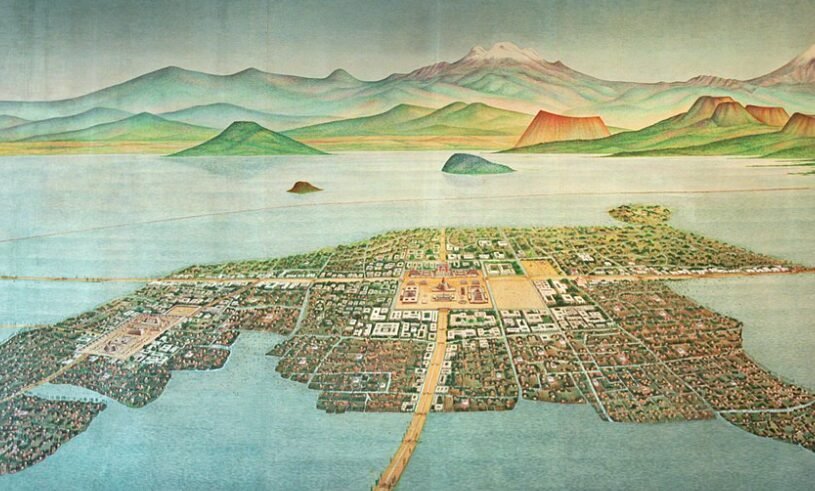
A painting depicting Tenochtitlan and Lake Texcoco.
The Olmec Civilization
The Olmec are best known for their colossal stone heads, which likely represented rulers or important figures. These heads, along with other Olmec artwork and artifacts, demonstrate the civilization’s advanced artistic and engineering skills. The Olmec also developed early forms of writing and a calendar system, which influenced subsequent Mesoamerican cultures.
The Olmec civilization thrived in the Gulf Coast region of Mexico, and their trade networks extended as far as Central America. They were also pioneers in the development of complex social hierarchies and political systems.
The Maya and Aztec Civilizations
Building upon the Olmec legacy, the Maya and Aztec civilizations emerged as some of the most sophisticated societies in Mesoamerica. The Maya, known for their advanced knowledge of astronomy, mathematics, and writing, developed the only known fully developed written language in pre-Columbian America. The Aztecs, on the other hand, created an expansive empire in central Mexico, with impressive architectural achievements, including the construction of Tenochtitlán, their capital city, which featured massive temples and plazas.
The Andes: The Caral-Supe Civilization
In South America, the Caral-Supe civilization, which flourished between 3000 BCE and 1800 BCE, is considered the earliest known civilization in the Andes. Located along the Pacific coast of modern-day Peru, Caral-Supe is distinguished by its large urban centers, monumental architecture, and a unique social structure.

The ruins of Caral’s two main pyramids stand in the dry Supe Valley.
Urban Development and Architecture
The Caral-Supe civilization developed along the Supe River and was centered in the city of Caral, which features large platform mounds and sunken plazas. Unlike other early civilizations, Caral-Supe did not rely on ceramics and appears to have focused on agricultural production and maritime resources. The civilization’s advanced architecture and urban planning suggest a highly organized society, capable of mobilizing large labor forces to construct monumental structures.
Decline and Legacy
The Caral-Supe civilization eventually declined around 1800 BCE, possibly due to environmental changes such as shifts in climate or the depletion of resources. However, the legacy of Caral-Supe is seen in later Andean cultures, particularly the Inca, who developed a highly organized society based on agriculture, trade, and monumental architecture.
Frequently Asked Questions
What is a cradle of civilization?
A cradle of civilization refers to a location and culture where civilization developed independently, marked by the emergence of complex societies with urbanization, social stratification, and written or symbolic communication systems.
What common feature do all cradles of civilization share?
All of the cradles of civilization relied on agriculture for sustenance, with farming surplus supporting centralized governments, religious leaders, and public works in urban centers.
How is the term “cradle of civilization” used informally?
Informally, the term may refer to later civilizations, such as Greece and Rome, which are often called the “cradle of Western civilization.”
What was the role of agriculture in the rise of civilizations?
Agriculture provided a stable food supply, which allowed people to settle in one place, form cities, and support complex societal structures like governments and religious institutions.

When did the first signs of sedentary culture emerge?
The first signs of sedentary culture appeared around 12,000 BC in the Levant with the Natufian culture, which evolved into an agricultural society by 10,000 BC.
What is the Neolithic Revolution and why is it significant?
The Neolithic Revolution, starting around 10,000 BC, marks the transition from nomadic hunting and gathering to settled farming communities, which is crucial for the development of civilization.
What were some of the earliest proto-urban settlements?
Early proto-urban settlements, such as Uruk and Eridu in Mesopotamia, emerged by 3100 BC, marking the beginning of urbanization.
When did writing systems develop in early civilizations?
Writing systems began to develop around 3300 BC in the Near Eastern Chalcolithic period and evolved in other regions, such as the Indus Valley and Mesoamerica, by 900 BC.
What is the concept of “civilized” life based on?
The concept of “civilized” life is linked to intensive agriculture, urbanization, social stratification, and the development of formal institutions and material culture.
Why are Mesopotamia and Egypt considered the earliest cradles of civilization?
Mesopotamia and Egypt are among the earliest cradles of civilization because they developed urban centers, writing systems, and complex social structures starting from the 4th millennium BC.
What was the significance of the Fertile Crescent in the rise of civilizations?
The Fertile Crescent is considered the oldest cradle of civilization due to its fertile land, which allowed for the rise of agriculture and early Neolithic cultures, such as Jericho and Çatalhöyük.
How did the Indus Valley Civilization contribute to early urbanization?
The Indus Valley Civilization, with its well-planned cities like Mohenjo-daro, demonstrated advanced urban planning, including sanitation systems and trade networks, marking a key development in urbanization.
What was the role of the Olmec civilization in Mesoamerica?
The Olmec civilization, considered the first Mesoamerican civilization, laid the foundations for future cultures like the Maya and Aztec, influencing their religious practices, art, and social structures.
How does the development of Chinese civilization differ from other cradles?
Chinese civilization, emerging from the Yellow and Yangtze River regions, evolved through several cultures like the Peiligang and Yangshao, eventually leading to the Erlitou culture and the semi-legendary Xia dynasty.





