The Han dynasty: Origin Story, Territorial Extent and Major Accomplishments
The Han Dynasty (202 BC – 220 AD) stands as one of the most influential and enduring periods in Chinese history. Established by Liu Bang, known posthumously as Emperor Gaozu, the Han Dynasty succeeded the short-lived Qin Dynasty and ushered in a golden age that profoundly shaped Chinese culture, politics, and identity.
In the article below, World History Edu explores the Han Dynasty’s origin, territorial expansion, and key accomplishments that solidified its legacy.

Map showing the extent of the Han Dynasty.
Origin Story
The Han Dynasty emerged from the tumultuous period following the collapse of the Qin Dynasty (221–206 BC). After Qin Shi Huang‘s death, widespread rebellion ensued, leading to the Chu–Han Contention (206–202 BC), a power struggle between two primary rivals: Xiang Yu of Chu and Liu Bang of Han.
Despite Xiang Yu’s military prowess, Liu Bang’s strategic acumen and popular support culminated in his decisive victory at the Battle of Gaixia in 202 BC. This victory enabled Liu Bang to proclaim himself Emperor Gaozu, establishing the Han Dynasty and choosing Chang’an (modern-day Xi’an) as its capital.

A depiction of Qin Shi Huang
To stabilize the newly unified empire, Emperor Gaozu implemented measures to centralize authority while appeasing powerful warlords. Initially, the Han territory was divided into thirteen commanderies directly controlled by the central government and ten semi-autonomous kingdoms granted to prominent commanders and relatives. However, recurring insurrections, most notably the Rebellion of the Seven States in 154 BC, prompted Emperor Jing to limit the power of these kingdoms.
By enacting reforms that restricted their ability to appoint officials and centralizing tax collection, the Han government effectively reduced regional autonomy, ensuring greater imperial control and cohesion within the empire.
Territorial Extent of the Han Dynasty
Northern and Western Expansion
One of the Han Dynasty’s most significant endeavors was its military campaigns against the Xiongnu, a formidable nomadic confederation in the eastern Eurasian Steppe. Under Emperor Wu (141–87 BC), the Han initiated aggressive military actions that ultimately subdued the Xiongnu, fragmented their confederation, and secured Han dominance over the Hexi Corridor and the Tarim Basin. This expansion not only secured China’s northern borders but also facilitated the establishment of the Silk Road, enhancing trade and cultural exchanges with Central Asia and beyond.

Remains of a Han dynasty watchtower.
Southern and Eastern Conquests
Emperor Wu also led successful campaigns in the south, annexing Nanyue in 111 BC, which extended Han control over present-day Guangdong, Guangxi, and northern Vietnam. Additionally, Han forces conquered parts of the Korean Peninsula, establishing the Xuantu and Lelang commanderies in 108 BC. These expansions solidified Han influence across diverse regions, integrating various cultures and expanding the empire’s economic and strategic reach.
Protectorate of the Western Regions
From 60 BC onwards, the Han Dynasty established the Protectorate of the Western Regions to oversee the Tarim Basin’s defense and foreign affairs. This strategic move not only secured vital trade routes but also allowed the Han to exert influence over neighboring civilizations, including the Kushan Empire and various oasis city-states. Diplomatic missions, such as those led by Zhang Qian, further expanded Han China’s interactions with distant territories, fostering a cosmopolitan empire interconnected through trade and diplomacy.
Major Accomplishments

Political and Administrative Reforms
The Han Dynasty is renowned for its sophisticated governance structure, which balanced imperial authority with the influence of the nobility and scholarly officials. The emperor held supreme power but relied heavily on a bureaucratic system composed of appointed ministers and local administrators. The division of the empire into commanderies and counties ensured effective governance and tax collection. Additionally, the Han implemented the civil service examination system, promoting meritocracy by selecting officials based on their knowledge of Confucian texts and their administrative abilities.
Economic Prosperity and Innovations
Under the Han Dynasty, China experienced significant economic growth characterized by agricultural advancements, increased trade, and the development of a robust money economy. The standardization of coinage with the introduction of the wuzhu coin in 120 BC facilitated commerce and economic stability, remaining in use until the Tang Dynasty. Emperor Wu’s nationalization of the salt and iron industries in 117 BC aimed to finance military campaigns and consolidate economic control, although these monopolies were later repealed during the Eastern Han period.
Technological innovations flourished during the Han era. The invention of paper by Cai Lun in 105 AD revolutionized record-keeping and literature. Advances in metallurgy led to the production of superior iron tools and weapons, enhancing agricultural productivity and military capabilities. The Han also saw the development of hydraulic-powered armillary spheres for astronomy and the creation of seismometers by Zhang Heng, demonstrating the dynasty’s commitment to scientific progress.
Military Campaigns and Foreign Relations
The Han Dynasty’s military prowess was instrumental in expanding and securing its vast territories. Emperor Wu’s campaigns against the Xiongnu not only neutralized a major threat but also opened up the Silk Road, facilitating trade with the Roman Empire, Parthian Empire, and various Central Asian states. Diplomatic missions, such as Gan Ying’s attempted envoy to Rome in 97 AD, underscored the Han’s interest in establishing long-distance relations, although such missions were often met with logistical challenges.
The establishment of the Xuantu and Lelang commanderies in Korea exemplifies the Han’s strategic military and administrative initiatives to integrate conquered regions into the empire. These efforts extended Han influence into the Korean Peninsula, fostering cultural and economic exchanges that would have lasting impacts on East Asian history.
Cultural Achievements and Confucianism
The Han Dynasty is often credited with solidifying Confucianism as the ideological foundation of Chinese governance and society. Under Emperor Wu, Confucianism was promoted through the establishment of the Imperial University and the endorsement of Confucian scholars. This state-sponsored Confucianism emphasized ethical governance, filial piety, and social harmony, shaping Chinese cultural and political norms for centuries.
Advancements in cartography and the creation of detailed maps underscored the Han Dynasty’s intellectual and artistic accomplishments.
Literature and historical scholarship thrived during the Han era. Sima Qian’s “Records of the Grand Historian” set the standard for historical writing in China, providing a comprehensive account of China’s past. Poetry, particularly the fu genre, flourished, reflecting the era’s cultural richness.
Scientific and Technological Advancements
The Han Dynasty’s contributions to science and technology were profound and multifaceted. In astronomy, the development of the armillary sphere by Zhang Heng allowed for more accurate celestial observations, enhancing the understanding of the cosmos. His invention of the seismometer, capable of detecting distant earthquakes, showcased the dynasty’s innovative spirit and commitment to practical science.
Engineering feats during the Han included the construction of extensive infrastructure such as roads, canals, and the Great Wall‘s expansion. The Han also made significant strides in mechanical engineering, with inventions like the odometer cart, which measured distances traveled, and improvements in waterwheel technology, which powered various industrial processes.
In mathematics, Han scholars made notable advancements, including the use of negative numbers and the development of methods for solving complex equations. The Han’s mathematical innovations were instrumental in fields ranging from astronomy to engineering, demonstrating the dynasty’s intellectual versatility.
READ MORE: Did the Great Wall really guarantee China’s safety?
Establishment of the Silk Road
Perhaps one of the Han Dynasty’s most enduring legacies is the establishment and expansion of the Silk Road, a vast network of trade routes connecting China with the Mediterranean world. Initiated by Zhang Qian’s diplomatic missions, the Silk Road facilitated the exchange of goods, ideas, and cultures between East and West.
Chinese silk, spices, precious metals, and technological innovations traveled westward, while goods such as glassware, gemstones, and various luxury items flowed eastward. This interconnectedness not only boosted the Han economy but also laid the groundwork for centuries of cross-cultural interaction and globalization.

Legacy and Influence
The Han Dynasty’s influence extended well beyond its temporal boundaries, profoundly shaping Chinese civilization. The majority ethnic group in modern China identifies as Han Chinese, and many aspects of Chinese language, culture, and societal structure trace their origins to the Han era. The dynastic model established by the Han became a template for subsequent Chinese empires, emphasizing centralized bureaucracy, Confucian governance, and cultural cohesion.
Moreover, the Han Dynasty’s achievements in governance, economy, culture, and technology set high standards that later dynasties aspired to emulate. The enduring legacy of the Han Dynasty is evident in China’s historical consciousness, where the Han period is often regarded as a pinnacle of Chinese civilization, embodying ideals of unity, prosperity, and cultural sophistication.
Frequently Asked Questions
Who founded the Han Dynasty, and how did it begin?
Liu Bang, later Emperor Gaozu, founded the Han Dynasty after defeating Xiang Yu in the Chu–Han Contention. He established Chang’an as the capital and consolidated the empire.

An illustration depicting Emperor Gaozu of Han.
What were the major divisions of the Han Dynasty?
The Han Dynasty is divided into the Western Han (202 BC – 9 AD) and Eastern Han (25–220 AD), separated by the Xin Dynasty’s usurpation under Wang Mang.
How did Confucianism shape Han governance?
Emperor Wu adopted Confucianism as the state ideology, integrating it into government, education, and moral philosophy, shaping the Han administration and societal norms.
What were the key technological and scientific achievements of the Han Dynasty?
The Han Dynasty saw innovations such as papermaking, the seismometer, the armillary sphere, advanced metallurgy, agricultural tools like the iron plow, and mathematical advancements including the use of negative numbers.
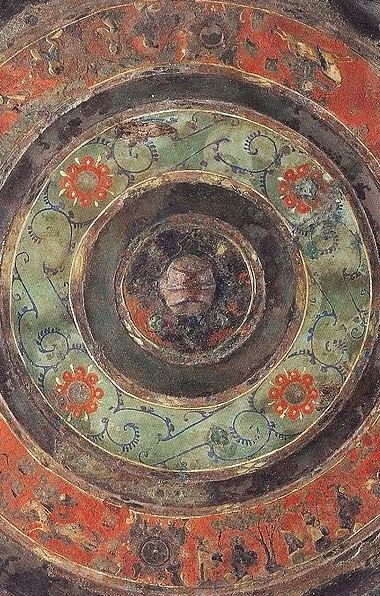
The back side of a Western Han bronze mirror adorned with a painted floral design.
How did the Han Dynasty manage relations with the Xiongnu and other neighboring states?
Initially employing diplomacy, the Han shifted to military campaigns under Emperor Wu, defeating the Xiongnu and expanding influence into Central Asia, facilitating the Silk Road’s establishment.
What internal challenges led to the Han Dynasty’s decline?
Corruption, eunuch influence, power struggles, and widespread rebellions like the Yellow Turban Rebellion weakened the central government, allowing regional warlords to gain power.

Han Dynasty Timeline
202 BC: Liu Bang establishes the Han dynasty after defeating Xiang Yu in the Chu–Han Contention, proclaiming himself Emperor Gaozu. Capital set at Chang’an.
141–87 BC: Emperor Wu reigns, initiating major expansions. Launches campaigns against the Xiongnu, securing the Hexi Corridor and Tarim Basin, facilitating the Silk Road.
111–108 BC: Conquests extend southward by annexing Nanyue and Dian, and into the Korean Peninsula, establishing the Xuantu and Lelang commanderies.
119 BC: Battle of Mobei marks decisive Han victory over the Xiongnu, forcing their submission and fragmentation.
2 AD: First nationwide census records a population of over 57 million, reflecting economic prosperity and population growth.
25 AD: Eastern Han begins under Emperor Guangwu after restoring the dynasty post-Wang Mang’s Xin interruption. Capital moves to Luoyang.
105 AD: Cai Lun invents papermaking, revolutionizing writing and administration.
78–139 AD: Zhang Heng develops the seismometer and armillary sphere, advancing scientific knowledge.
184 AD: Yellow Turban Rebellion erupts, highlighting internal strife but leading to military and administrative reforms.
220 AD: Han dynasty concludes as Cao Pi usurps the throne, initiating the Three Kingdoms period. The Han legacy endures, shaping Chinese identity and culture.
FACT CHECK: At World History Edu, we strive for utmost accuracy and objectivity. But if you come across something that doesn’t look right, don’t hesitate to leave a comment below.





