How Were Elephants Used in Greek & Roman Warfare?
The use of elephants in warfare by Greek and Roman forces represents a fascinating chapter in ancient military history. These majestic animals, often referred to as “war elephants,” were not native to Europe but were imported primarily from India and Africa, where their utility as instruments of war was well-established. Their introduction to the battlefields of Greece and Rome was a result of expanding empires, intercultural exchanges, and the strategic need for psychological and physical advantages in combat.
Origins and Early Use in Warfare
Elephants were first employed in war in ancient India, where they had been a staple of armies since at least the Vedic period (1500-500 BCE). Indian rulers like Chandragupta Maurya and his successors in the Mauryan Empire extensively used elephants as a core component of their military forces. These early examples demonstrated the elephant’s dual capacity for causing physical destruction and instilling fear in enemy ranks.
The use of elephants in Greek and Roman warfare highlights the intersection of practicality, innovation, and cultural exchange in the ancient world.
The Achaemenid Empire of Persia introduced the war elephant to the Near East, employing them during their campaigns in the 6th and 5th centuries BCE. Persian kings such as Darius III utilized elephants in their armies, including in the famous Battle of Gaugamela in 331 BCE, where they faced Alexander the Great.
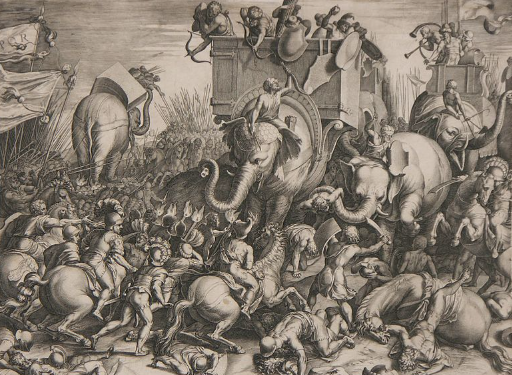
READ MORE: Rulers of the Achaemenid Empire: From Cyrus the Great to Artaxerxes V
Alexander the Great and the Introduction of Elephants to Greek Warfare
Alexander the Great encountered war elephants during his campaigns against the Achaemenid Empire. His first notable encounter was at the Battle of Gaugamela, where the Persians deployed 15 elephants. Although these elephants did not significantly impact the outcome, they piqued Alexander’s interest.
After Alexander’s victory in the Battle of the Hydaspes (326 BCE) against King Porus, he captured a significant number of Indian elephants and incorporated them into his own forces. These elephants became part of his army and served as a demonstration of his openness to adopting and integrating foreign military practices.
Elephants in the Hellenistic Kingdoms
Following Alexander’s death in 323 BCE, his generals (the Diadochi) divided his empire and formed their own kingdoms. War elephants became a symbol of prestige and power among these Hellenistic rulers, particularly the Seleucid Empire and the Ptolemaic Kingdom.
Seleucid Empire
The Seleucids maintained large numbers of Indian elephants, sourced primarily through trade and tribute with Indian kingdoms. Seleucid kings, such as Antiochus III, utilized elephants extensively in their military campaigns. For example, at the Battle of Raphia (217 BCE) against Ptolemaic Egypt, elephants were a central component of the Seleucid army.
Ptolemaic Egypt
The Ptolemies primarily relied on African elephants, sourced from regions like Nubia and modern-day Eritrea. Although smaller and less intimidating than their Indian counterparts, African elephants were still an effective weapon of war. At the Battle of Raphia, the Ptolemies used African elephants against the Seleucid Indian elephants, though the latter proved more formidable.
Other Hellenistic States
The Antigonids of Macedon and the smaller Hellenistic states also incorporated elephants, though to a lesser extent than the Seleucids and Ptolemies. The prestige associated with owning elephants often outweighed their practical utility in some cases.
Elephants in Roman Warfare
The Romans initially encountered war elephants during the Pyrrhic Wars (280–275 BCE) against Pyrrhus of Epirus. Pyrrhus used a contingent of elephants, which he had acquired from the Hellenistic kingdoms, at the Battle of Heraclea (280 BCE) and the Battle of Asculum (279 BCE). These elephants were highly effective against Roman infantry, causing chaos and disrupting their formations.
The Roman response to elephants evolved over time. Initially, they struggled to counter these massive beasts, but through adaptation and ingenuity, they developed methods to neutralize the elephant’s impact. By the time of the Second Punic War (218–201 BCE), the Romans had become adept at countering elephants, particularly during their conflicts with Hannibal.
READ MORE: Answers to Frequently Asked Questions about the Punic Wars
Hannibal and Elephants in the Punic Wars
Hannibal Barca famously used elephants during his campaign against Rome in the Second Punic War. In his audacious crossing of the Alps in 218 BCE, Hannibal brought a small contingent of elephants. While many of the elephants perished in the harsh conditions, the survivors, particularly his favorite elephant Surus, became symbols of Carthaginian resilience.
During the Battle of Zama (202 BCE), Scipio Africanus faced Carthaginian elephants and employed innovative tactics to neutralize them. Roman soldiers created gaps in their ranks to allow the charging elephants to pass through, reducing their impact and rendering them vulnerable to attack.
Tactical Roles of War Elephants
War elephants served several critical roles on the battlefield.
The sheer size and unfamiliarity of elephants struck fear into enemy soldiers and horses. Armies unaccustomed to elephants often panicked, leading to disarray.
Elephants were used as battering rams to break through enemy lines, crush infantry, and disrupt cavalry formations.
Also, elephants carried howdahs (small structures or platforms) on their backs, from which archers and javelin throwers could attack from an elevated position.
Beyond battlefields, elephants were used to transport heavy equipment, supplies, and siege engines, making them invaluable in prolonged campaigns.
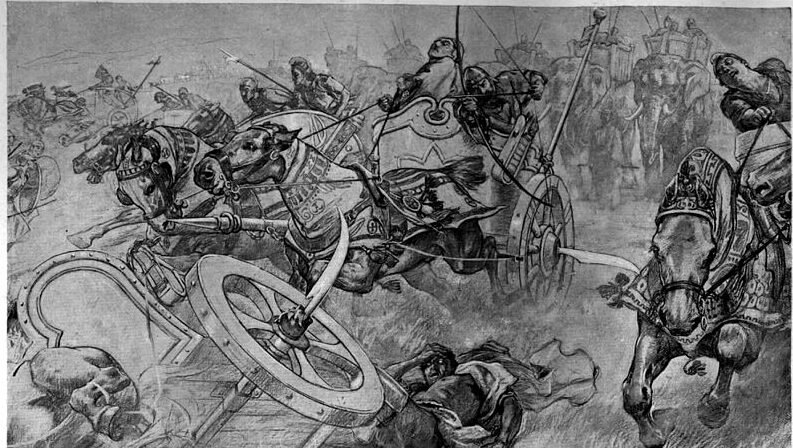
At the Battle of Gaugamela, the Achaemenid army employed Indian war elephants in combat.
Limitations and Countermeasures
While elephants were formidable, they had significant limitations.
First and foremost, elephants required substantial amounts of food and water, making them difficult to sustain during long campaigns. Their upkeep was costly and resource-intensive.
Also, elephants could become uncontrollable when injured or frightened, often causing more harm to their own troops than the enemy.
While war elephants briefly captivated ancient commanders, their logistical challenges and limitations curtailed their effectiveness.
The Romans and other adversaries developed effective countermeasures, such as deploying skirmishers armed with javelins to target elephants or using flaming projectiles to frighten them.
Elephants were not as agile as cavalry or infantry, making them less effective in certain terrains and against well-disciplined opponents.
Decline of Elephants in Roman Warfare
By the time of the late Roman Republic and early Empire, the use of war elephants had significantly declined. Several factors contributed to this:
The Romans relied more on disciplined infantry and cavalry units, which were better suited to the tactics of the time.
The difficulties of maintaining elephants in European climates and terrains discouraged their use.
The rise of heavily armored infantry and cavalry, as well as advancements in siege warfare, rendered elephants less effective.
Despite this decline, elephants occasionally appeared in Roman military campaigns and public spectacles. They were often used in triumphal processions and gladiatorial games, serving as symbols of imperial power and exoticism rather than practical military assets.
Cultural and Symbolic Significance
Elephants were not just tools of war; they held immense cultural and symbolic value in both Greek and Roman societies. They represented wealth, power, and dominion over foreign lands. Their presence in armies or royal courts signified the prestige of their owners.
In art and literature, elephants were often depicted as exotic and awe-inspiring creatures. They appeared in mosaics, coins, and sculptures, reflecting their status as symbols of imperial might.
READ MORE: How and when did Rome conquer Greece?
Questions and Answers

What motivated ancient armies to use elephants in warfare?
Ancient armies of Greece, Carthage, and occasionally Rome used elephants as awe-inspiring and destructive weapons. Their massive size and exotic nature struck terror in unprepared enemies, making them seem like the ultimate weapon in an era with limited technological innovation.
What species of elephants were known in antiquity?
The two recognized species were the Asian elephant (Elephas maximus) and the African forest elephant (Loxodonta cyclotis). The African forest elephant was smaller than the savannah elephant (Loxodonta africana), which ancient writers were unaware of.
When did Asian elephants become known in Europe?
Asian elephants became known in Europe after Alexander the Great’s campaigns in the 4th century BCE, particularly following his encounters with the Mauryan Empire of India.
How did Alexander the Great use elephants in his army?
After witnessing the war elephants of King Porus at the Battle of Hydaspes in 326 BCE, Alexander formed his own ceremonial elephant corps. His successors expanded this tradition by deploying elephants on battlefields.
What challenges were associated with acquiring and using elephants in warfare?
Elephants were expensive to acquire, required extensive training for both the animals and their riders, and posed significant logistical challenges for transportation and upkeep.
How did Hannibal utilize elephants during the Second Punic War?
Hannibal famously transported 37 elephants across the Alps into Italy in 218 BCE, a remarkable logistical feat. He used them effectively in battles such as Trebia and at the Siege of Capua.
How did Seleukos I Nikator acquire elephants for his army?
In 305 BCE, Seleukos I Nikator traded parts of his eastern empire for around 500 elephants from the Indian emperor Chandragupta.
What notable battles featured elephants in the armies of the Hellenistic kingdoms?
The Battle of Ipsus in 301 BCE involved over 470 elephants, and in 275 BCE, Antigonus Gonatas used 16 elephants to rout a larger Gallic force in the “Elephant Victory.”
Who first introduced elephants to European warfare, and what were the outcomes?
Pyrrhus of Epirus introduced elephants to European warfare during his campaigns in Italy and Sicily (280–275 BCE), achieving victories against Rome at the battles of Heraclea and Asculum.
How did the Carthaginians employ elephants in warfare?
The Carthaginians formed an elephant corps in the 260s BCE, using African elephants from the Atlas forest region effectively in the Punic Wars, notably at Trebia and Capua.
How did Romans initially respond to war elephants?
Romans viewed elephants as a novelty and were unimpressed with their military utility. They used unconventional methods, such as releasing pigs to frighten elephants at the Battle of Maleventum (275 BCE).
How did Scipio Africanus counter elephants at the Battle of Zama?
Scipio created gaps in his lines to let Hannibal’s 80 elephants pass harmlessly through and then redirected them into Hannibal’s own ranks, causing chaos.
What were the main features of elephant armor and battlefield strategies?
Elephants were equipped with armor for their heads and sides, tusks fitted with blades, and bells to amplify their psychological impact. Mahouts controlled them with hooked sticks, and larger elephants carried towers (howdahs) housing soldiers.
What tactics did opponents use to neutralize elephants?
Opponents trained horses to withstand elephants, used artillery to target them, dug pits to trap them, and aimed for their vulnerable legs. If elephants became uncontrollable, mahouts killed them with a metal spike to the brain.
Why did the use of elephants in warfare decline?
Elephants became less effective as Roman mobility, advanced siege tactics, and artillery evolved. Logistical challenges and the ability of enemies to counter elephants further reduced their battlefield utility.
What roles did elephants serve after their decline in warfare?
Elephants were used in ceremonial roles, such as public spectacles and diplomatic gifts, and became symbols of power in arenas and processions. This demand contributed to the near extinction of the North African forest elephant.