Thutmose I: The third pharaoh of the 18th Dynasty of Egypt
Pharaoh Thutmose I stands as one of the pivotal figures in ancient Egyptian history, marking a period of remarkable military expansion, architectural innovation, and cultural flourishing during the 18th Dynasty.
Reigning approximately from 1506 to 1493 BC—though some scholars propose earlier dates based on differing chronological interpretations—Thutmose I’s leadership significantly extended Egypt’s influence and set foundational precedents for subsequent pharaohs.
His life, reign, and accomplishments reflect a blend of military prowess, strategic governance, and visionary building projects that together elevated Egypt’s status as a formidable ancient superpower.

King Thutmose the First built many temples in Egypt and was the first pharaoh confirmed to have built a tomb in the Valley of the Kings; Amenhotep I may have preceded him. Image: A stone head, most likely depicting Thutmose I, at the British Museum
Early Life and Familial Background
The exact details of Thutmose I’s early life and lineage remain somewhat enigmatic due to the limited and sometimes ambiguous historical records from that era.
It is speculated that his father was Amenhotep I, the preceding pharaoh, but definitive evidence confirming this connection is lacking. Thutmose’s mother, Senseneb, was of non-royal origin, which was not uncommon in the royal harems where pharaohs often took multiple wives and concubines from various backgrounds. Senseneb’s non-royal status may have influenced Thutmose’s need to legitimize his claim to the throne through strategic marital alliances.
Thutmose I married Queen Ahmose, who held the esteemed title of Great Royal Wife. She was possibly the daughter of Ahmose I and the sister of Amenhotep I, although she was never explicitly referred to as a “king’s daughter” in surviving inscriptions, leaving some uncertainty about her exact relationship within the royal family. This marriage likely served to strengthen Thutmose’s legitimacy as pharaoh by aligning him with the established royal lineage of the 18th Dynasty.
Children and Succession Dynamics
With Queen Ahmose, Thutmose I had several children who played crucial roles in the royal succession and the future of Egypt. Their sons included Amenmose and Wadjmose, both of whom predeceased their father. Amenmose held the prominent title of “Great Army Commander of his Father,” indicating his importance within the military hierarchy and his potential as an heir. Wadjmose’s life is less documented, but his death before Thutmose I further complicated the line of succession.
Thutmose I and Queen Ahmose also had two daughters: Hatshepsut and Nefrubity. Nefrubity died in infancy, leaving Hatshepsut as the surviving daughter. Hatshepsut would later ascend to the throne, becoming one of Egypt’s most renowned and successful pharaohs. Her reign is notable for its prosperity, extensive building projects, and the establishment of trade networks.
In addition to his children with Queen Ahmose, Thutmose I had a son named Thutmose II with another wife, Mutnofret. Mutnofret was likely connected to the royal family, possibly as a sister of Amenhotep I, which would have further solidified Thutmose I’s familial ties to the established dynasty.
To secure the succession and maintain the purity of the royal bloodline, Thutmose I arranged the marriage of his daughter Hatshepsut to Thutmose II. This union was a strategic move to reinforce the legitimacy of his lineage and ensure a smooth transition of power.
Ascension to the Throne and Legitimacy
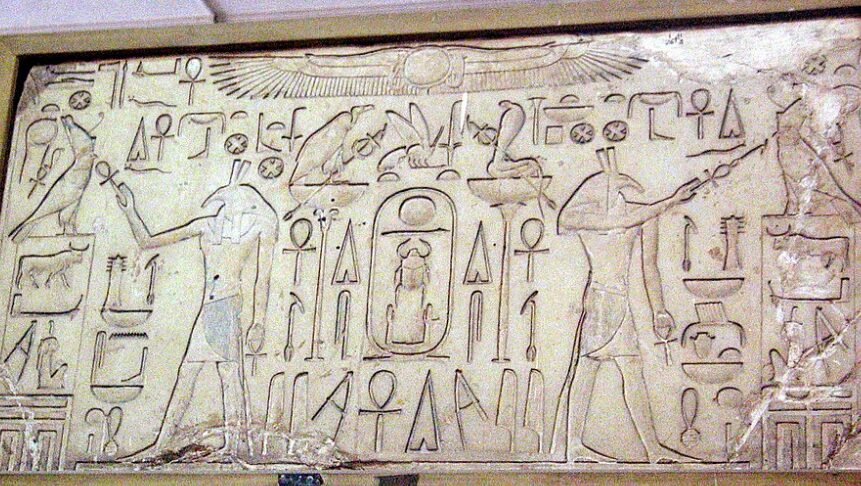
Stela of Thutmose I in the Cairo Museum
Thutmose I’s rise to the throne may have involved navigating complex court politics and issues of legitimacy, especially given his mother’s non-royal status.
By marrying Queen Ahmose and aligning himself with the royal lineage, he bolstered his claim to kingship. The early deaths of his sons Amenmose and Wadjmose removed immediate rivals or alternative heirs, but also meant that the succession would depend on his arrangements with Thutmose II and Hatshepsut.
Thutmose I was the third pharaoh of Egypt’s 18th Dynasty, a period known for military expansion, architectural innovation, and cultural development.
Hatshepsut later claimed that her father had intended for her to rule jointly with Thutmose II, presenting this assertion through inscriptions and monuments. Historians generally interpret this claim as part of Hatshepsut’s political strategy to legitimize her unprecedented assumption of pharaonic power as a female ruler. Regardless of the veracity of her statements, these familial dynamics played a significant role in shaping the future of the 18th Dynasty.
Military Campaigns and Expansion
Upon ascending the throne, Thutmose I faced immediate military challenges that tested his leadership and set the tone for his reign. Nubia, located to the south of Egypt, rebelled against Egyptian control, seeking to assert its independence. Nubia was of immense strategic and economic importance due to its rich resources, including gold mines and valuable trade routes connecting central Africa with Egypt and the Mediterranean world.
Thutmose I personally led a military expedition to suppress the Nubian rebellion. According to the tomb autobiography of Ahmose, son of Ebana—a soldier who served under several pharaohs—Thutmose I confronted the Nubian forces directly. He is said to have killed the Nubian king in battle, an act that symbolized the crushing of the rebellion and served as a powerful demonstration of Egyptian might.
Displaying the Nubian king’s body on the prow of his ship as he sailed back to Thebes was a calculated gesture intended to deter further insurrection and to communicate his victory to both Egyptians and potential adversaries.
In his third regnal year, Thutmose I embarked on a second expedition into Nubia to consolidate his earlier successes and further extend Egypt’s southern boundaries. Recognizing the logistical challenges of navigating the Nile’s cataracts, he ordered the dredging of a canal at the first cataract—a project initially undertaken during the 12th Dynasty under Sesostris III. By improving this canal, Thutmose I facilitated easier movement of troops and goods upstream, enhancing military efficiency and economic integration.
Thutmose I’s campaigns pushed the Egyptian frontier deeper into Nubia than ever before. He established a fortress at Tombos near the third cataract, solidifying Egyptian presence and control in the region. This fortress served as a strategic military outpost and a center for administration, helping to integrate Nubia more fully into the Egyptian empire. These actions not only secured valuable resources but also opened up new opportunities for trade and cultural exchange.
Campaigns in the Levant and Syria
Beyond Nubia, Thutmose I directed his military ambitions toward the northeast, into the Levant and Syria. These regions were significant for their strategic locations and for controlling trade routes that connected Egypt with the Near East and beyond. Thutmose I’s campaigns in these areas represented a bold expansion of Egyptian influence and set precedents for future pharaohs.
He is believed to have crossed the Euphrates River, marking the first time an Egyptian pharaoh had penetrated so far into Mesopotamia. Although the stela commemorating this achievement has not been found in modern times, ancient records suggest that he established markers to assert Egyptian presence and to proclaim his victories. Crossing the Euphrates was a remarkable feat that demonstrated Egypt’s growing power and ambition.
Thutmose I’s reign marked a turning point in Egypt’s history through territorial expansion and consolidation of power.
During his campaigns, Thutmose I subdued local princes who, facing the might of the Egyptian army, declared their allegiance to him. However, recognizing the transient nature of such loyalty secured through force, these princes fortified their cities after his departure to prepare for potential future conflicts. This pattern highlighted the challenges of maintaining long-term control over distant territories.
Thutmose I celebrated his military successes with activities that reinforced his royal image and connected him to traditional symbols of power. Notably, he conducted an elephant hunt near Niy, close to present-day Apamea in Syria. Hunting large and formidable animals like elephants was a royal prerogative that symbolized dominance over nature and served as a metaphor for the king’s ability to conquer formidable adversaries.
An interesting observation from Thutmose I’s campaigns was the Egyptians’ encounter with the Euphrates River’s directional flow. Unlike the Nile, which flows from south to north, the Euphrates flows from north to south. This reversal led the Egyptians to refer to the Euphrates as the “inverted water,” reflecting their worldview centered around the Nile’s familiar patterns.
Impact of Military Campaigns
Thutmose I’s military campaigns significantly expanded Egypt’s territory and influence. By pushing the borders farther than any of his predecessors, he established Egypt as a dominant regional power. The control of Nubia secured access to precious resources and trade routes, bolstering the economy. In the Levant and Syria, although maintaining direct control proved challenging, his campaigns asserted Egyptian presence and opened avenues for trade and diplomatic relations.
These expansions laid the groundwork for Egypt’s imperial zenith under later pharaohs, such as Thutmose III and Amenhotep III. The military successes enhanced the pharaoh’s prestige, both domestically and abroad, and reinforced the image of the pharaoh as a warrior king, a protector of Egypt, and a ruler favored by the gods.
Architectural Achievements
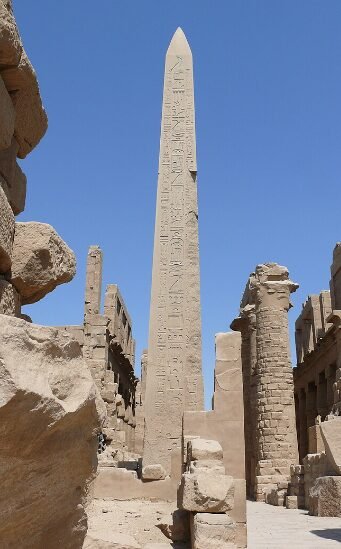
Thutmose I reigned approximately from 1506 to 1493 BC. However, some scholars propose an earlier dating of 1526 to 1513 BC based on different interpretations of astronomical observations in ancient Egyptian chronology. Image: Court of the 4th pylon – obelisk of Thutmose I at Karnak
Thutmose I was not only a warrior but also a patron of monumental architecture. His reign saw significant building projects that contributed to religious life, demonstrated royal power, and showcased advances in engineering and artistic expression.
At the Temple of Karnak in Thebes, one of the most important religious sites in Egypt dedicated to the god Amun-Ra, Thutmose I undertook extensive expansions. Under the supervision of his architect Ineni, he added the fourth and fifth pylons along the temple’s main axis. Pylons were monumental gateways that served as symbolic thresholds between the earthly realm and the divine. The construction of these pylons enhanced the temple’s grandeur and reinforced the pharaoh’s devotion to Amun-Ra.
Thutmose I also erected two enclosure walls and added hypostyle halls adorned with cedar wood columns. These columns were designed to resemble papyrus stalks, a motif associated with creation and rebirth in Egyptian mythology. The use of cedar wood, imported from the Levant, reflected the wealth and extensive trade connections of Egypt under his rule.
Colossal statues and obelisks were integral to Thutmose I’s architectural contributions. Obelisks, tall stone pillars with pyramid-shaped tops, were symbols of the sun god and served as markers of the pharaoh’s accomplishments. Some of these structures were later inscribed by his grandson, Thutmose III, indicating their lasting significance and the continuation of his architectural legacy.
Beyond Karnak, Thutmose I commissioned building projects across Egypt and Nubia. In cities such as Abydos, Armant, Ombos, el-Hiba, Memphis, and Edfu, he constructed temples, statues, and other structures that enhanced the religious and cultural landscape. In Nubia, he expanded temples and built edifices at Semna, Buhen, Aniba, and Quban. These projects served multiple purposes: they facilitated worship and religious ceremonies, demonstrated the pharaoh’s piety and power, and reinforced Egyptian control over important territories.
Funerary Innovations and Tomb
Thutmose I introduced significant innovations in funerary practices, particularly concerning the location and design of royal tombs. He was the first pharaoh definitively known to have been buried in the Valley of the Kings, a remote area on the west bank of the Nile near Thebes. This departure from previous burial sites aimed to protect royal tombs from grave robbers and desecration.
He commissioned his architect Ineni to construct his tomb, which is often identified as KV38. By separating his burial place from his mortuary temple—a structure dedicated to the cult of the deceased king and located elsewhere—Thutmose I established a new precedent in royal funerary architecture. This innovation reflected a strategic response to the persistent threat of tomb robbery and signaled a shift in how the pharaohs approached their journey to the afterlife.
The exact location of his mortuary temple remains uncertain. It may have been demolished or incorporated into later constructions by Hatshepsut at Deir el-Bahri. A yellow quartzite sarcophagus bearing Thutmose I’s name was discovered in KV38, suggesting that he was initially interred there.
However, evidence indicates that his body may have been moved to KV20, the tomb of his daughter Hatshepsut. She had originally commissioned a sarcophagus for herself but later donated it to her father, inscribing it with dedications that expressed her filial devotion. This act underscores the close relationship between father and daughter and Hatshepsut’s efforts to honor her father while also reinforcing her own legitimacy as pharaoh.
Thutmose III, who succeeded Hatshepsut, later reinterred Thutmose I in KV38. Through inscriptions proclaiming his love and reverence for his grandfather, Thutmose III emphasized the continuity of the royal lineage and his rightful place within it. These actions highlight the importance of ancestral veneration and the manipulation of funerary practices for political purposes.
Discovery of His Mummy and Modern Analysis
In 1881, a cache of royal mummies was discovered in Deir el-Bahri (DB320), a hidden repository that contained the remains of several New Kingdom pharaohs and nobles. Among them was a mummy initially identified as Thutmose I by Gaston Maspero, a French Egyptologist. Maspero based his identification on familial resemblance to the mummies of Thutmose II and Thutmose III and on embalming techniques consistent with the period.
The mummy, cataloged as CG 61065, was unlabelled, and subsequent examinations raised doubts about its true identity. In 2007, Zahi Hawass, a prominent Egyptian archaeologist, announced that the mummy previously thought to be Thutmose I was actually that of a man who died around the age of 30 from an arrow wound to the chest. These circumstances did not align with historical records suggesting that Thutmose I was older at the time of his death.
The revelation led to the conclusion that the true mummy of Thutmose I remains unidentified. This uncertainty underscores the challenges of Egyptology, where gaps in the historical record and the complexities of ancient burial practices can obscure definitive conclusions.
In April 2021, the mummy associated with Thutmose I was moved to the National Museum of Egyptian Civilization during the Pharaohs’ Golden Parade, a ceremonial event that transported royal mummies to a new resting place. The parade celebrated Egypt’s rich heritage and aimed to promote cultural tourism.
Legacy and Impact

A statue of deified Thutmose I in symbolic black, being dragged with offerings and rites, ca. 1294–1279 B.C., at the MET Museum.
Thutmose I’s reign had a profound and lasting impact on ancient Egypt. His military campaigns expanded Egypt’s borders and secured resources that contributed to the kingdom’s wealth and stability. By establishing permanent military and administrative presence in Nubia and asserting influence in the Levant and Syria, he set the stage for Egypt’s imperial zenith under later pharaohs.
His architectural projects, particularly at the Temple of Karnak, had enduring religious and cultural significance. The expansions and embellishments he commissioned not only honored the gods but also reinforced the pharaoh’s divine status and the state’s stability. These constructions served as physical manifestations of royal power and piety, inspiring awe among subjects and visitors alike.
Thutmose I’s innovations in funerary practices influenced subsequent royal burials. By choosing the Valley of the Kings for his tomb and separating it from his mortuary temple, he addressed the practical concerns of tomb security and established new traditions that were adopted by his successors.
His familial arrangements and succession plans had significant implications for the 18th Dynasty. By intertwining the royal lineage through strategic marriages, he facilitated Hatshepsut’s rise to power. Her eventual reign as pharaoh was one of the most remarkable in Egyptian history, characterized by peace, prosperity, and monumental building projects that continued and expanded upon her father’s legacy.
Despite uncertainties regarding his final resting place and the identity of his mummy, Thutmose I’s impact on Egypt is well documented through inscriptions, monuments, and historical records. His reign exemplifies the ambitions of New Kingdom pharaohs to expand their influence, secure their borders, and leave enduring marks on the cultural and political landscape of ancient Egypt.
Conclusion
Pharaoh Thutmose I’s life and reign were marked by significant achievements that shaped the course of Egyptian history. His military campaigns extended Egypt’s reach and secured its wealth, his architectural innovations enhanced its cultural legacy, and his strategic familial alliances influenced the succession and governance of the kingdom.
Through his actions, Thutmose I reinforced the image of the pharaoh as a warrior, builder, and divine intermediary. His contributions laid the foundations for Egypt’s prosperity and stability during the 18th Dynasty and beyond. As a ruler who navigated complex political landscapes, expanded the empire, and invested in monumental projects, Thutmose I remains a figure of enduring interest and importance in the study of ancient Egypt.
Frequently Asked Questions
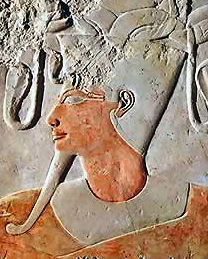
Thutmose I, the third pharaoh of Egypt’s 18th Dynasty, succeeded Amenhotep I. He campaigned deep into Nubia and the Levant, extending Egypt’s borders farther than ever before.
What is known about Thutmose I’s parentage and family background?
Thutmose I’s familial lineage is somewhat unclear. It is speculated that his father was Amenhotep I, the preceding pharaoh, but definitive evidence is lacking. His mother, Senseneb, was of non-royal origin and may have been a lesser wife or concubine. Thutmose married Queen Ahmose, who held the title of Great Royal Wife. She was possibly the daughter of Ahmose I and sister of Amenhotep I, though she was never explicitly called “king’s daughter,” leaving some uncertainty about her exact relationship to the royal family.

Representation of Pharaoh Amenhotep I from Tomb TT359 at Deir el-Medina
Who were Thutmose I’s children with Queen Ahmose, and what were their fates?
Thutmose I and Queen Ahmose had several children:
- Sons:
- Amenmose: Held the title “great army-commander of his father” but died before Thutmose I.
- Wadjmose: Also died before his father.
- Daughters:
- Hatshepsut: Later became one of Egypt’s most renowned pharaohs.
- Nefrubity: Died in infancy.
Who was Thutmose II, and how was he related to Thutmose I?
Thutmose II was the son of Thutmose I and another wife, Mutnofret, who was likely connected to the royal family, possibly as a sister of Amenhotep I. To secure the succession, Thutmose I married his daughter Hatshepsut to Thutmose II. Thutmose II succeeded Thutmose I as pharaoh.

Thutmose I was the father of Thutmose II. Image: Relief of Thutmose II in Karnak Temple complex.
How did Hatshepsut later justify her claim to the throne?
Hatshepsut claimed that her father, Thutmose I, had willed the kingship jointly to her and Thutmose II. Historians generally view this claim as political propaganda designed to legitimize her eventual rule as pharaoh.
What immediate military challenges did Thutmose I face upon his accession to the throne?
Upon his accession, Thutmose I faced a rebellion in Nubia, to the south of Egypt. The Nubians sought to regain independence from Egyptian control. Thutmose personally led a military campaign to suppress the rebellion.
How did Thutmose I handle the Nubian rebellion, and what was the outcome?
Thutmose I led his forces into Nubia, where he is said to have killed the Nubian king in battle. As a display of victory and a warning to others, he displayed the Nubian king’s body on the prow of his ship. This decisive action quelled the rebellion and reinforced Egyptian dominance over Nubia.
What were Thutmose I’s achievements during his third regnal year in Nubia?
In his third regnal year, Thutmose I led another expedition into Nubia. He ordered the dredging of a canal at the first cataract of the Nile, originally constructed under Sesostris III, to facilitate easier navigation upstream. He established a fortress at Tombos near the third cataract, extending Egyptian influence further south than ever before and integrating Nubia more fully into the Egyptian empire.
What unique geographical observation did the Egyptians make during Thutmose I’s campaign near the Euphrates River?
The Egyptians observed that the Euphrates River flowed from north to south, which was opposite to the Nile’s south to north flow. Because of this, they referred to the Euphrates as the “inverted water.”
How did Thutmose I celebrate his victories in Syria?
Thutmose I celebrated his victories with an elephant hunt near Niy, close to modern-day Apamea in Syria. This hunt was both a demonstration of his prowess and a royal pastime.
What architectural contributions did Thutmose I make to the Temple of Karnak?
Thutmose I significantly expanded the Temple of Karnak under the supervision of his architect Ineni. He constructed the fourth and fifth pylons along the temple’s main axis, erected two enclosure walls, and added hypostyle halls adorned with cedar wood columns symbolizing papyrus marshes—a motif associated with creation in Egyptian mythology. He also installed colossal statues and obelisks, some of which were later inscribed by his grandson, Thutmose III.
In which other regions did Thutmose I commission building projects, and what was their significance?
Beyond Karnak, Thutmose I commissioned buildings and statues in several locations:
- In Egypt: Abydos, Armant, Ombos, el-Hiba, Memphis, and Edfu.
- In Nubia: He expanded temples and built structures at Semna, Buhen, Aniba, and Quban.
These projects served religious purposes, demonstrated his power, and reinforced Egyptian presence and influence in these regions.
How did Thutmose I innovate in terms of his funerary practices and tomb construction?
Thutmose I was the first pharaoh definitively known to have been buried in the Valley of the Kings. He commissioned his architect Ineni to construct his tomb, separating his burial place from his mortuary temple—a departure from previous practices. This innovation aimed to protect his tomb from grave robbers.
What is known about Thutmose I’s tomb and sarcophagus?
Thutmose I’s tomb is often identified as KV38 in the Valley of the Kings. A yellow quartzite sarcophagus bearing his name was discovered there. Evidence suggests that his body may have been moved to KV20, the tomb of his daughter Hatshepsut. She initially commissioned a sarcophagus for herself but later donated it to her father, inscribing it with dedications expressing her filial devotion.
What actions did Thutmose III take concerning Thutmose I’s burial?
Thutmose III, Hatshepsut’s successor, later reinterred Thutmose I in KV38. He emphasized his respect for his grandfather through inscriptions that proclaimed his love and reverence. This act was likely meant to honor Thutmose I and legitimize Thutmose III’s own claim to the throne.

One of the few women to be crowned pharaoh of Egypt, Queen Hatshepsut was the daughter and only child of Thutmose I and his chief consort Ahmose
How was Thutmose I’s mummy discovered, and what challenges exist regarding its identification?
Thutmose I’s mummy was found in the Deir el-Bahri Cache (DB320) in 1881, a hidden repository containing the remains of several New Kingdom pharaohs and nobles. Initially, Gaston Maspero identified an unlabelled mummy (CG 61065) as Thutmose I based on familial resemblance to other royal mummies and embalming techniques consistent with the period. However, later examinations cast doubt on this identification.
What was the significance of the Pharaohs’ Golden Parade in 2021 concerning Thutmose I?
In April 2021, the mummy associated with Thutmose I was moved to the National Museum of Egyptian Civilization during the Pharaohs’ Golden Parade. This ceremonial event transported royal mummies to their new resting place, highlighting Egypt’s rich ancient heritage and honoring past pharaohs.





