Pharaoh Thutmose II
Thutmose II, also spelled as Thutmosis or Tuthmosis, was the fourth pharaoh of Egypt’s Eighteenth Dynasty. His reign, dated to approximately 1493 to 1479 BCE under the Low Chronology, was a relatively short and enigmatic period in Egyptian history, overshadowed by the powerful figures around him—his father Thutmose I, his wife and half-sister Hatshepsut, and his son and successor, Thutmose III. Despite this, Thutmose II’s reign marks a transitional phase in the Eighteenth Dynasty, blending military campaigns, dynastic struggles, and significant political influence from his wife Hatshepsut.
Early Life and Background
Thutmose II was born to Pharaoh Thutmose I and his lesser wife, Mutnofret, a daughter of Ahmose I. As a son of a secondary wife, his claim to the throne was less secure than that of Hatshepsut, his half-sister, whose mother was Thutmose I’s principal wife, Queen Ahmose. Despite this, Thutmose II ascended to the throne following the death of his father, likely due to the absence of a surviving full-blooded male heir.
To solidify his rule and legitimize his claim to the throne, Thutmose II married Hatshepsut, following a common practice among Egyptian royalty to preserve the purity of the royal bloodline. This marriage not only strengthened his kingship but also tied him closely to the family lineage of Ahmose I, a critical factor in securing the legitimacy of his reign.

Thutmose II, also known as Thutmosis or Tuthmosis, ruled Egypt’s Eighteenth Dynasty from approximately 1493 to 1479 BCE. Image: An artwork depicting Thutmose II in Karnak Temple complex.
Challenges to the throne and Hatshepsut’s influence
Though Thutmose II was crowned as king, many scholars believe that his reign was largely influenced, if not dominated, by Hatshepsut. As the daughter of the powerful Thutmose I, Hatshepsut had strong claims to the throne in her own right.
Evidence suggests that Hatshepsut may have been the de facto ruler during much of Thutmose II’s reign, given her experience and royal lineage. Depictions from the time often show Hatshepsut alongside or in place of Thutmose II in relief scenes, suggesting that she played a significant role in governance and religious affairs.
Hatshepsut later declared herself pharaoh several years after Thutmose II’s death, and many of the policies, both foreign and domestic, that characterized Thutmose II’s reign closely mirrored those later pursued under her rule. This continuity has led historians to believe that Hatshepsut exerted considerable power behind the throne. There is further evidence of Hatshepsut’s influence in inscriptions where her name replaced that of Thutmose II, a practice that underscored her growing authority.
Military Campaigns and Foreign Policy
Thutmose II’s reign is marked by a few notable military campaigns, though there is debate over whether the king himself participated in these campaigns or if they were led by his generals. Given that many scholars believe Thutmose II was relatively young when he assumed the throne, it is likely that his generals played a more active role in these military efforts.
One of the most significant campaigns during Thutmose II’s reign was against Nubia, a region to the south of Egypt. Nubia had been subjugated by Thutmose I, but upon Thutmose II’s coronation, the Nubians, led by a figure named Khenthennofer, rebelled against Egyptian rule. Thutmose II’s forces quickly crushed this rebellion, likely with the aid of generals who had served under his father. This military action reasserted Egyptian control over Nubia and ensured the continued flow of valuable resources such as gold into Egypt.
Thutmose II also conducted a campaign against the Shasu Bedouin, a nomadic group in the Sinai Peninsula. This campaign is mentioned in the autobiographical inscription of Ahmose Pen-Nekhbet, a loyal official who served both Thutmose II and Hatshepsut. The campaign against the Shasu is considered a minor raid by most scholars but demonstrates Egypt’s ongoing military presence and activity in the region.
There is also some evidence of a campaign in Upper Retenu (Syria), referenced in a fragmentary inscription recorded by Kurt Sethe. This inscription suggests that Thutmose II’s forces reached as far as the city of Niy, where his father had once hunted elephants during his military campaigns. If accurate, this would indicate that Thutmose II continued his father’s expansionist policies in the Levant, albeit on a smaller scale.
Length of Reign
The length of Thutmose II’s reign has been a topic of debate among Egyptologists. Manetho, the Egyptian historian, credits Thutmose II with a reign of 13 years, and this length of reign is traditionally accepted by many scholars. However, there are other records that suggest Thutmose II may have ruled for a much shorter period—perhaps as little as three years. The lack of extensive dated documents and the relatively small number of surviving monuments attributed to Thutmose II complicate efforts to determine the exact length of his reign.
One of the key pieces of evidence supporting a shorter reign comes from statistical analyses of scarabs (small, carved amulets that were often inscribed with the names of pharaohs). A much smaller number of scarabs bearing Thutmose II’s name has been found compared to those of his predecessors and successors, particularly his father, Thutmose I, and his wife, Hatshepsut. This scarcity suggests that his reign may have been brief, with some estimates placing it at around three to four years.
However, other scholars, including J. von Beckerath, argue that Thutmose II may have reigned for 13 years, noting that he fathered two children and lived long enough to solidify his position as king. Beckerath also points out that inscriptions once attributed to an 18th year of reign, originally thought to be Thutmose II’s, likely refer to Hatshepsut. This discrepancy highlights the difficulty in determining an exact timeline for Thutmose II’s reign.

Family and Succession
Thutmose II fathered two known children during his reign. His daughter, Neferure, was born to Hatshepsut and played a significant role in the royal court, particularly during her mother’s reign. His son and successor, Thutmose III (variously also spelt Thothmes or Tuthmosis), was born to a lesser wife named Iset. Thutmose III would go on to become one of Egypt’s most successful military rulers, expanding the empire to its greatest territorial extent.
Following Thutmose II’s death, Hatshepsut acted as regent for the young Thutmose III. However, within a few years, Hatshepsut declared herself pharaoh and ruled Egypt in her own right for over two decades, an unprecedented move for a female ruler. During this time, Hatshepsut carried out significant building projects, including her famous mortuary temple at Deir el-Bahari, and conducted extensive trade expeditions, most notably to the land of Punt.
Monuments and Architectural Legacy
Thutmose II left behind fewer monuments compared to other pharaohs of the Eighteenth Dynasty. The most significant structure attributed to his reign is a limestone gateway at Karnak, located at the front of the Fourth Pylon’s forecourt. However, this gateway was not completed during his lifetime and was finished by his son, Thutmose III. Later, Amenhotep III dismantled the gateway, incorporating its blocks into the foundation of the Third Pylon.
In addition to the Karnak gateway, there is evidence of other building projects undertaken during Thutmose II’s reign. French Egyptologists working at Karnak have uncovered remains of a pylon and a festival court, which may have been commissioned by Thutmose II. These discoveries suggest that his reign may have been more significant in terms of architectural development than the sparse surviving documentation indicates.
Thutmose II’s short reign was overshadowed by Thutmose I, Hatshepsut, and Thutmose III, yet marked a transitional period of military campaigns, dynastic struggles, and Hatshepsut’s political influence.
Some scholars, such as Catherine Roerig, have proposed that the famous tomb KV20 in the Valley of the Kings, traditionally attributed to Hatshepsut, may have originally been intended as the tomb of Thutmose II. If true, this would indicate that Thutmose II had grand plans for his burial and that his reign may have lasted long enough to initiate such a major construction project. However, the tomb was ultimately used by Hatshepsut, and Thutmose II’s original burial site remains a subject of speculation.

To strengthen his rule and legitimize his reign, Thutmose II married Hatshepsut, a customary Egyptian royal practice to maintain dynastic purity. Hatshepsut is regarded as one of ancient Egypt’s greatest pharaohs and one of the few female rulers who reigned in her own right. Image: Statue of Queen Hatshepsut on display at the Metropolitan Museum of Art, New York City, United States
Burial and Mummy
Thutmose II’s final resting place has not been definitively identified, although it is speculated that he may have originally been buried in KV42, a tomb in the Valley of the Kings. Another possible burial site is tomb C4, located at the opposite end of the Theban mountain. However, Thutmose II’s mummy was discovered in the Royal Cache at Deir el-Bahari, along with the mummies of other prominent pharaohs, including Ahmose I, Amenhotep I, and Thutmose I.
Thutmose II’s mummy was unwrapped in 1886 by the French Egyptologist Gaston Maspero, revealing significant damage caused by ancient tomb robbers. The mummy had suffered post-mortem injuries, including the severing of the pharaoh’s arms and legs. Despite the damage, the facial features of the mummy closely resembled those of Thutmose I, supporting the identification of the body as Thutmose II.
The mummy was reburied in the Deir el-Bahari cache to protect it from looting, and it was rediscovered in the late 19th century. Today, Thutmose II’s mummy can be viewed at the National Museum of Egyptian Civilization in Cairo.

Thutmose II likely died in his early 30s, and little is known about his achievements during his rule. His mummified remains were discovered in the Deir el-Bahri Cache, located near the Mortuary Temple of Hatshepsut. Image: Mummy of Thutmose II.
2025 Discovery of Thutmose II’s Tomb
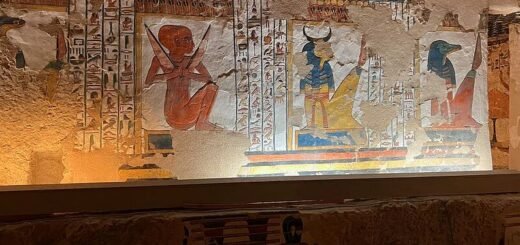
In mid-February 2025, the Ministry of Tourism and Antiquities confirmed that Tomb C4 in the Valley of the Kings belonged to Thutmose II. The tomb contained several elements characteristic of a royal burial, including a blue ceiling adorned with yellow stars and fragments of the Amduat, an ancient funerary text inscribed on the walls. Additionally, inscribed vessels and alabaster jars bearing the names of Thutmose II and his queen, Hatshepsut, provided strong evidence of the tomb’s ownership.
This discovery is particularly significant as it marks the first royal tomb found in the Valley of the Kings since British Egyptologist Howard Carter uncovered Tutankhamun’s tomb in 1922. The identification of Thutmose II’s burial adds valuable insight into early 18th Dynasty funerary practices and royal lineage.
The tomb’s location beneath two waterfalls caused extensive damage over time due to periodic flash floods. Mohamed Abdel Badi, head of the Egyptian Antiquities Sector, noted that its placement at the bottom of a slope led to continuous water infiltration, which significantly impacted its preservation.
READ MORE: Who are the most pioneering figures in Egyptology?
Legacy and Conclusion
Thutmose II’s reign remains one of the most enigmatic periods of the Eighteenth Dynasty. Though overshadowed by the powerful figures of his father, Thutmose I, his wife, Hatshepsut, and his son, Thutmose III, Thutmose II played a crucial role in maintaining Egypt’s stability during a transitional phase. His marriage to Hatshepsut helped secure his claim to the throne, while his military campaigns in Nubia and the Sinai Peninsula ensured the continued dominance of Egypt in these regions.
Thutmose II’s reign, though brief, laid the groundwork for the achievements of his successors and remains a key chapter in the history of ancient Egypt’s royal dynasties.
The scarcity of surviving monuments and inscriptions makes it difficult to fully assess the impact of Thutmose II’s reign. However, recent archaeological discoveries suggest that his contributions to Egypt’s architectural and political landscape may have been more significant than previously thought. His influence can also be seen through his children, particularly Thutmose III, whose long and successful reign helped to solidify the Eighteenth Dynasty as one of Egypt’s most powerful and prosperous periods.
Frequently Asked Questions about Pharaoh Thutmose II and his reign

Who were Thutmose II’s parents?
Thutmose II was the son of Pharaoh Thutmose I and a lesser wife named Mutnofret, who was the daughter of Ahmose I.

An Osiride stone head from Karnak, likely representing Thutmose I, is exhibited at the British Museum.
Why did Thutmose II marry his half-sister Hatshepsut?
Thutmose II married his half-sister Hatshepsut to strengthen his claim to the throne, as Hatshepsut was the daughter of Thutmose I and his principal wife.
How many children did Thutmose II have, and who were they?
Thutmose II fathered two children: Neferure, his daughter with Hatshepsut, and Thutmose III, his son with a lesser wife named Iset.
What role did Hatshepsut play during Thutmose II’s reign?
Many historians believe Hatshepsut held significant influence during Thutmose II’s reign, with some suggesting she was the real power behind the throne. She later declared herself pharaoh after Thutmose II’s death.
How long did Thutmose II reign?
The length of Thutmose II’s reign is debated. Some records suggest it lasted around three years, while others, based on the number of children he fathered and other evidence, estimate it may have been as long as 13 years.
What are the major monuments associated with Thutmose II?
Thutmose II is associated with a limestone gateway at Karnak, although it was completed by his son, Thutmose III. His reign left behind fewer monuments compared to other Eighteenth Dynasty pharaohs.

Pharaoh Thutmose III was the son of Thutmose II. Image: Thutmose III statue in Luxor Museum, Luxor, Egypt
What military campaigns did Thutmose II conduct?
Thutmose II’s reign included campaigns against the Nubians, led by Khenthennofer, and the Shasu Bedouin in the Sinai. He may have also conducted a campaign in Syria, extending Egypt’s influence.
Where was Thutmose II’s mummy discovered?
Thutmose II’s mummy was discovered in the Royal Cache at Deir el-Bahari, where it had been reburied to protect it from tomb robbers.
The mummy was significantly damaged by ancient tomb robbers. His arms and legs had been severed, but his facial features closely resembled those of his father, Thutmose I.