Tomb of Asif Khan in Lahore
The Tomb of Asif Khan is a 17th-century mausoleum located in Shahdara Bagh, Lahore, Punjab. This monumental structure was built in honor of Mirza Abul Hassan Jah, known by his title Asif Khan, a distinguished statesman of the Mughal Empire. Asif Khan was the brother of Empress Nur Jahan and the brother-in-law of Mughal Emperor Jahangir. His tomb lies adjacent to the Tomb of Jahangir and near the Tomb of Nur Jahan, forming part of a historically significant Mughal-era funerary complex. The mausoleum, designed in Central Asian architectural style, is situated at the heart of a Persian-style Charbagh garden, reflecting the elegance and symmetry of Mughal craftsmanship.
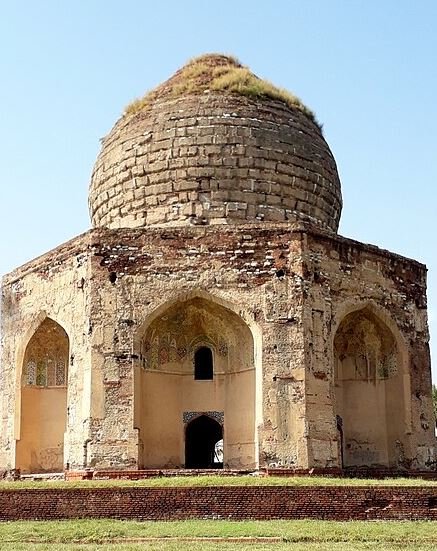
Front view of the Tomb of Asif Khan
Background and Historical Context
Asif Khan held a prominent place in the Mughal court. His daughter, Arjumand Bano Begum, later known as Mumtaz Mahal, was the beloved wife of Emperor Shah Jahan, who famously built the Taj Mahal in her memory. Asif Khan was a trusted nobleman, rising to the rank of Khan-e-Khana (Grand Vizier) and Commander-in-Chief in 1636. A year later, he was appointed Governor of Lahore.
Asif Khan’s life ended on June 12, 1641, during a battle against rebel Raja Jagat Singh. Following his death, Shah Jahan commissioned his tomb, ensuring it was built in Shahdara Bagh, close to his brother-in-law Jahangir’s tomb. According to Abdul Hamid Lahori, the author of the Padshahnama, the construction took four years, from 1641 to 1645, costing approximately over a quarter of a million rupees—a significant sum at the time.

A portrait of Shah Jahan by Indian artist Bichitr
Historical Transformations and Damage
The Sikh Empire era brought significant destruction to the tomb. Under the rule of Gujjar Singh, Lahna Singh, and Subha Singh, the monument suffered extensive damage, including the planting of large pipal trees that obstructed its view. These trees were later removed during the British colonial period.
During the 19th century, the tomb was heavily plundered for its marble and sandstone. Ranjit Singh, the Sikh ruler, stripped the tomb of its precious stones and marble, repurposing them for the Golden Temple in Amritsar and Hazuri Bagh Baradari near Lahore Fort. British explorer William Moorcroft documented this widespread looting, lamenting the loss of the tomb’s original splendor.
Architectural Features of the Tomb
Layout and Structure
The Tomb of Asif Khan is an octagonal structure, a design commonly reserved for high-ranking noblemen rather than emperors. The tomb is built entirely of brick and is elevated on a chabutra (podium) standing 3 feet 9 inches above the surrounding garden. Each of the eight sides of the octagon measures 38 feet 8 inches.
The tomb complex spans a vast area, with a quadrangle measuring 300 yards on each side. The main entrance is on the southern side, with an additional gate to the north. The eastern wall houses a small mosque, which was repurposed as a residence during British rule, while the western wall provides access to the Tomb of Jahangir through the Akbari Sarai.
Exterior Design
At the time of its construction, the tomb was considered a masterpiece of Mughal craftsmanship. The exterior was originally adorned with marble inlay work, stucco tracery, and blue kashi tiles, elements characteristic of Mughal Lahore’s artistic heritage. The floors were richly decorated with marble inlaid with precious stones.
Each side of the tomb features a deeply recessed iwan (archway) with a door and arched window, allowing light and ventilation into the tomb. Though much of its decorative elements have disappeared over time, remnants of intricate tile work and stucco reliefs still hint at its former grandeur.
Interior Design and Cenotaph
The tomb’s interior features eight portals, allowing multiple access points from the outside. The walls were once richly adorned with white marble and precious stones, which have since been stripped away. The dome’s ceiling features intricate high-relief plasterwork, with traces still visible today.
At the center of the tomb lies Asif Khan’s cenotaph, a pure marble structure inscribed with verses from the Qur’an, mirroring the design of Jahangir’s tomb. The original flooring, composed of red sandstone, was removed during the Sikh period.
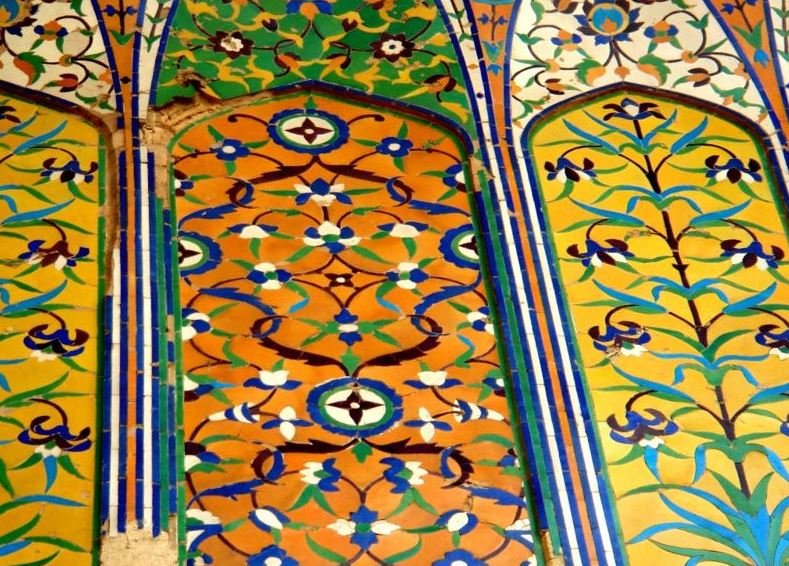
Tile work in the interior of the Tomb.
The Dome: A Mughal Innovation
A large central double-layered brick bulbous dome crowns the tomb, marking it as a Shah Jahan-era innovation. Originally covered in marble veneer, the dome’s unique bulbous shape set it apart from other Mughal-era structures. The architectural style seen here influenced later masterpieces, including the Taj Mahal in Agra.
The Surrounding Charbagh Garden
The tomb is situated within a Persian-style Charbagh garden, a traditional Mughal design symbolizing paradise. The garden was originally irrigated by a water reservoir, which fed fountains and pathways. Four long pools (hauz), oriented along the cardinal directions, enhanced the garden’s symmetry and aesthetic appeal.
Southern and Northern Gates
The southern gate serves as the primary entrance. It is a double-story brick structure, originally adorned with red sandstone and white marble. The façade featured stucco decorations, while the flooring displayed intricate geometric brickwork. The gate’s central iwan portal, flanked by four smaller iwans, remains a prominent architectural feature.
The northern boundary of the complex features the jawab gate, meaning “response gate”. This two-story structure mirrors the southern gate in design and is embellished with tile-work (kashi kari), some of which still survives.
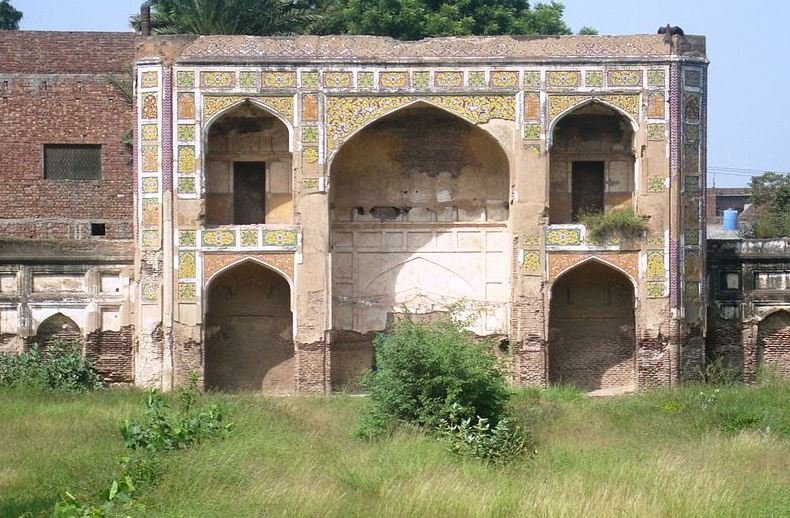
A view of the Jawab gate of the tomb.
Conservation Efforts
British authorities took limited conservation measures for the tomb. In 1905, a destroyed staircase was rebuilt, while the brick flooring and plaster ceiling were repaired. The tomb gained formal protection under British law in 1912, with further restorations in 1920–21, 1924–25, and 1930–34.
After Pakistan’s independence, the Department of Archaeology assumed responsibility for the site. However, flooding from the River Ravi in 1955 and 1973 severely damaged the tomb’s southern walls, which were repaired in 1986–87.
Despite legal prohibitions against new construction within 150 feet of heritage sites, private residences have encroached upon the tomb’s western and northern boundaries. Additionally, the shrine of Nim Pir, dating from the Mughal era, stands immediately north of the tomb.
Restoration efforts resumed in 2005 with assistance from the Global Heritage Fund. Today, the tomb remains in a dilapidated condition, though it has been included on the tentative list of UNESCO World Heritage Sites, alongside the Tomb of Jahangir and Akbari Sarai.
Frequently Asked Questions
Who commissioned the Tomb of Asif Khan and when was it built?
Emperor Shah Jahan commissioned the tomb in 1641, and it was completed in 1645 at a cost of over 250,000 rupees.
What architectural style does the tomb follow?
It follows a Central Asian architectural style and is set within a Persian-style Charbagh garden, featuring an octagonal layout.
How was the tomb affected during the Sikh Empire?
The tomb was heavily damaged, plundered for its marble and sandstone, and obstructed by large trees planted by Sikh rulers. Ranjit Singh repurposed its materials for structures like the Golden Temple.

What are the key features of its exterior and interior?
The exterior was once adorned with marble inlay, stucco tracery, and blue kashi tiles. The interior had eight portals, lavish white marble, and intricate plaster reliefs, though much of it was looted.
What makes the tomb’s dome unique?
The tomb’s large bulbous dome, originally covered in marble, is distinctive among Mughal structures and represents an architectural innovation of Shah Jahan’s era.
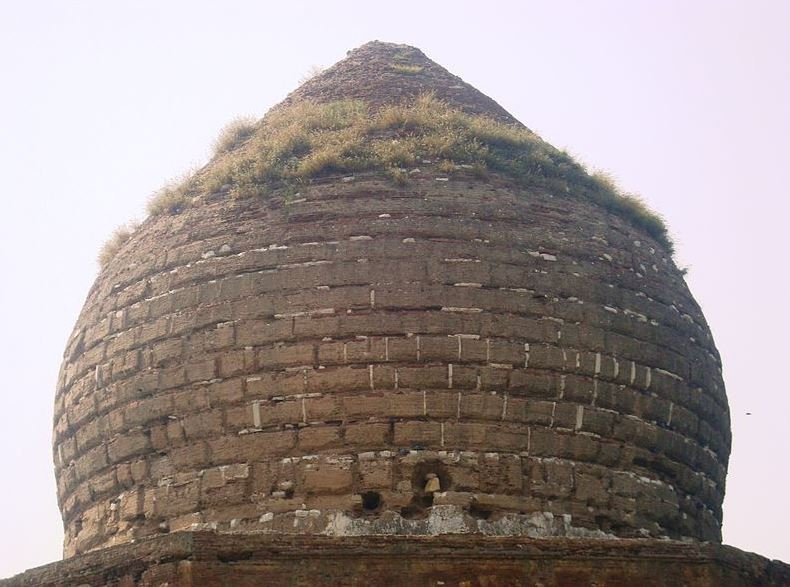
A clearer view of the bulbous dome of the tomb.
What conservation efforts have been undertaken?
British authorities initiated preservation efforts in the early 20th century, and Pakistan’s Department of Archaeology later conducted repairs, with additional restoration support from the Global Heritage Fund since 2005.
What is the tomb’s current status?
Despite legal protections, the tomb is in a dilapidated state, with encroachment by private homes. It remains on UNESCO’s tentative list for World Heritage status.