Tomb of Cyrus the Great
The Tomb of Cyrus the Great, located in Pasargadae, Iran, stands as a monumental testament to the legacy of one of history’s most influential rulers.
As the final resting place of Cyrus II (also known as Cyrus the Great), the founder of the Achaemenid Empire, the tomb not only embodies architectural brilliance but also symbolizes cultural resilience and historical continuity.
In the article below, World History Edu delves into the rich history and enduring significance of the Tomb of Cyrus the Great, exploring its origins, transformations, architectural features, restoration efforts, and its place in both classical accounts and modern Iranian culture.
READ MORE: Rulers of the Achaemenid Empire
Historical Background
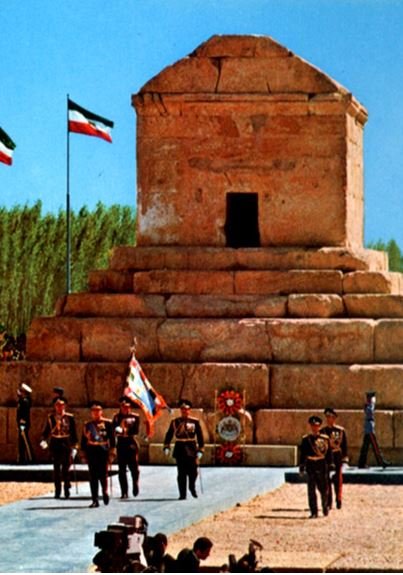
The Tomb of Cyrus the Great (Persian: آرامگاه کوروش بزرگ, Ârâmgâh-e Kuroš-e Bozorg) is the final resting place of Cyrus the Great, founder of the ancient Achaemenid Empire. Image: A picture of a ceremony at the tomb during the early 1970s.
Cyrus the Great and the Achaemenid Empire
Cyrus the Great (c. 600–530 BCE) was the founder of the Achaemenid Empire, which became the largest empire the world had seen at that time, stretching from the Balkans and Eastern Europe to the Indus Valley.
Renowned for his military prowess, administrative genius, and progressive policies, Cyrus established a model of governance that emphasized respect for the cultures and religions of the lands he conquered. His reign marked the beginning of a dynasty that would shape the political and cultural landscape of the ancient Near East for centuries.

Image: Cyrus the Great, created by renowned French artist Charles Texier.
Construction of the Tomb
The Tomb of Cyrus was constructed to honor Cyrus the Great and to serve as his final resting place. Located in Pasargadae, the first capital of the Achaemenid Empire, the tomb reflects the architectural sophistication of the period. Built from yellowish-white limestone sourced from the Sivand mine, the mausoleum is remarkably enduring, having withstood natural and human-induced challenges for approximately 2,500 years. The tomb’s design, featuring a stone platform base, a six-step stone platform, and a gabled roofed room, showcases the ingenuity of ancient Persian engineering.
persPost-Achaemenid Transformation
Following the Muslim conquest of Persia and the fall of the Sasanian Empire in the 7th century CE, the Tomb of Cyrus underwent significant transformations. To protect the monument from invading Arab armies and to obscure its original Zoroastrian significance, the tomb was renamed the Tomb of Suleiman’s Mother. This renaming referenced either Caliph Sulayman ibn Abd al-Malik or the biblical Bathsheba, mother of Solomon, thereby integrating the site into the Islamic cultural and religious framework.
During the Medieval period in Iran, the tomb was further integrated into the Islamic landscape by being converted into a revered Islamic shrine. This transformation involved the construction of additional structures and the incorporation of Islamic architectural elements, making the tomb a focal point of local religious practices. The renaming and conversion not only safeguarded the tomb from desecration but also ensured its continued veneration within a new cultural and religious context.
European Discovery and Identification
The Tomb of Cyrus first attracted European attention through the travels of Venetian explorer Giosafat Barbaro and later Johan Albrecht de Mandelslo. Barbaro’s accounts provided some of the earliest European insights into this ancient monument, highlighting its mysterious and sacred aura. Mandelslo’s observations in the early 17th century further documented the tomb’s unique architectural features and local legends surrounding its origins.
Located in Pasargad, Fars Province, Iran, the Tomb of Cyrus the Great was identified in modern times by James Justinian Morier, who matched it with descriptions by Greek historian Arrian.
It was not until the early nineteenth century that the tomb was definitively identified as the final resting place of Cyrus the Great. In 1812, British diplomat and traveler James Justinian Morier made this groundbreaking identification, drawing parallels between his observations and the descriptions provided by the Greek historian Arrian.
Robert Ker Porter, an influential British artist and archaeologist, supported Morier’s conclusions in 1821, solidifying the tomb’s association with Cyrus the Great. Morier’s detailed descriptions emphasized the tomb’s extraordinary architecture and the deep reverence it commanded among local populations.
Architectural Features
The Tomb of Cyrus is constructed primarily from yellowish-white limestone, sourced from the Sivand mine, which contributes to its enduring presence in the Pasargad plain. The mausoleum rests on a stone platform, forming a rectangular base measuring approximately 13.35 meters in length and 12.30 meters in width. The structure is divided into two main sections: a six-step stone platform and a room with a gabled roof positioned above the sixth step. This division not only provides a hierarchical architectural layout but also signifies the tomb’s sacred purpose.
Morier’s observations highlighted the tomb’s unique design, which locals referred to as the “court of the deevis or devil” due to its unconventional form. The tomb features a square base composed of large marble blocks arranged in seven pyramid-like layers, creating a striking visual impact. The monument is adorned with inscriptions, though intriguingly, none bear the characters of ancient Persian or older Arabic scripts. These inscriptions indicate the site’s sacred status but also hint at its transformation and integration into Islamic traditions.
The tomb’s roof presents a notable contrast between its interior and exterior. Internally, the roof is smooth and simple, while externally, it is gabled with a two-sided slope resembling the number eight. The roof is composed of two precious stones topped by a pyramid stone measuring 6.25 by 3 meters with a half-meter thickness.
Originally, a stone cap sat atop the roof, though it is no longer present. The design includes internal voids, likely influenced by Achaemenid traditions, to facilitate the movement of heavy stones and possibly to serve as a burial chamber. The tomb room itself is spacious, measuring 3.17 meters in length, 2.11 meters in width, and 2.11 meters in height, with walls up to 1.5 meters thick constructed from precisely cut stone.
Restoration Efforts
The Tomb of Cyrus has undergone two major restorations. The first renovation took place in 1972 to commemorate the 2,500-year celebration of the Persian Empire, aiming to preserve and highlight the tomb’s historical significance. The second restoration occurred between 2002 and 2009, intended to further protect and restore the monument. These efforts reflect the ongoing commitment to maintaining the tomb’s structural integrity and historical authenticity.
The Tomb of Cyrus the Great is more than just an ancient mausoleum; it is a symbol of Persia’s historical grandeur, architectural innovation, and cultural resilience.
The second restoration between 2002 and 2009 faced significant challenges, particularly concerning the tomb’s roof. Cultural heritage experts criticized the restoration process, highlighting the lack of scientific expertise among the restorers. An Italian expert group initially involved in the restoration of Persepolis abandoned the project, and responsibility shifted to local restorers. Experts pointed out that restoration errors led to substantial damage to the roof, asserting that a scientifically sound restoration would have required additional time and expertise. These criticisms underscore the complexities involved in restoring ancient monuments and the importance of adhering to rigorous preservation standards.
Classical Accounts
Arrian’s Description
The most comprehensive classical description of the Tomb of Cyrus comes from Arrian’s “The Anabasis of Alexander,” which references a lost account by Aristobulus, a companion of Alexander the Great.
According to Arrian, Aristobulus found Cyrus’s tomb desecrated, having been looted and pillaged. The tomb was situated within the royal park at Pasargadae, surrounded by a diverse grove of trees and watered by a stream, creating a lush meadow.
The base was rectangular, made of squared stone, topped by a stone building with a narrow entrance barely allowing entry.
Inside lay a golden coffin containing Cyrus’s body, accompanied by a golden couch, Babylonian tapestry carpets, and various luxurious garments and ornaments adorned with precious stones.
Additionally, there was a table and offerings made by the Magians who guarded the tomb, including daily sheep and monthly horse sacrifices.
Strabo’s Corroboration
Strabo, another classical historian, corroborated aspects of Aristobulus’s account. He detailed how Alexander the Great visited the tomb after looting Persepolis, finding remnants of gold and precious items despite the presence of Magian guards.
Strabo mentioned inscriptions in Persian letters proclaiming Cyrus’s identity and achievements, although no such inscriptions survive today. These accounts provide valuable insights into the tomb’s historical context and the reverence it commanded in antiquity.
Others (Onesicritus)
Onesicritus offered a slightly different account, describing a ten-story tower tomb with inscriptions in both Greek and Persian, though these details are not supported by existing evidence. This discrepancy highlights the variations in historical narratives and the challenges in accurately reconstructing ancient monuments’ histories.
Cultural and Modern Significance

From its origins as the final resting place of one of history’s most influential rulers to its transformation into an Islamic shrine and its eventual recognition by European explorers, the Tomb of Cyrus encapsulates centuries of historical evolution. Image: A 2017 photo of the tomb.
The Tomb of Cyrus the Great is recognized as a UNESCO World Heritage Site, underscoring its global cultural and historical significance. As part of the archaeological site of Pasargadae, the tomb contributes to our understanding of Achaemenid architecture and Persian heritage. Its inclusion in the UNESCO list helps ensure its preservation and promotes international recognition of Iran’s rich historical legacy.
Cyrus the Great Day, or Cyrus Day (Persian: روز کوروش ruz-e kuroš), is an unofficial holiday in Iran celebrated annually on October 29 (7 of Aban in the Iranian calendar). This day commemorates Cyrus the Great, marking the anniversary of his entry into Babylon. Celebrations often include gatherings at the Tomb of Cyrus, reflecting his enduring legacy as the founder of the first Persian Empire, the Achaemenid Empire. The day serves as a reminder of Cyrus’s contributions to Persian identity and his role in shaping ancient and modern Iranian culture.
Celebrations like Cyrus the Great Day and Nowruz ensure that his memory continues to be honored, bridging the ancient past with the present and maintaining the tomb’s significance in both historical and cultural contexts.
During Nowruz, the Persian New Year, celebrations are held annually around the Tomb of Cyrus. Iranians from across the country gather to honor Cyrus the Great, reflecting his status as the founder of Iran and the Achaemenid Empire. These gatherings blend traditional New Year festivities with historical reverence, fostering a sense of continuity and national pride. Nowruz celebrations at the tomb highlight the enduring connection between contemporary Iranian identity and its ancient heritage.
The architectural design of the Tomb of Cyrus has influenced subsequent monumental structures in Iran and beyond. Similar tombs, such as Gur-e-Dokhtar in Bushehr Province and Taş Kule in Sardis, exhibit architectural parallels, suggesting that Cyrus’s tomb served as a model for later constructions.
Alireza Shapour Shahbazi, a prominent Iranian archaeologist, suggested that Gur-e-Dokhtar might be the tomb of Cyrus the Younger, further emphasizing the tomb’s architectural impact. These influences demonstrate the tomb’s role in shaping Persian architectural traditions and its lasting legacy in the region’s built environment.
READ MORE: Susa – the Imperial Capital of the Achaemenid Empire
Conclusion
From its origins as the final resting place of one of history’s greatest rulers to its transformation into an Islamic shrine and its recognition by European explorers, the tomb encapsulates centuries of historical evolution. Its architectural features, including the enduring limestone structure, intricate design elements, and resilient construction, reflect the ingenuity of the Achaemenid Empire. Restoration efforts, though fraught with challenges, highlight the ongoing commitment to preserving this invaluable monument.
Frequently Asked Questions about the Tomb of Cyrus the Great
What was the Tomb of Cyrus the Great renamed to after the Muslim conquest of Persia?
It was renamed the Tomb of Suleiman’s Mother, referencing either Caliph Sulayman ibn Abd al-Malik or the biblical Bathsheba, mother of Solomon.
The renaming aimed to obscure its original significance and protect it from invading Arab armies by associating it with Islamic or biblical figures.
How was the tomb integrated into Islamic culture during the Medieval period in Iran?
It was converted into a revered Islamic shrine, becoming part of the Islamic cultural and religious landscape in Medieval Iran.
Which European travelers were among the first to visit the tomb?
Venetian traveler Giosafat Barbaro and Johan Albrecht de Mandelslo were among the first European explorers to visit the tomb.
Who definitively identified the tomb as the final resting place of Cyrus the Great in the early nineteenth century?
James Justinian Morier identified the tomb as Cyrus’s in 1812, a conclusion later supported by Robert Ker Porter in 1821.
Morier noted it was called the “court of the deevis or devil” due to its unusual form, resting on a square base of large marble blocks arranged in seven pyramid-like layers, and adorned with non-Persian inscriptions.
What unique restrictions existed regarding access to the tomb during Morier’s time?
Only women were permitted to enter the tomb, with the key exclusively kept by females.
What similarities and discrepancies did Morier note when comparing the tomb to Arrian’s description of Cyrus’s tomb?
Morier observed similarities in size and construction but noted discrepancies like the absence of Arrian’s inscription, lack of a surrounding grove, and a triangular roof instead of an arched one.
What are the main materials and structural components of the Tomb of Cyrus?
Constructed from yellowish-white limestone from the Sivand mine, the tomb features a stone platform base, a six-step stone platform, and a gabled roofed room, with thick stone walls and an ornate gate motif.

Image: A closer view of the Tomb of Cyrus the Great.
How has the tomb been restored, and what issues arose during the restorations?
The tomb was renovated in 1972 and between 2002-2009. The latter restoration damaged the roof due to restoration errors and lack of scientific expertise, leading to criticism from cultural heritage experts.
What do classical accounts by Arrian and Strabo describe about the tomb?
Arrian, citing Aristobulus, described the tomb as containing a golden coffin and luxurious items, guarded by Magians. Strabo corroborated these accounts, mentioning inscriptions and remnants of precious items despite looting.
How is the Tomb of Cyrus celebrated in modern Iranian culture?
During Nowruz, the Persian New Year, Iranians gather at the tomb to honor Cyrus the Great, reflecting his legacy as the founder of Iran and the Achaemenid Empire. Additionally, Cyrus the Great Day is celebrated annually on October 29.





