Who are the Anunnaki?
The Anunnaki, derived from the Sumerian words “da-nuna” or “da-nuna-ke4-ne,” meaning “princely offspring” or “offspring of An,” were a group of deities central to the ancient Mesopotamian pantheon. They appeared in the mythologies of the Sumerians, Akkadians, Babylonians, and Assyrians, often depicted as powerful gods with the authority to decree human destinies. These deities were believed to be the offspring of the sky god An and the earth goddess Ki. In early Sumerian texts, the Anunnaki were considered the supreme council of divine beings, tasked with major decisions affecting both gods and humanity.

An Akkadian cylinder seal, circa 2300 BCE, depicting the deities Inanna, Utu, and Enki, prominent members of the Anunnaki.
Etymology and Lineage
The name “Anunnaki” directly links these deities to their progenitor, An, the sky god, while their connection to Ki identifies them with the earth. Early myths highlight the separation of heaven and earth as a pivotal event carried out by Enlil, one of the Anunnaki and a son of An. Enlil’s act of dividing heaven and earth signified the beginning of the world’s order. This lineage positioned the Anunnaki as central figures in the cosmic hierarchy, embodying the forces that governed creation and the natural world.
Worship and Iconography
Unlike many other deities, the Anunnaki were not typically worshipped as a singular collective. Each deity within this group maintained an individual cult. Evidence of their worship is sparse, possibly due to the focus on individual gods like Enlil or Inanna rather than the Anunnaki as a whole.
Depictions of the Anunnaki were rare, and no unified representation of the group exists. Mesopotamian deities were anthropomorphic, often shown wearing horned caps symbolizing divinity and garments adorned with gold and silver. They exuded melam, an aura of divine splendor that inspired awe and fear.
The Anunnaki occupy a central place in Mesopotamian mythology, serving as both creators and judges, celestial beings, and underworld rulers.
Their temples, viewed as earthly residences of the gods, housed cult statues treated as physical embodiments of the divine. These statues were clothed, fed, and transported in elaborate ceremonies, reinforcing the gods’ connection to both the spiritual and material realms.
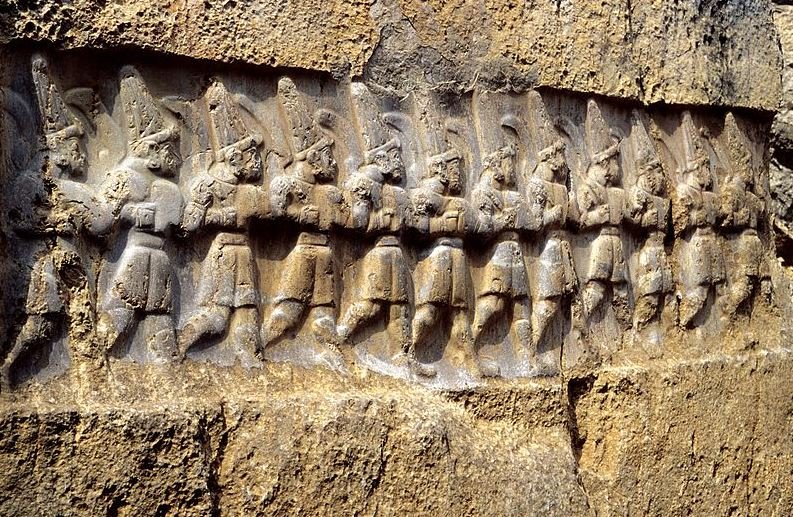
Hittite relief from Yazılıkaya sanctuary shows twelve underworld gods, linked to Mesopotamian Anunnaki.
Role in Mythology
The Anunnaki first appeared in literary texts during the reign of Gudea and the Third Dynasty of Ur. In these early records, they were described as the most powerful deities, including prominent gods like Enlil, Enki, and Inanna. While Sumerian texts often referred to the Anunnaki as a group, the exact number and roles of its members varied across myths.
In the poem Enki and the World Order, the Anunnaki are depicted as subordinates to Enki, honoring him and participating in the divine administration of the cosmos. Another myth, Inanna’s Descent to the Netherworld, presents the Anunnaki as underworld judges who condemn the goddess Inanna for her hubris, illustrating their role as arbiters of divine and mortal law.
While the roles of the Anunnaki evolved across different cultures and periods, their significance as mediators between gods and humanity remained constant.
Major Sumerian gods, including members of the Anunnaki, were tied to celestial bodies. Inanna was associated with Venus, Utu with the Sun, and Nanna with the Moon. An governed the stars of the equatorial sky, while Enlil and Enki presided over the northern and southern skies, respectively. These celestial connections reflected the gods’ omnipresence and their influence over both cosmic and earthly domains.
Evolution in Akkadian, Babylonian, and Assyrian Traditions
As Mesopotamian beliefs evolved, the Anunnaki were increasingly associated with the underworld. In Akkadian texts, they are portrayed as chthonic figures inhabiting the realm of the dead, often under the rule of Ereshkigal. In one Akkadian version of Inanna’s Descent, the Anunnaki are described as consuming water alongside Ereshkigal and sitting on golden thrones, emphasizing their status as rulers of the afterlife.
During the Old Babylonian Period, the Igigi, a separate group of heavenly gods, emerged in Mesopotamian texts. The relationship between the Igigi and the Anunnaki was sometimes ambiguous. In some myths, the Igigi were subordinate to the Anunnaki, laboring on their behalf before rebelling, as depicted in the Atra-Hasis Epic. This rebellion led to the creation of humanity by Enki, providing the Anunnaki with a new labor force.
The Anunnaki are deities from ancient Mesopotamian mythology, regarded as descendants of An (the sky god) and Ki (the earth goddess).
By the Middle Babylonian Period, the Anunnaki were firmly identified with the underworld, while the Igigi were linked to the heavens. The Epic of Gilgamesh describes the Anunnaki as judges who unleash destruction during the Great Flood. Similarly, in the Enûma Eliš, Marduk, the Babylonian national god, assigns roles to the Anunnaki, signifying their continued relevance in later cosmological narratives.

Illustration of Marduk, accompanied by his servant dragon Mušḫuššu.
Hurrian and Hittite Interpretations
In the mythologies of the Hurrians and Hittites, the Anunnaki were equated with the “former gods,” an ancient generation banished to the underworld by younger deities. These old gods, numbering eight, were often invoked in rituals to ensure oaths were kept or to purify individuals through sacrifices. A prominent Hittite myth recounts their assistance in defeating the stone giant Ullikummi, further highlighting their enduring influence in the mythological traditions of neighboring cultures.
Extraterretrial Beings and Other Pseudoarchaeological Theories
In modern times, the Anunnaki have been the subject of numerous pseudoarchaeological theories. Erich von Däniken’s Chariots of the Gods? (1968) proposed that the Anunnaki were extraterrestrial beings who visited Earth in antiquity, inspiring the development of human civilizations. Zecharia Sitchin expanded on this idea in his 1976 book The Twelfth Planet, claiming that the Anunnaki were advanced aliens from a planet called Nibiru who created humans as a slave race to mine gold.
These speculative theories, widely discredited by historians and archaeologists, have nonetheless influenced conspiracy theories and popular culture. David Icke’s reptilian conspiracy theory identifies the Anunnaki as shape-shifting reptilian overlords who manipulate human affairs.
Cultural and Religious Impact
The Anunnaki’s role in Mesopotamian religion exemplified the interplay between mythology and governance. They served as divine parallels to earthly kings and councils, embodying justice, law, and order. As symbols of both celestial and chthonic forces, the Anunnaki reflected the ancient Mesopotamians’ attempts to reconcile the complexities of their world, from the mysteries of the heavens to the inevitability of death.
Questions and Answers
What does the name Anunnaki mean?
The name derives from the Sumerian “An” (sky), meaning “princely offspring” or “offspring of An.”
What is the Anunnaki’s role in mythology?
Initially, the Anunnaki were seen as powerful heavenly deities governing fate. In later myths, they are portrayed as chthonic (underworld) deities, judges, or participants in key mythological narratives like Inanna’s Descent and Enki and the World Order.
What are their most notable members?
Major deities often associated with the Anunnaki include An, Enlil, Enki, Ninhursag, Nanna, Utu, and Inanna.

Akkadian cylinder seal impression shows vegetation goddess, likely Ninhursag, enthroned and surrounded by worshippers (2350–2150 BC).
How were the Anunnaki worshipped?
The Anunnaki lacked a unified cult; individual members had their own temples and priests. Their statues were treated as divine embodiments, clothed, fed, and transported for rituals and festivals.
What are the Anunnaki’s connections to celestial bodies?
Deities linked to the Anunnaki were associated with celestial entities: Inanna with Venus, Utu with the sun, Nanna with the moon, and others with constellations or cosmic realms.
What myths involve the Anunnaki?
In Inanna’s Descent, seven Anunnaki serve as underworld judges. In the Epic of Gilgamesh, they are linked to the Great Flood. The Enûma Eliš assigns them roles in the underworld and acknowledges their construction of Marduk’s temple.
What are modern interpretations of the Anunnaki?
Pseudoscientific theories suggest the Anunnaki were extraterrestrials who created humans as a slave race. Mainstream scholars dismiss these ideas as pseudoarchaeology, noting deliberate misinterpretations of Mesopotamian texts.





