Who was Seneca the Younger?
Let’s start with the basics. When you hear the name “Seneca,” think of a Roman philosopher who didn’t just sit around pondering life’s mysteries—he also shaped the empire’s politics, mentored an emperor, wrote gut-wrenching tragedies, and died a death that’s been painted and dramatized for centuries. Born around 4 BC in Corduba, a Roman city in modern-day Spain, Lucius Annaeus Seneca the Younger came from a well-connected and literary family.
His father, Seneca the Elder, was a famous rhetorician. His older brother would go on to be known as Gallio, a governor who shows up in the New Testament. His nephew? The celebrated poet Lucan, who wrote an epic about the civil war between Caesar and Pompey. Basically, the family dinner conversations were probably as intellectually charged as they come.
READ ALSO: Roman Emperors Who Changed the Course of History
From Córdoba to Rome: Early Life and Education
Seneca didn’t stay in Spain long. As a small child—maybe around five—he was taken to Rome by his aunt. There, he received an elite Roman education. He studied grammar, rhetoric, and the crown jewel of Roman intellectual life: philosophy.
Seneca was drawn to Stoicism early on, but his influences were eclectic. He studied under Attalus the Stoic, and also teachers from the School of the Sextii, which blended Stoic and Pythagorean ideas. For a while, Seneca even became a vegetarian, though he gave it up after his father worried it made him look like a religious zealot.
His early adult life wasn’t easy. He struggled with chronic health issues, likely asthma or possibly tuberculosis, and spent a long recovery period in Egypt, living with his uncle, who was the prefect there. That trip likely saved his life—and helped him form early connections that would later prove vital.

A statue of Seneca in Córdoba.
Into the Political Arena—and Into Trouble
Seneca climbed the Roman political ladder pretty smoothly. He was elected quaestor, which gave him a seat in the Senate and marked the official beginning of his public career. He gained a reputation as a sharp orator—too sharp, perhaps. The emperor Caligula was supposedly so offended by Seneca’s eloquence that he considered having him killed. The only thing that saved Seneca? His fragile health. Caligula allegedly thought nature would finish the job.
Things didn’t get better under Claudius. In 41 AD, Seneca was accused of adultery with Julia Livilla, Caligula’s sister. Most historians doubt the charge, suspecting it was a political hit job engineered by Messalina, Claudius’s ambitious wife. Whatever the truth, Seneca was exiled to Corsica, a rugged island where he remained for eight long years.
Exile and Return: Philosophizing in Isolation
Life in Corsica wasn’t exactly a beach holiday. It was remote, harsh, and lonely. Seneca wrote two consolations during this time—one to his mother, Helvia, and another to Polybius, a freedman of Claudius. In both, we see his stoic resolve, but also his human longing to return to Rome.
Seneca also suffered personal grief there. He mentions the death of a young son during this period, and while the details are scarce, it’s one of the more poignant notes in his writings.
His break came in 49 AD. Claudius married Agrippina the Younger, who wanted her son Nero to have the best education. She arranged Seneca’s recall from exile and had him appointed Nero’s tutor. And just like that, Seneca went from outcast to royal confidant.
At Nero’s Side: Power and Philosophy in Balance
When Nero became emperor in 54 AD at just 16 years old, Seneca became one of the two most powerful men in Rome—alongside the Praetorian Prefect Burrus. For about five years, they guided Nero’s rule with surprising competence. Seneca wrote speeches for Nero, helped draft laws, and even authored the satirical Apocolocyntosis, mocking Claudius’s deification.
This period is often called the “quinquennium Neronis”—the golden years of Nero’s reign. Seneca’s influence was everywhere. His essay On Clemency was basically a manual for how to be a good emperor (with plenty of praise for Nero, of course). It was part ethics lecture, part public relations.
But as Nero matured—and perhaps grew more paranoid or power-hungry—Seneca’s sway started to wane. The turning point came with Agrippina’s murder in 59 AD. Though it’s unclear whether Seneca approved of the act, he wrote a letter justifying it to the Senate. The man who had taught virtue and restraint now seemed entangled in deadly court politics.
READ ALSO: Atrocities Committed By Emperor Nero
Wealth and Hypocrisy? Public Criticism and Personal Doubts
In 58 AD, the senator Publius Suillius Rufus publicly accused Seneca of greed and corruption. He claimed that Seneca had amassed an obscene fortune—300 million sestertii—by lending money at extortionate rates. Suillius even hinted at a scandalous relationship with Agrippina.
Seneca struck back, launching prosecutions against Suillius and having him exiled. But the accusations stuck. Seneca owned several luxurious villas, country estates, and even property in Egypt. It didn’t help that he often preached simplicity and detachment from wealth while living like an aristocrat.
In response, he wrote On the Happy Life, a defense of wealth from a Stoic perspective. To Seneca, having money wasn’t the problem—it was how you used it. The challenge, of course, was convincing others he was practicing what he preached.
Retreat and Reflection: The Final Years
After Burrus’s death in 62 AD, Seneca’s political influence collapsed. He asked Nero twice to retire. Nero refused, but Seneca slowly withdrew anyway, retreating to his country estates and focusing on philosophy.
In this quiet phase, Seneca produced some of his most mature and meaningful works. He wrote the Naturales Quaestiones, a treatise on the natural world, and the celebrated Letters to Lucilius—124 letters filled with wisdom, introspection, and moral guidance.
These letters are conversational, thoughtful, and deeply personal. They explore everything from time management to mortality, anger to friendship. In them, Seneca emerges not as a distant philosopher but as someone deeply engaged with life’s struggles—his own and others’.
The End: A Stoic Death
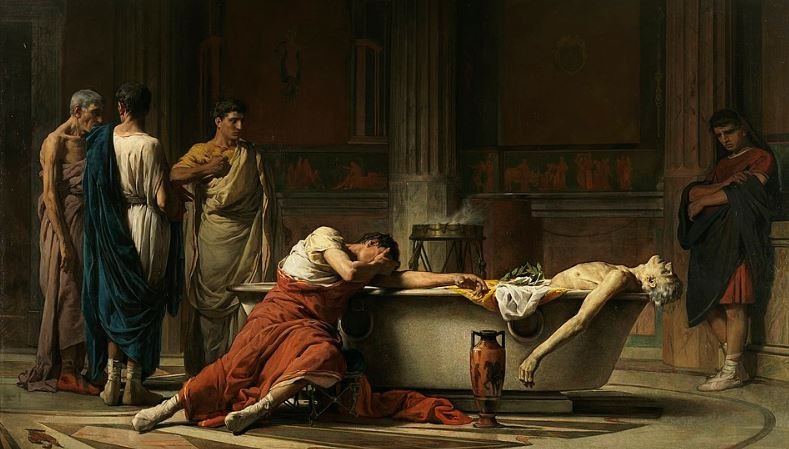
“Death of Seneca”, painting by Spanish painter Manuel Domínguez Sánchez.
In 65 AD, a plot to kill Nero—called the Pisonian Conspiracy—was uncovered. Seneca was implicated, though most historians agree he probably wasn’t involved. Still, Nero ordered him to commit suicide.
Seneca met his death with the calm dignity befitting a Stoic. He tried to bleed out by opening his veins. When that didn’t work quickly enough—his body was weakened by age and a strict diet—he drank poison and finally suffocated in a warm bath, hoping the steam would hasten death.
His wife, Paulina, tried to join him in death, but Nero’s men stopped her. Seneca’s last moments, attended by friends and pupils, were recorded by Tacitus, who paints them with a blend of admiration and skepticism. To some, it was a noble end. To others, a carefully staged performance.
The Philosopher: Stoicism and Practical Ethics
Seneca is best known as a Stoic philosopher, but he wasn’t just parroting Greek ideas. He adapted Stoicism to the Roman world, making it more personal, more practical, and more emotionally aware.
He believed in confronting suffering, practicing virtue, facing death with calm, and managing destructive emotions like anger and grief. Unlike earlier Stoics, who often emphasized logic, Seneca focused on the human side of philosophy—the part that helps you survive loss, betrayal, illness, and injustice.
His works like On Anger, On the Shortness of Life, On the Firmness of the Wise, and of course, his letters, remain some of the clearest, most relatable expressions of ancient philosophy available today.
The Dramatist: Dark Tragedies and Unchecked Passion
While he wrote philosophy, Seneca also penned ten tragedies, though scholars believe only eight are genuinely his. These include Medea, Thyestes, Phaedra, Hercules Furens, and Troades.
They’re filled with intense emotions, moral dilemmas, and violent ends. Critics have long debated how a Stoic could write such passion-driven works. Maybe they were moral warnings. Maybe they were literary exercises. Or maybe Seneca, like all of us, wrestled with the very emotions he tried to master.
His tragedies had a massive impact on Renaissance drama, inspiring playwrights like Shakespeare, Racine, and Kyd, especially in the genre of Revenge Tragedy. Thyestes in particular, with its themes of vengeance and cannibalism, remains one of the darkest and most influential plays of antiquity.
READ ALSO: 10 Most Renowned English Poets and their Best-Known Works
A Complicated Legacy: Saint, Hypocrite, or Sage?
Seneca’s reputation has always been a bit of a paradox. To early Christians, he was almost a proto-saint. A forged correspondence with St. Paul even tried to link him directly to Christian thought. By the Middle Ages, his moral essays and letters were widely read, often quoted in sermons and treatises.
The Renaissance rediscovered him with gusto. Writers like Erasmus, Calvin, and Montaigne admired his clarity and ethics. But his critics didn’t go away. Many pointed out the contradictions between his wealth and his philosophy. Even Tacitus seemed unsure whether to praise or critique him.
Modern scholars like Martha Nussbaum have given Seneca a fresh look, especially for his insights into emotions, anger, and political ethics. Others have noted his subtle approach to education, gratitude, and moral resilience.
Still Speaking: Seneca’s Enduring Voice
Today, Seneca is one of the most widely read Roman philosophers. His words resonate in a world still grappling with anxiety, ambition, grief, and injustice. His essays are studied in philosophy classes. His letters are quoted in self-help books. His tragedies are staged in modern theaters.
Seneca’s life wasn’t flawless—far from it. He was rich while preaching frugality. He advised a tyrant while writing about virtue. But maybe that’s why he still matters. He didn’t write from an ivory tower. He lived through the mess, the politics, the contradictions—and still tried to live wisely.
And in that, maybe, we find the real Stoicism—not cold detachment, but the courage to strive for virtue in an imperfect world.
QUESTIONS AND ANSWERS
Where was Seneca born and what was his background?
Seneca was born in Corduba (modern Córdoba, Spain) around 4 BC to a wealthy Roman family. His father, Seneca the Elder, was a well-known rhetorician, and his family had strong literary and political ties.
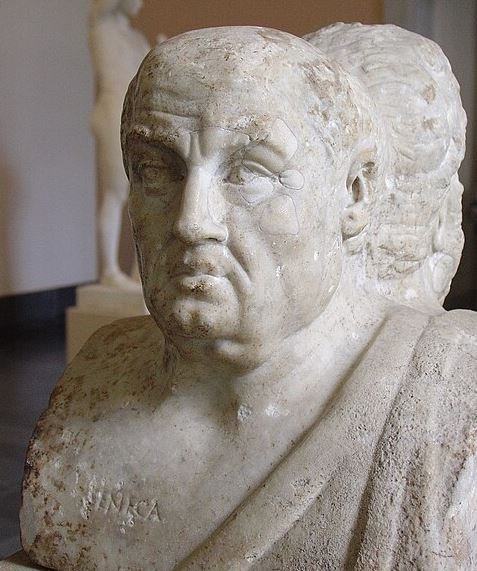
Bust of Seneca the Younger
What kind of education did Seneca receive?
He was brought to Rome as a child and received elite training in grammar, rhetoric, and philosophy. He studied Stoicism and also learned from teachers of the School of the Sextii, blending Stoic and Pythagorean ideas.
How did Seneca begin his political career?
After recovering from health issues in Egypt, Seneca became a quaestor and gained a seat in the Senate, earning praise for his oratory skills.
Why was Seneca exiled in AD 41?
He was accused of adultery with Julia Livilla, likely a politically motivated charge. Claudius commuted his death sentence to exile on Corsica, where Seneca remained for eight years.
How did Seneca return to political life?
In 49 AD, Agrippina the Younger arranged his return and appointed him as tutor to her son, Nero, positioning Seneca at the heart of imperial power.
What role did Seneca play in Nero’s early reign?
From 54 to 62 AD, Seneca was a key advisor to Nero, shaping policies, writing speeches, and helping maintain a stable administration during Nero’s early years.

Nero’s head from a monumental statue on display at Glyptothek, Munich.
How did Seneca respond to Nero’s growing tyranny?
Seneca tried to influence Nero toward virtuous rule, writing works like On Clemency, but eventually withdrew from court life as Nero became more ruthless.
What criticisms did Seneca face during his career?
He was accused of hypocrisy for amassing great wealth while preaching Stoic simplicity. Critics like Publius Suillius accused him of corruption and greed.
What were Seneca’s most important philosophical works?
His key works include Letters to Lucilius, On the Shortness of Life, On Anger, On the Happy Life, and Naturales Quaestiones. These writings explore ethics, emotion, mortality, and the Stoic ideal.
How did Seneca die?
In 65 AD, after being accused of involvement in a plot against Nero, Seneca was forced to commit suicide. He calmly faced death by opening his veins, drinking poison, and entering a warm bath to speed his death.
What is Stoicism, and how did Seneca interpret it?
Stoicism is a philosophy that emphasizes virtue, reason, and emotional control. Seneca adapted it to Roman life, stressing practical ethics, resilience, and acceptance of fate.
What is the significance of Seneca’s tragedies?
Seneca wrote intense tragedies like Thyestes, Medea, and Phaedra, which influenced Renaissance and Elizabethan drama, especially the revenge tragedy genre.
How was Seneca viewed in later centuries?
He was admired by early Christians, Renaissance thinkers, and Enlightenment writers, though his reputation has also been marked by debates over his integrity and lifestyle.
Seneca’s insights on time, anger, mortality, and moral clarity continue to resonate in modern philosophy, self-improvement literature, and discussions on how to live meaningfully.