Who were the Ionians of Ancient Greece?
The Ionians were one of four major ancient Greek tribes, alongside Dorians, Aeolians, and Achaeans. The dialect of the Ionians was a key linguistic division in the Hellenic world. Narrowly, “Ionian” referred to Ionia in Asia Minor, but broadly it included speakers in Euboea, the Cyclades, and Ionian colonies.
In the article below, World History Edu delves into origins, culture and accomplishment of the Ionians of ancient Greece.
Etymology and Early Origins
The term “Ionians” (Greek: Ἴωνες or Ἰᾱ́ϝoνες) has an enigmatic origin, with several scholarly theories attempting to trace its roots.
One prominent hypothesis suggests a Proto-Indo-European onomatopoeic root *wi- or *woi-, which may relate to a shout for assistance, potentially translating to “devotees of Apollo.”
Another theory posits that the name derives from an early eastern Mediterranean island population, referenced in ancient Egyptian as ḥꜣw-nbwt.
Additionally, the root *uiH-, meaning “power,” has been proposed as a possible source. Despite these theories, the exact etymological origins of “Ionians” remain unresolved, highlighting the complexities of tracing ancient tribal names.

Image: A wall relief of an Ionian soldier.
Early Historical References
Ionians are not the earliest Greeks documented in historical records; the Danaans and Achaeans precede them. The earliest Ionian references appear in Mycenaean Crete, where a fragmentary Linear B tablet from Knossos (tablet Xd 146) mentions “i-ja-wo-ne,” likely an ethnic designation predating Dorian dominance. Dated to around 1400 or 1200 B.C., these tablets indicate that Ionians were present in Crete before their later prominence in Greek history.
Classical Greek Literature
In classical Greek literature, Homer provides one of the earliest mentions of the Ionians. In “The Iliad,” he refers to them as Ἰάονες (iāones), associating them with Athenians during a conflict with Hector. Similarly, Hesiod references them in the singular form, Ἰάων (iāōn). These mentions align closely with the Mycenaean forms found in Linear B, suggesting a continuity of Ionian identity from the Mycenaean period into later Greek culture.
Biblical and Near Eastern Connections
In the Hebrew Bible, the term Yavan (Yāwān) represents the Greek-speaking world and is widely believed to correspond to the Ionians. Yavan is considered to symbolize the Greeks and Macedonians, linking the Ionians to broader Near Eastern identities.
This connection is further supported by ancient sources where Yevana aligns with the Hittites and Persian records mention Yauna, correlating directly with Ionians in Asia Minor. These references underscore the Ionians’ significant presence and influence across various civilizations in the Near East.
Assyrian Records and Ionian Raids
Assyrian records from the 8th century BCE provide evidence of Ionian activities, notably raids on Phoenician cities. Letters from Tiglath-Pileser III in the 730s BCE document attacks by groups identified as Ionians (ia-u-na-a-a) on the Phoenician coast.
Additionally, regions like Yadnana in Cyprus are mentioned, suggesting that some Ionians originated from or operated in Cyprus. These records highlight the Ionians’ active maritime presence and their interactions, both hostile and cooperative, with other civilizations in the eastern Mediterranean.
Ionians in the Achaemenid Persian Empire
Within the Achaemenid Persian Empire, Old Persian inscriptions refer to the Ionians as Yaunā (𐎹𐎢𐎴𐎠), distinguishing them within the empire’s diverse provinces. Inscriptions by rulers such as Darius mention Ionians inhabiting both mainland Greece and coastal regions, indicating their significant role within the empire. The presence of Ionians in various Persian provinces demonstrates their integration and influence in the vast and culturally diverse Achaemenid realm.
Ionians in Indic Literature and the Indo-Greek Kingdoms
In Indic literature, influenced by Achaemenid Iranians, the Ionians are referred to as Yavana or Yona. Ashoka’s Edicts, dating to circa 250 BCE, mention the Seleucid king Antiochos as “Aṃtiyako Yona Rājā” (“The Yona king Antiochos”), indicating a Greek-Macedonian presence in the Indian subcontinent.
These references are associated with the Indo-Greek Kingdoms established by Alexander the Great and his successors, reflecting the enduring legacy of the Ionians in regional politics and cultural exchanges across Asia.
Chinese Historical Accounts
Chinese historical texts refer to the Ionians as Dayuan (大宛), associated with the Ferghana Valley in Central Asia. Descriptions from “Records of the Grand Historian” and the “Book of Han” link Dayuan to the Hellenistic polis Alexandria Eschate (modern Khujand, Tajikistan). This connection suggests a relationship between Greek settlers and Central Asian polities, illustrating the geographical spread and influence of Ionian culture beyond the traditional boundaries of the Greek world.
Linguistic Legacy in Modern Languages
The legacy of the Ionians persists in modern Western Asian languages, where terms like Yavan in Hebrew, Hunastan in Armenian, al-Yūnān in Arabic, Yūnānestān in Persian, and Yunanistan in Turkish refer to Greece and Greeks. This linguistic continuity underscores the lasting impact of the Ionian identity on the perception and naming of Greek people across diverse cultures and languages.
The Ionic Language and Its Significance
The Ionic language was a prominent dialect of Ancient Greek, part of the Attic–Ionic or Eastern dialect group. It encompassed varieties spoken in regions such as Euboea (West Ionic), the northern Cyclades (Central Ionic), and Asiatic Ionia, where Ionian colonists established cities around 1000 BCE.
Ionic served as the foundation for several literary forms during the Archaic and Classical periods, including Homeric epics like “The Iliad” and “The Odyssey,” as well as Hesiod’s works.
Over time, the Attic dialect supplanted Ionic, becoming the dominant form of the Greek language and literature by the 5th century BCE. The Ionic dialect’s literary prominence played a crucial role in shaping Greek cultural and intellectual traditions.
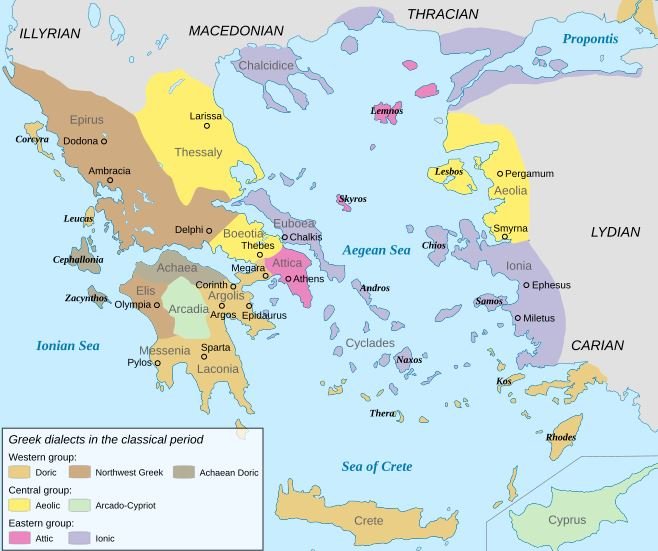
Image: This map illustrates the various ancient Greek dialects.
Pre-Ionic Ionians and Mycenaean Roots
Pre-Ionic Ionians trace their origins back to mainland Greece during the Mycenaean period, as suggested by literary sources that indicate an Ionian identity prior to the establishment of Ionia. Although archaeological inscriptions from this era are limited, the literary tradition implies a longstanding presence of Ionians in mainland Greece before their migration and colonization of Asia Minor. This early Ionian identity laid the groundwork for their later cultural and political developments.
Herodotus’ Account of Ionian Origins
Herodotus of Halicarnassus provides one of the most detailed accounts of Ionian origins. He asserts that the Ionians descended from Ion, son of Xuthus, and were considered the least esteemed among the Hellenic tribes, with Athens serving as their primary city.
Herodotus describes the Ionians’ expansion from Athens to various Aegean islands, including Sifnos, Serifos, Naxos, Kea, and Samos. He also notes their earlier residence in Achaea before being displaced by Dorian invasions.
According to Herodotus, the Ionians subsequently moved to Attica and later to Asia Minor, where they founded twelve cities modeled after those in Achaea. This narrative emphasizes the Ionians’ migration and settlement patterns, highlighting their adaptability and influence across different regions.

Image: Herodotus (c. 484 BC – c. 425 BC)
Strabo’s Perspective on Ionian Migration
Strabo offers an alternative origin story, enriching the narrative of Ionian migration and settlement. According to Strabo, Ion, son of Xuthus and grandson of Hellen, married the daughter of Erechtheus of Athens.
Their descendants established Attica’s Tetrapolis, a rural district, and later colonized Asia Minor, founding twelve cities modeled after those in Achaea.
Strabo’s account underscores the interconnectedness of Ionian and Achaean communities and highlights the strategic migrations that facilitated the Ionians’ expansion and cultural influence in both mainland Greece and Asia Minor.
The Ionian School of Philosophy
One of the most significant accomplishments of the Ionians lies in their contributions to philosophy and scientific thought.
During the 6th century BCE, Ionian coastal cities such as Miletus and Ephesus became centers of intellectual revolution.
Philosophers like Thales led the Ionian School, which focused on natural explanations for phenomena, moving away from mythological interpretations. This school emphasized rationality, empirical observation, and the formulation of hypotheses based on personal experience and reflection.
The Ionian philosophers, known as physiologoi, sought to understand the universe through logical and evidence-based methods, laying the groundwork for scientific inquiry and rational thought in Western philosophy. Their pioneering efforts marked the first great scientific revolution and established principles that would influence subsequent generations of thinkers.

Cultural and Scientific Legacy
The Ionian School’s emphasis on naturalistic explanations and rational inquiry had a profound impact on Greek culture and beyond. Their approach to understanding the natural world fostered a spirit of inquiry and critical thinking that became foundational to Western intellectual traditions.
The works of Ionian philosophers influenced later philosophical schools, including the Platonic and Aristotelian traditions, and contributed to advancements in various scientific disciplines. The legacy of the Ionians in promoting logic, evidence-based reasoning, and systematic study remains integral to modern scientific and philosophical practices.
Ionian Colonization and Expansion
The Ionians were instrumental in the colonization and expansion of Greek culture across the Mediterranean and Black Sea regions. Their establishment of cities in Asia Minor, such as Miletus, Ephesus, and Smyrna, facilitated the spread of Greek culture, language, and political structures. These colonies became vibrant centers of trade, art, and intellectual exchange, contributing to the Hellenistic civilization’s richness and diversity.
Ionian colonization also played a key role in the dissemination of Greek philosophy, science, and democratic ideals, further solidifying their influence in the ancient world.
Political and Social Structures
The Ionians were notable for their contributions to political and social structures, particularly in the development of democracy. Athens, the most prominent Ionian city, became a model of democratic governance, emphasizing citizen participation, debate, and legislative decision-making.
The Ionian emphasis on civic engagement and political innovation influenced other Greek city-states and laid the foundations for modern democratic systems. Additionally, the Ionians’ social structures, which valued education, public discourse, and cultural achievements, fostered an environment conducive to intellectual and artistic flourishing.
Art and Architecture
Ionian contributions to art and architecture are also significant. Ionian architectural styles, characterized by elegant proportions and decorative elements, influenced the broader Greek architectural tradition. The use of columns, intricate friezes, and harmonious designs in Ionian buildings set aesthetic standards that were emulated throughout the Greek world.
In art, the Ionians excelled in sculpture, pottery, and other decorative arts, creating works that reflected their philosophical ideals and cultural values. These artistic achievements not only enhanced the aesthetic landscape of ancient Greece but also served as mediums for expressing and disseminating Ionian thought and philosophy.
Economic and Trade Networks
The Ionians established extensive trade networks that connected various regions of the ancient world. Their strategic locations along the coast facilitated maritime trade, enabling the exchange of goods, ideas, and cultural practices.
Ionian cities became bustling hubs of commerce, attracting merchants, artisans, and intellectuals from diverse backgrounds. These economic networks not only enriched Ionian cities but also contributed to the interconnectedness of different civilizations, fostering cultural and technological exchanges that spurred innovation and development across regions.
Military Engagements and Conflicts
While the Ionians are often celebrated for their cultural and intellectual achievements, they were also involved in military engagements and conflicts. Assyrian records from the 8th century BCE document Ionian raids on Phoenician cities, indicating their active participation in regional power dynamics.
Additionally, Ionian cities faced invasions and conquests, such as those by the Dorians, which led to migrations and the establishment of new settlements. These military interactions shaped the geopolitical landscape of the ancient Mediterranean, influencing the distribution of power and the formation of alliances among different Greek tribes and neighboring civilizations.
Religious and Mythological Contributions
The Ionians also made significant contributions to Greek religion and mythology. As devotees of Apollo, one of the major Olympian gods, the Ionians played a key role in the worship and dissemination of his cult.
Their religious practices and festivals, such as the Apaturia, emphasized communal worship, artistic expression, and philosophical reflection. Ionian myths and legends, often intertwined with their philosophical inquiries, enriched the broader tapestry of Greek mythology, providing narratives that explored themes of nature, divinity, and human existence.
Decline and Legacy
The decline of Ionian dominance began with the rise of other Greek powers and external conquests, such as those by the Persians and later the Macedonians under Alexander the Great. Despite these challenges, the legacy of the Ionians endured through their contributions to philosophy, science, art, and political thought.
The intellectual foundations laid by Ionian philosophers continued to influence subsequent generations, while their cultural and architectural achievements left an indelible mark on the Greek world and beyond. The enduring recognition of Ionian contributions underscores their pivotal role in shaping the trajectory of Western civilization.
Conclusion
The Ionians of Ancient Greece were a remarkable tribe whose origins, though somewhat obscure, led to significant historical and cultural developments. From their early mentions in Mycenaean Crete to their widespread influence across the Mediterranean, Near East, and even into Central Asia and India, the Ionians played a crucial role in the dissemination of Greek culture and intellectual traditions. Their accomplishments in philosophy, language, political structures, art, and trade not only enriched their own society but also laid the groundwork for future advancements in Western thought and civilization.
Frequently Asked Questions

What are the primary theories regarding the etymology of the term “Ionians”?
The etymology of “Ionians” (Ἴωνες or Ἰᾱ́ϝoνες) is uncertain, with several theories proposed:
- Proto-Indo-European Root: Derived from *wi- or *woi-, an onomatopoeic root expressing a shout for assistance, possibly meaning “devotees of Apollo.”
- Ancient Egyptian Connection: From an early eastern Mediterranean island population’s name, represented by ḥꜣw-nbwt.
- Power-Related Root: From the Proto-Indo-European root *uiH-, meaning “power.” Despite these hypotheses, the exact origin remains unclear.
Where are the earliest historical references to the Ionians found?
The earliest references to the Ionians are found in Mycenaean Crete. A fragmentary Linear B tablet from Knossos (tablet Xd 146) mentions “i-ja-wo-ne,” likely an ethnic name predating Dorian dominance. These tablets date to around 1400 or 1200 B.C., indicating the presence of Ionians before they became prominent in later Greek history.
How do Homer and Hesiod reference the Ionians in their works?
In classical Greek literature:
- Homer: Mentions the Ionians as Ἰάονες (iāones) in “The Iliad,” associating them with Athenians during a conflict with Hector.
- Hesiod: References them singularly as Ἰάων (iāōn) in his works. These early mentions align with the Mycenaean forms, suggesting a continuity of Ionian identity into later Greek culture.
How are the Ionians depicted in the Hebrew Bible, and what is their significance?
In the Hebrew Bible:
- Yavan (Yāwān): Represents the Greek-speaking world, likely referring to the Ionians. This term is believed to correspond to the Greek “Ion” and serves as a name for Greeks and Macedonians.
- Biblical Connections: Yavan is linked to broader Greek and Macedonian identities in Near Eastern texts, aligning with references in other ancient sources such as Yevana with the Hittites and Yauna in Persian records.
What do Assyrian records from the 8th century BCE reveal about the Ionians?
Assyrian records from the 8th century BCE document Ionian raids on Phoenician cities. For example:
- Tiglath-Pileser III’s Letter (730s BCE): Reports raids by the Ionians (ia-u-na-a-a) on the Phoenician coast.
- Geographical References: Mentions regions like Yadnana in Cyprus, suggesting that some Ionians originated from or operated in Cyprus. These records indicate active Ionian presence and interactions in the eastern Mediterranean.
How are the Ionians identified in Old Persian inscriptions of the Achaemenid Empire?
In the Achaemenid Persian Empire:
- Yaunā (𐎹𐎢𐎴𐎠): Refers to the Ionians, with distinctions made between those on the mainland and by the sea.
- Darius’s Inscriptions: Mention Ionians in various provinces, indicating their habitation in both mainland Greece and coastal regions. These inscriptions highlight the Ionians’ integration into the diverse provinces of the Persian Empire.
What is the significance of the terms “Yavana” and “Yona” in Indic literature concerning the Ionians?
In Indic literature:
- Yavana/Yona: Derived from the Ionian legacy, influenced by Achaemenid Iranians.
- Ashoka’s Edicts: Refer to the Seleucid king Antiochos as “Aṃtiyako Yona Rājā” (“The Yona king Antiochos”), indicating Greek-Macedonian presence in the Indian subcontinent.
- Indo-Greek Kingdoms: These terms pertain to the states formed by Alexander the Great and his successors in India, reflecting the enduring Ionian influence in regional politics and culture.
How do Chinese historical texts refer to the Ionians, and what connection do they make to Central Asia?
In Chinese historical texts:
- Dayuan (大宛): The Chinese exonym for a country in the Ferghana Valley, Central Asia.
- Historical Accounts: Descriptions from the “Records of the Grand Historian” and the “Book of Han” link Dayuan to the Hellenistic polis Alexandria Eschate (modern Khujand, Tajikistan).
- Connection: Suggests a relationship between Greek settlers and Central Asian polities, indicating the geographical spread of Ionian influence.
What role did the Ionian School of philosophy play in the development of Western thought?
The Ionian School of philosophy, emerging in the 6th century BCE in coastal Ionian cities like Miletus and Ephesus, was pivotal in shaping Western thought:
- Philosophers: Figures like Thales led the movement towards natural explanations of phenomena, rejecting mythological interpretations.
- Approach: Emphasized rationality and empirical observation, laying the groundwork for scientific inquiry.
- Impact: Ionian philosophers, known as physiologoi, shifted Greek thought towards logic and evidence-based understanding, significantly influencing the development of Western philosophy and the scientific method.





