Life and Military Career of General Arthur Percival

General Percival’s legacy remains controversial, with ongoing debate among historians about his role in the fall of Singapore. His career reflects the complexities of wartime leadership under difficult circumstances.
General Arthur Percival was a British Army officer best known for his role in the fall of Singapore during World War II, one of the most significant and controversial defeats in British military history. His life and military career, however, were much more complex and multifaceted than this single event suggests.
In the article, leading WWII historians at World History Edu provide a comprehensive exploration that covers General Percival’s early life, military rise, service in World War I, interwar years, World War II, and his legacy.
Early Life and Education
Arthur Ernest Percival was born on December 26, 1887, in Aspenden, Hertfordshire, England. He came from a modest background, his father being a tenant farmer. Percival was educated at Rugby School, a prestigious institution known for producing many notable military and political figures. Following his schooling, he worked in the timber industry before deciding to pursue a military career later in life compared to most officers of his era.
Percival joined the British Army’s Officers’ Training Corps in 1914, just as World War I was breaking out. His late entry into the army didn’t hinder his rapid advancement, largely due to his exceptional leadership skills and tactical acumen.
World War I Service
Percival’s military career began in earnest with World War I, where he served with distinction. He was commissioned into the British Army and assigned to the newly formed 7th Battalion of the Bedfordshire Regiment. Initially a junior officer, Percival quickly proved himself in the heat of battle. He fought in the trenches on the Western Front, participating in some of the most grueling battles of the war.
In 1916, he was involved in the Battle of the Somme, one of the largest and bloodiest campaigns of the conflict. Percival’s courage under fire and his ability to lead men in extreme conditions earned him a promotion to captain and later to major. His actions during the war were recognized with several awards, including the Military Cross, a decoration for gallantry during active operations against the enemy.
Percival’s service in World War I shaped his military philosophy and leadership style. The brutal trench warfare he experienced deeply influenced his views on defense and fortification, which would later play a critical role in his decisions during World War II.
Interwar Military Career
After World War I, Percival remained in the British Army and continued to build his career. He served in Ireland during the Irish War of Independence (1919–1921), where he commanded units involved in counterinsurgency operations against the Irish Republican Army (IRA). Percival’s time in Ireland was controversial, as he was seen as a tough and efficient officer, implementing harsh tactics to suppress the insurgency.
Following his time in Ireland, Percival was posted to various roles in the British Empire, including service in the Sudan and Malaya. His experiences in colonial administration and defense planning would later influence his command decisions during World War II.
By the mid-1930s, Percival had risen through the ranks to become a full colonel. His expertise in jungle warfare, gained during his time in Malaya, and his knowledge of fortifications from his World War I experience positioned him as a respected officer within the British military establishment.

British Army Officer Percival in Ireland
World War II: The Fall of Singapore
Arthur Percival’s military legacy is most closely tied to his role in the defense of Singapore during World War II. In 1941, as the British Empire faced the expanding threat of Imperial Japan in Southeast Asia, Percival was appointed General Officer Commanding (GOC) of Malaya. His primary responsibility was to defend British interests in Malaya and Singapore, considered vital strategic strongholds in the region.
Strategic Importance of Singapore
Singapore, known as the “Gibraltar of the East,” was a key British naval base and a symbol of British colonial power in Asia. Its fall was considered unthinkable by British authorities, who had invested heavily in its fortifications and believed it to be an impregnable fortress. However, several critical factors contributed to Singapore’s vulnerability, many of which would become apparent during the Japanese invasion.
One of the most glaring issues was the underestimation of Japan’s military capabilities. The British believed the Japanese would attack from the sea, so they heavily fortified the southern coastal defenses. However, they neglected to secure the northern approaches through Malaya, assuming the dense jungles would prevent a land-based assault. This miscalculation would prove disastrous.
Japanese Invasion of Malaya
On December 8, 1941, just hours after the attack on Pearl Harbor, Japanese forces launched a swift and highly coordinated invasion of Malaya. General Tomoyuki Yamashita, commanding the Japanese 25th Army, utilized fast-moving infantry and tanks to overwhelm the British defenses. The Japanese made extensive use of air superiority, and their highly trained troops were experienced in jungle warfare, giving them a decisive advantage.

General Tomoyuki Yamashita and the Malayan Campaign
Percival’s forces, despite their training and familiarity with the terrain, were outmatched by the speed and efficiency of the Japanese advance. The British defenses in Malaya crumbled rapidly, with key cities like Kuala Lumpur falling within weeks. Percival’s troops, a mix of British, Indian, Australian, and local forces, were inadequately equipped and suffered from poor coordination. Moreover, the British military underestimated the effectiveness of the Japanese strategy of bypassing fortified positions and striking at the rear.
By early February 1942, Japanese forces had reached the island of Singapore. Despite being outnumbered and undersupplied, the Japanese launched an audacious attack across the Johore Strait, bypassing many of the British coastal defenses. British forces were soon pushed back to the city of Singapore itself.
READ ALSO: How and why did Japan get involved in WWII?
The Surrender of Singapore

Lieutenant-General Arthur Percival (right), escorted by Ichiji Sugita, walks under a flag of truce to negotiate Commonwealth forces’ surrender in Singapore, February 15, 1942.
On February 15, 1942, after a week of intense fighting, General Percival faced an agonizing decision. His forces were running out of food, ammunition, and other essential supplies. Civilian casualties were mounting, and the city’s infrastructure was being destroyed by relentless Japanese air raids. With no hope of reinforcements and further resistance likely to result in a massacre, Percival chose to surrender.
The surrender of Singapore was one of the darkest moments in British military history. Over 80,000 British, Australian, and Indian troops were taken prisoner, making it the largest surrender of British-led forces ever. The fall of Singapore sent shockwaves throughout the British Empire and emboldened Japanese forces in their campaign to dominate Southeast Asia.
Percival himself became a prisoner of war and was treated with disdain by his Japanese captors, who considered his surrender a personal humiliation. He was sent to a POW camp in Manchuria, where he remained for the duration of the war.
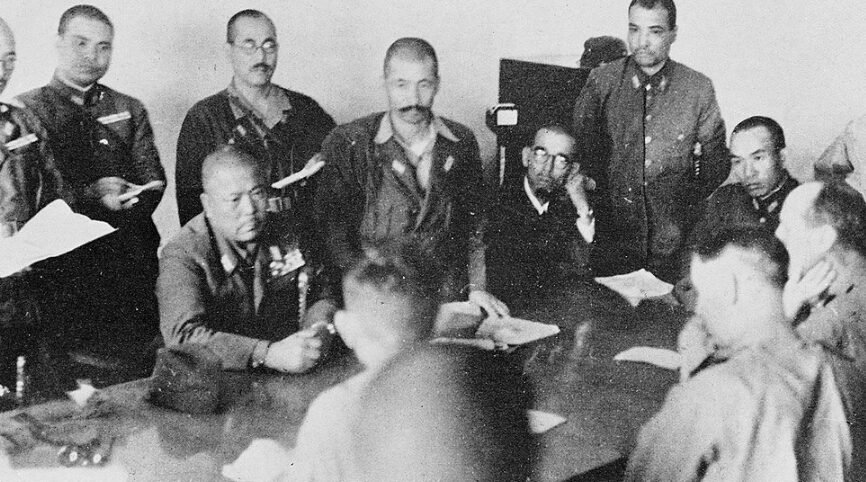
Japanese General Yamashita (seated, center) pounds the table, demanding unconditional surrender, as General Percival sits between his officers, hand clenched to his mouth.
Post-War Life and Legacy

Supreme Allied Commander General Douglas MacArthur signs the Instrument of Surrender for the Allies, with Generals Wainwright and Percival, former Japanese prisoners, standing behind him.
After Japan’s surrender in 1945, Percival was liberated from captivity and returned to Britain. Despite his long and distinguished military career, Percival’s reputation was overshadowed by the fall of Singapore. Many in Britain and Australia blamed him for the defeat, criticizing his leadership and decision-making during the Malayan campaign.
Percival defended his actions, arguing that he had been placed in an impossible situation with inadequate resources and insufficient intelligence about Japanese capabilities. He maintained that the decision to surrender was necessary to avoid needless civilian casualties and further destruction.
In 1945, Percival attended the Japanese surrender ceremony aboard the USS Missouri in Tokyo Bay. His presence, alongside General Jonathan Wainwright, another senior Allied officer who had been held as a POW, was a symbolic moment of Allied resilience and the eventual triumph over Japan.
Following the war, Percival retired from the military and lived a quiet life. He wrote a memoir, The War in Malaya, in which he detailed his experiences and attempted to explain the decisions that led to the fall of Singapore. While his account provided valuable insights, it did little to change public perception of his role in the disaster.
Percival spent his post-war years engaging in charitable work and supporting veterans’ causes. He lived out the remainder of his life in England and passed away on January 31, 1966, at the age of 78.
Assessment of Percival’s Legacy
Arthur Percival’s military career is often defined by the fall of Singapore, and his legacy remains a subject of debate among historians. Some view him as a competent and dedicated officer who was placed in an untenable situation due to broader strategic failures and a lack of resources. Others argue that his defensive mindset, influenced by his World War I experience, led to a failure to adapt to the new realities of modern warfare, contributing to the swift Japanese victory.
One of the primary criticisms of Percival’s leadership was his failure to anticipate and prepare for the possibility of a land-based attack through Malaya. His reliance on static defenses and his underestimation of the Japanese ability to conduct rapid, mobile warfare were major factors in the fall of Singapore. Additionally, some critics argue that Percival’s leadership style was too cautious and indecisive during the critical stages of the Japanese invasion.
However, it is important to consider the context in which Percival was operating. The British military in Southeast Asia was stretched thin, and many of the troops under his command were inexperienced or poorly equipped. Furthermore, the underestimation of Japanese capabilities was a widespread issue among British and Allied military leaders at the time.
In the years following the war, there has been a more nuanced re-evaluation of Percival’s role in the fall of Singapore. While his leadership during the campaign remains controversial, many historians acknowledge the broader strategic and logistical challenges he faced. The lack of air support, the failure to secure reinforcements, and the under-preparation of Singapore’s defenses all contributed to the eventual defeat.
Conclusion
General Arthur Percival’s life and military career reflect the complexities of leadership during times of immense crisis. While he is often remembered for the fall of Singapore, his long service to the British Army, including his experiences in World War I and his counterinsurgency efforts in Ireland, demonstrate his dedication and skill as a military officer.





singapore was doomed no what .even if the allies had fought and defeated the jap forces .the japanese air force were superior in the air having 100 dive bombers to singapores nine .they could and probably would have bombed Singapore in to submission .they already destroyed the water supply and other infrastructure .if that happened singapore would have had no choice but to surrender .