Princess Roxana of Bactria
Roxana of Bactria, an influential figure in the ancient world, was born into a noble Bactrian family as the daughter of Oxyartes, a noble who served the satrap Bessus. Her life changed dramatically when Alexander the Great conquered Bactria and set his sights on the regions of Central Asia.
Roxana’s marriage to Alexander the Great and her subsequent life placed her in a prominent role during the tumultuous period following his sudden death, marking her as a key figure in the political landscape of Alexander’s fragmented empire.
Early Life and Marriage to Alexander the Great
Roxana’s exact date of birth remains uncertain, but she was raised as a princess in a powerful and culturally sophisticated region, Bactria, located in modern-day Afghanistan. Bactria was part of the Persian Empire, and its people fiercely resisted Alexander’s invasion.
Her father, Oxyartes, was among the nobles who opposed Alexander’s forces and supported Bessus, the Persian satrap and one of the primary resistors to Alexander’s advance. When Bessus was eventually captured and Alexander consolidated control over Bactria, Oxyartes and other local leaders, including the warlord Spitamenes, sought refuge in a fortress known as the Sogdian Rock, a formidable mountain stronghold.
It was at the Sogdian Rock that Roxana and Alexander first met. After a successful siege, Alexander celebrated his victory and reportedly met Roxana at a feast held by her father.
Ancient sources suggest that Alexander was captivated by Roxana’s beauty and charm, falling in love with her at first sight. Historians, however, point out that the marriage also had strategic importance: by marrying Roxana, Alexander established a crucial alliance with the people of Bactria and Sogdia, helping to stabilize the region by securing the loyalty of its nobility.
Despite opposition from his Macedonian companions, who preferred a Macedonian or Greek queen, Alexander married Roxana in 327 BC in a Macedonian ceremony, further symbolizing her acceptance into his culture.

Image: A painting by French artist André Castaigne entitled “The Wedding of Alexander and Roxane”
READ MORE: Famous Battles Alexander the Great Fought in
Life with Alexander and Political Implications
Roxana quickly adapted to her role as Alexander’s wife, and the marriage solidified political unity between the Greeks and the Bactrians. She accompanied Alexander during his campaigns, including his expedition into India, where she faced the challenges of living in military camps and enduring long marches.
Tragically, Roxana and Alexander’s first child was born during this campaign near the Acesines River in India but died soon after birth.
As Alexander continued his conquests, he began to integrate Persian customs and influence into his administration, creating tension with his Macedonian troops. In 324 BC, he married two more women of Persian nobility, Stateira II, daughter of the former Persian king Darius III, and Parysatis, daughter of Artaxerxes III, further aligning himself with the Persian elite. This decision might have been unsettling for Roxana, whose place in Alexander’s life now had to be shared with his other royal brides. To maintain her family’s influence, Alexander promoted Roxana’s brother to a position in his elite cavalry unit, strengthening her connections within his army.
However, Alexander’s sudden death in 323 BC threw Roxana’s future into uncertainty. Alexander’s passing left a power vacuum, and his empire—lacking a clear line of succession—began to fracture. With her husband gone, Roxana’s primary goal became securing her son’s inheritance and protecting her own position amid the political instability.
At the time of Alexander’s death, Roxana was pregnant, and speculation over the gender of her unborn child created significant intrigue. If her child was a son, he would be a legitimate heir to Alexander’s empire, but if she bore a daughter, her influence would be severely reduced.
Struggles for Power and Roxana’s Actions after Alexander’s Death
In the absence of Alexander, Roxana allegedly took drastic measures to secure her son’s position. With the support of Perdiccas, one of Alexander’s most trusted generals, she is believed to have orchestrated the murder of Stateira II and her sister Drypetis to eliminate any rivals who could challenge her son’s claim to the throne. This decisive act underscored Roxana’s determination to protect her child’s future.
Alexander’s generals, known as the Diadochi, were left to decide the succession. Perdiccas and another prominent general, Ptolemy (later Ptolemy I Soter), argued for a regency until Roxana’s child was born, hoping for a male heir. Meanwhile, the Macedonian soldiers, wary of the increasing Persian influence in Alexander’s court, resisted the idea of Roxana’s child as sole heir.
Ultimately, a compromise was reached in which Alexander’s half-brother, Philip III Arrhidaeus, was declared king, while Roxana’s unborn child would share the throne if it was a boy.
In 323 BC, Roxana gave birth to a son, Alexander IV, securing her position and temporarily solidifying her child’s claim to the throne. Her influence, however, was precarious, as Alexander’s empire continued to fragment. By 317 BC, Philip III’s wife, Eurydice, began to challenge Roxana’s status, further complicating the balance of power.
At this time, Alexander’s mother, Olympias, intervened, forming an alliance with Roxana and her son. Together, they fled to Epirus, where they sought safety from the political turmoil unfolding in Macedon.
Successor Wars that erupted after the death of Alexander the Great
Imprisonment and Assassination
Despite the temporary support of Olympias, Roxana’s fortunes continued to decline. In 316 BC, Cassander, one of Alexander’s former generals, sought to assert control over Macedon and establish his own rule. Cassander captured Olympias and executed her, removing a key ally of Roxana. He then imprisoned Roxana and Alexander IV in the citadel of Amphipolis under the guard of a general named Glaucias.
Despite her confinement, Roxana’s status as the mother of Alexander’s heir made her a symbol of the Argead dynasty, and she remained a potential rallying point for Macedonian loyalty.
Following the Third Diadochi War, a peace treaty was signed in 311 BC, recognizing Alexander IV’s claim to the throne and naming Cassander as his guardian. However, as Alexander IV grew closer to the age of maturity, factions supporting the Argead dynasty called for him to assume his rightful powers, posing a direct threat to Cassander’s ambitions.
To secure his rule, Cassander ordered the secret execution of Roxana and her son, Alexander IV, in 309 BC. According to sources, they were both poisoned, ending the bloodline of Alexander the Great.
Legacy and Archaeological Discoveries
The death of Roxana and her son marked the final dissolution of Alexander the Great’s immediate family and the end of the Argead dynasty. Her life and death underscore the complex, often dangerous political environment that followed Alexander’s death, as his generals and their successors carved out kingdoms for themselves from his former empire.
Roxana’s legacy has endured, symbolizing both the transient nature of political alliances and the often ruthless lengths individuals went to in pursuit of power during the Diadochi period. In the 1970s, the Greek archaeologist Manolis Andronikos discovered royal tombs at the Great Tumulus in Vergina, believed by some to contain the remains of Alexander IV and possibly Roxana, though this remains speculative. The discovery has sparked significant interest and provided insights into the funerary customs of Macedonian royalty.
Her story also permeates classical literature and art, reflecting her lasting influence. In one notable example, the Greek painter Echion depicted Roxana’s wedding to Alexander, a painting that received acclaim from the Olympic judge Proxenidas, who admired Echion’s work so much that he allowed the artist to marry his daughter. Additionally, the asteroid 317 Roxane was named in her honor, signifying her continued recognition in the modern era.

Image: Mosaic of Alexander the Great
Roxana in Literature and Myth
Roxana’s life has inspired various romanticized accounts, including the popular Alexander Romances. In some versions of these narratives, Roxana is portrayed as the daughter of Darius III rather than Oxyartes, with her marriage to Alexander depicted as a strategic union blessed by her father. In these accounts, she is often portrayed in royal regalia, symbolizing her link to the former Persian Empire and her position as a bridge between Persian and Greek cultures.
Conclusion
Roxana’s life and death illustrate the volatility of the post-Alexander world. Born a Bactrian princess, she rose to become the queen of one of the world’s greatest empires, only to see her status collapse amidst the ambitions and power struggles of Alexander’s generals.
Despite her tragic end, Roxana’s story reveals her resilience and strategic acumen as she navigated the male-dominated political landscape to secure her son’s future.
Frequently Asked Questions

Image: “Marriage of Alexander and Roxana” by Italian painter Il Sodoma.
Who was Roxana, and how did she come into Alexander the Great’s life?
Roxana was a Bactrian princess, the daughter of the nobleman Oxyartes, who served Bessus, the satrap of Bactria and Sogdia. She met Alexander after he captured the fortress known as the Sogdian Rock, where her father and allies had taken refuge.
What significant event occurred when Alexander met Roxana?
According to various sources, Alexander reportedly fell in love with Roxana at first sight. While the exact location of their first encounter is disputed, some accounts place it at the Sogdian Rock, while others suggest the fortress of Chorienes.
Why did Alexander marry Roxana, and how did it benefit him politically?
Alexander married Roxana both out of genuine affection and for political reasons. By marrying her, he gained loyalty from the Sogdian and Bactrian people, helping to stabilize these regions under his control.
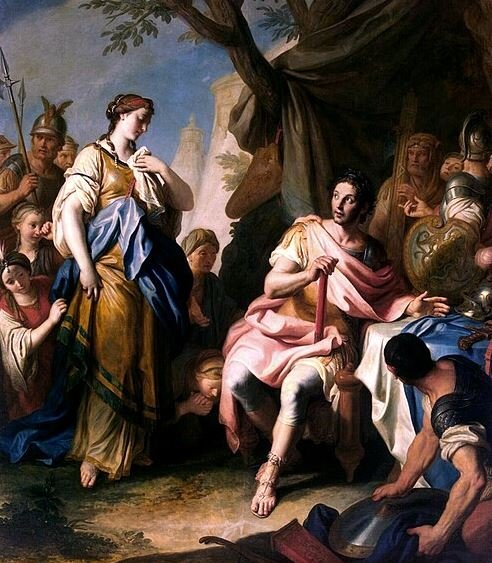
Image: “Alexander the Great and Roxana” by Italian painter Pietro Rotari.
What happened to Roxana and Alexander’s first child?
Roxana accompanied Alexander on his campaign into India, where she gave birth to a son near the Acesines River in 326 BC. Unfortunately, the child died shortly after birth.
How did Alexander the Great’s death affect Roxana’s position?
After Alexander’s death in 323 BC, Roxana’s position became precarious. She allegedly secured her son’s inheritance by murdering Alexander’s other wife, Stateira, and her sister, Drypetis, with the help of Alexander’s general Perdiccas.
What actions did Roxana take to protect her unborn child’s succession?
With Perdiccas’ support, Roxana took decisive steps to ensure her son’s inheritance, positioning herself to make her child, later named Alexander IV, an heir to Alexander’s empire alongside Philip III Arrhidaeus.
Who were Roxana’s main allies and opponents in her struggle to secure her son’s inheritance?
Roxana’s allies included Alexander’s general Perdiccas and Alexander’s mother, Olympias. Her main opponents were Philip III’s wife, Eurydice, and Cassander, who later imprisoned her and her son.
What was the significance of the treaty following the Third Diadochi War for Roxana and Alexander IV?
The 311 BC treaty recognized Alexander IV’s right to the throne and named Cassander as his guardian, temporarily securing Alexander IV’s position. However, Cassander saw Alexander IV as a threat to his power.
How and when did Roxana and her son Alexander IV die?
In 309 BC, Cassander ordered the execution of Roxana and Alexander IV. According to historical sources, they were poisoned, which effectively ended the Argead dynasty.
What archaeological discovery is associated with Roxana’s legacy?
In the 1970s, Greek archaeologist Manolis Andronikos discovered royal tombs at the Great Tumulus in Vergina. One of these tombs is believed to possibly contain the remains of Roxana and Alexander IV.
How has Roxana been commemorated in art and literature?
Roxana is honored through various cultural references, including the asteroid 317 Roxane and a famous painting by Echion depicting her marriage to Alexander. In the Alexander Romances, she is sometimes portrayed as the daughter of Darius III, adding a dramatic, romanticized element to her story.





