The Louvre Palace in Paris
The Louvre Palace (Palais du Louvre), situated on the Right Bank of the Seine in Paris, stands as one of the most iconic architectural landmarks of France. It extends between the Tuileries Gardens and the Church of Saint-Germain l’Auxerrois and has played multiple roles throughout history, evolving from a medieval fortress to a royal residence before becoming the world-famous Louvre Museum.
The Louvre Palace embodies centuries of political, artistic, and architectural transformations, reflecting the evolving identity of France.
Origins and Early History
The site of the Louvre had been occupied for thousands of years before its construction. The fortress of the Louvre was built by Philip II Augustus around 1190 as a defensive structure protecting Paris’s western front. It was part of the city’s fortifications and included a moat, thick walls, and a cylindrical keep. Over time, its military role diminished, and it began to serve other functions.
In the 14th century, King Charles V converted the fortress into a royal residence, adding turrets, windows, and decorations that transformed it into a gothic palace. However, the Louvre was soon overshadowed by other royal residences, and by the late 15th century, it had fallen into disrepair.
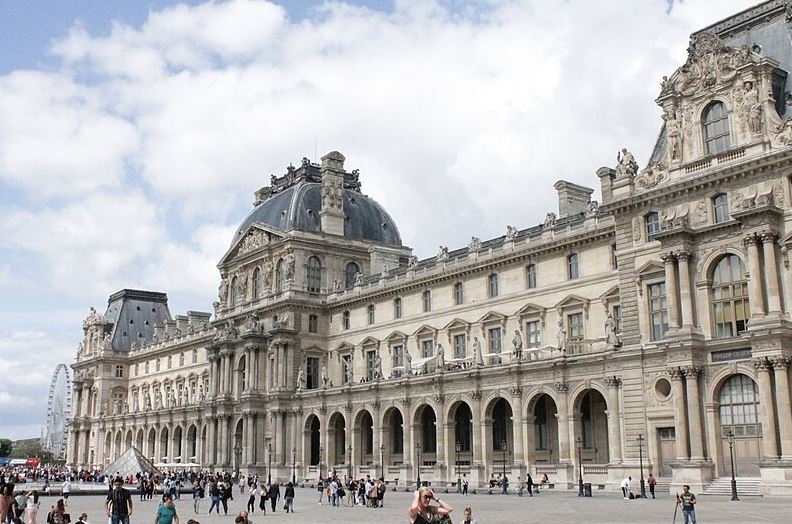
A view of the north wing of the Palace.
Renaissance and Early Modern Transformations (16th–18th Centuries)
In 1528, Francis I, known for his patronage of the arts, demolished the medieval keep and initiated the Louvre’s transformation into a Renaissance palace. He commissioned architect Pierre Lescot to redesign the Louvre with influences from Italian Renaissance architecture.
Lescot’s Lescot Wing, built between 1546 and 1551, set the foundation for the modern Louvre. It included ornate decorations, classical columns, and grand interiors, marking the first major shift in the palace’s design.
King Henry IV extended the Louvre by constructing the Grande Galerie (1595–1610) along the Seine, linking the palace to the Tuileries Palace (which had been built by Catherine de’ Medici in 1564). The Galerie housed France’s first national art collection, laying the groundwork for the Louvre’s future as a museum.
Under Louis XIII, architect Jacques Lemercier designed the Pavillon de l’Horloge (Clock Pavilion), further shaping the Louvre’s classical style. The construction of new wings expanded the Cour Carrée, the Louvre’s central courtyard.
King Louis XIV continued the transformation, envisioning a grand classical complex. He enlisted Louis Le Vau, Claude Perrault, and Charles Le Brun to design the Louvre Colonnade on the eastern façade, considered a masterpiece of French classicism.
However, Louis XIV moved the royal court to Versailles in 1682, halting further construction at the Louvre. The palace gradually became home to academies of painting and sculpture, solidifying its role as a cultural institution rather than a royal residence.
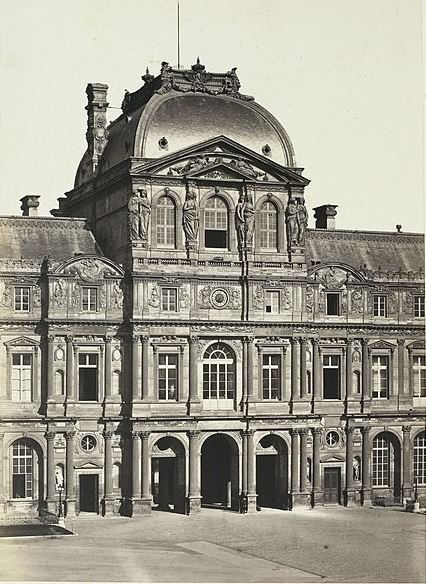
The Pavillon de l’Horloge of the Louvre. It was designed in 1624.
The Louvre as a Museum (18th–21st Century)
During the French Revolution, the Louvre was officially converted into a public museum in 1793. The Muséum Central des Arts opened its doors, displaying royal art collections confiscated from the monarchy and the aristocracy. Over time, Napoleon Bonaparte expanded the museum, renaming it Musée Napoléon and enriching its collection with artworks from across Europe.
In the mid-19th century, Emperor Napoleon III ordered the completion of the Louvre-Tuileries complex, linking the two palaces into a vast imperial complex. Architect Hector Lefuel completed the Richelieu and Denon wings, creating the Louvre’s final U-shaped layout.
Initiated in the 1980s, the Grand Louvre project expanded exhibition spaces, reorganized collections, and improved visitor accessibility, making the Louvre the world’s largest museum.
The Paris Commune of 1871 led to the destruction of the Tuileries Palace, which was set ablaze. This event permanently altered the Louvre’s design, leaving the Cour Napoléon open and redefining the palace’s spatial configuration.
In 1981, President François Mitterrand launched the Grand Louvre Project, which aimed to modernize and expand the museum. Architect I. M. Pei designed the Louvre Pyramid (1989) as the new main entrance, providing greater accessibility while integrating modern aesthetics with historical architecture.
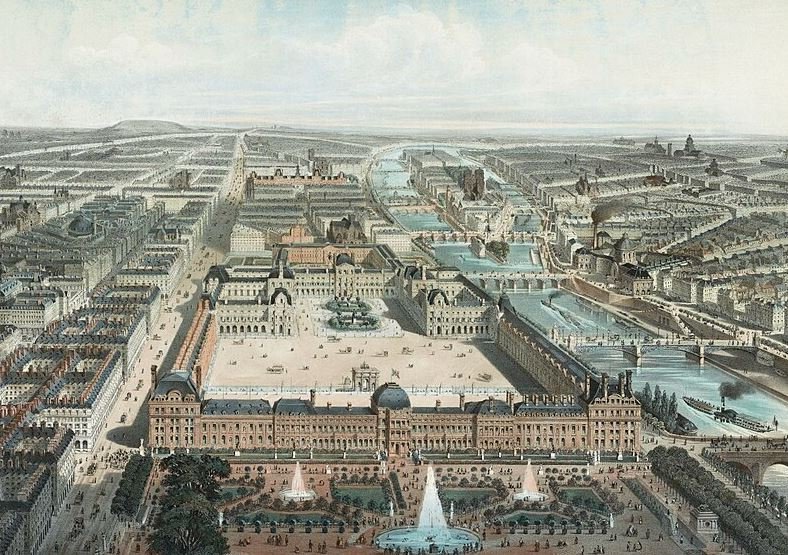
The Tuileries Palace in 1860.
The Louvre contains world-famous artifacts such as the Mona Lisa, the Venus de Milo, and the Winged Victory of Samothrace.
Did you know…?
As of 2024, the Louvre Palace holds the record of housing the largest art museum in the world, welcoming millions of visitors annually.
Architectural Features
Cour Napoléon and the Louvre Pyramid
The Cour Napoléon serves as the central courtyard, dominated by the Louvre Pyramid, an architectural marvel blending modernity with classical surroundings.
The Colonnade and Classical Façades
The Colonnade Wing, designed by Claude Perrault, showcases a symmetrical and classical façade, representing 17th-century French architectural ideals.
Sully, Denon, and Richelieu Wings
The palace is divided into three main wings:
- Sully Wing (oldest section, featuring medieval foundations and Renaissance structures)
- Denon Wing (home to the Mona Lisa and Venus de Milo)
- Richelieu Wing (houses sculptures and decorative arts)
Lescot Wing and the Cour Carrée
The Lescot Wing, built in the 16th century, features elaborate sculptures, arches, and intricate detailing, making it a hallmark of French Renaissance architecture.
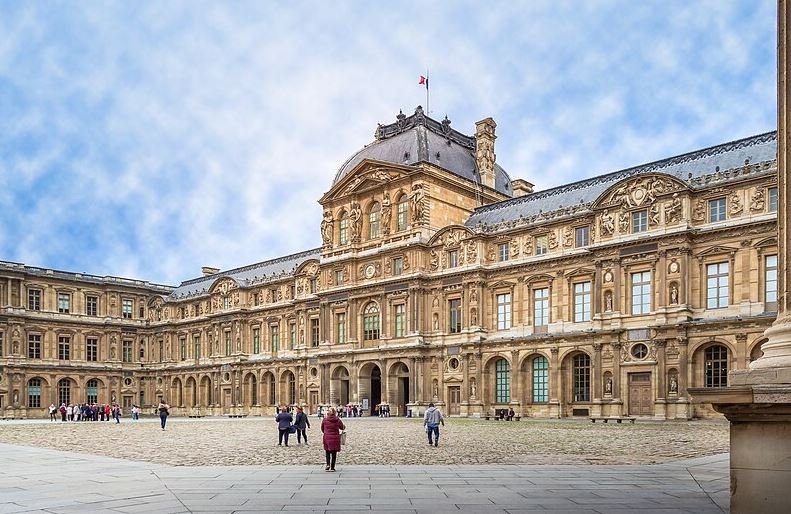
A view of the Cour Carrée at the Louvre Palace
Designed by I. M. Pei and completed in 1989, the Louvre Pyramid serves as the main entrance and symbolizes the modernization of the Louvre.
Lisa Gherardini: The woman in Leonardo da Vinci’s masterpiece, the Mona Lisa
Historical Significance
The Louvre Palace has served as a royal residence, military stronghold, and political hub. It hosted crucial historical events, including the signing of treaties, royal weddings, and the establishment of the Louvre Museum.
As a symbol of French cultural and artistic heritage, the Louvre has continuously adapted, reflecting the evolution of France from a monarchy to a republic.
Frequently Asked Questions
What was the original purpose of the Louvre Palace?
The Louvre was originally built as a defensive fortress in 1190 by King Philip II to protect Paris from invasion.
How did the Louvre transition from a fortress to a royal palace?
In the 16th century, Francis I and Henry II initiated renovations, transforming the medieval fortress into a Renaissance-style royal residence.

The Louvre Museum at night.
What is the significance of the Cour Carrée?
The Cour Carrée is the oldest part of the modern Louvre, completed in the 17th century, and showcases the evolution of French classical architecture.
How did the Grand Dessein influence the Louvre’s development?
Henry IV and later Louis XIV pursued the Grand Dessein, a vision to unite the Louvre with the Tuileries Palace, shaping the palace’s grand design.
Why did the Louvre stop being a royal residence?
Louis XIV moved the royal court to Versailles in 1682, leaving the Louvre for administrative, artistic, and academic purposes.
What role did Napoleon play in the Louvre’s expansion?
Napoleon expanded the museum, completed the Cour Carrée’s façades, and initiated plans to unite the Louvre with the Tuileries.
How did Napoleon III transform the Louvre?
Under Napoleon III, architect Hector Lefuel completed the Louvre-Tuileries connection, adding new wings and enhancing its grandeur.
What happened to the Tuileries Palace?
It was burned down during the Paris Commune in 1871 and demolished in 1883, permanently altering the Louvre’s layout.
How did the Louvre become a public museum?
The National Assembly decreed its transformation into a museum in 1793 during the French Revolution, making it accessible to the public.





