Prophet Muhammad’s Night Journey
The Israʾ and Miʿraj are two interlinked parts of a miraculous journey that, according to Islamic belief, was undertaken by the Prophet Muhammad (570–632 CE) during a single night around the year 621 CE. This journey, both physical and spiritual, is one of the most significant events in Islamic tradition. The Israʾ refers to Muhammad’s journey from Mecca to Al-Aqsa Mosque in Jerusalem, while the Miʿraj refers to his ascension to the heavens where he conversed with previous prophets and ultimately with God. This event is briefly referenced in the Quran and detailed further in the hadith, which are collections of the sayings and actions of Muhammad.

The gates of the Prophet’s Mosque in Medina bear the inscription, ‘Muhammad, the Messenger of God.’
“rising to a high place”
The term Israʾ means “walking or traveling at night,” while Miʿraj translates to “ascension” or “rising to a high place.” These words encapsulate the essence of the journey, emphasizing both movement and elevation, not only in physical terms but also in spiritual significance.
Quranic Basis and Islamic Sources
The Israʾ and Miʿraj are mentioned in Surah Al-Isra (17:1) of the Quran:
Glory be to the One Who took His servant by night from the Sacred Mosque to the Farthest Mosque whose surroundings We have blessed, so that We may show him some of Our signs. Indeed, He alone is the All-Hearing, All-Seeing.
This verse does not explicitly mention the details of the journey but forms the foundation of the event. Additional references are found in Surah An-Najm (53:13-18), where Muhammad is described as having seen divine signs near the Lote Tree (Sidrat al-Muntaha) at the boundary of the heavens.
The Night Journey (Israʾ)
According to Islamic tradition, Muhammad was in the Masjid al-Haram (Sacred Mosque) in Mecca when the Angel Jibrīl (Gabriel) came to him with Buraq, a celestial creature described as a white, horse-like being with wings. Muhammad mounted Buraq and was transported to Al-Aqsa Mosque in Jerusalem, a site revered in Islamic, Christian, and Jewish traditions.
Upon arriving at Al-Aqsa, Muhammad is said to have led previous prophets—including Abraham (Ibrahim), Moses (Musa), and Jesus (Isa)—in prayer. This act symbolized Muhammad’s leadership over previous prophetic traditions and reaffirmed Islam’s continuity with earlier monotheistic faiths.

An aerial view of the Masjid al-Haram
READ MORE: Most Famous Prophets in Islam
The Ascension to Heaven (Miʿraj)
Following the Israʾ, Muhammad ascended to the heavens, accompanied by Gabriel. In the seven heavens, he encountered different prophets at each level:
- First Heaven – Adam (the first prophet and father of humanity)
- Second Heaven – John the Baptist (Yahya) and Jesus (Isa)
- Third Heaven – Joseph (Yusuf), known for his beauty and wisdom
- Fourth Heaven – Idris (Enoch), a prophet associated with divine knowledge
- Fifth Heaven – Aaron (Harun), the brother of Moses
- Sixth Heaven – Moses (Musa), who plays a pivotal role in the later part of the journey
- Seventh Heaven – Abraham (Ibrahim), the patriarch of monotheism
Upon reaching the Lote Tree of the Farthest Boundary (Sidrat al-Muntaha), Muhammad was taken to a place where Gabriel could not accompany him further. Here, he is believed to have encountered God (Allah) directly.
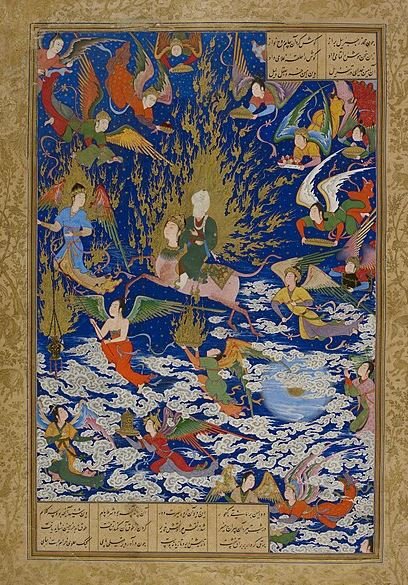
Ascent of Muhammad to Heaven
The Reduction of Prayers
During this meeting, Muhammad was initially commanded to establish fifty daily prayers for his followers. However, upon descending, Moses (Musa) advised him that this number was too burdensome for humanity. Muhammad returned multiple times to request a reduction, and the prayer requirement was ultimately reduced to five daily prayers, which remain obligatory in Islam today.
The Spiritual and Mystical Interpretations
The Israʾ and Miʿraj are not only historical or theological events but also hold deep mystical significance. In Sufi Islam, the journey is seen as symbolic of spiritual ascension—one where believers strive for closeness to God through prayer and devotion. Some interpretations suggest that Muhammad’s journey serves as an allegory for the spiritual enlightenment that every believer must seek.
Whether understood as a physical event, a visionary experience, or a mystical allegory, the Night Journey taken by Muhammad inspires Muslim devotion and theological reflection.
Alternative Interpretations and Scholarly Debates
While the traditional Islamic view holds that the journey was both physical and spiritual, some scholars and sects, particularly in the Muʿtazilite and Ismaili traditions, have argued that it was a purely visionary or spiritual experience. Additionally, some modern interpretations suggest that Muhammad may have experienced a profound dream or vision, rather than a literal journey.
There are also discussions regarding the location of Al-Masjid al-Aqsa in the Quranic verse. While the prevailing opinion identifies it with Jerusalem, some alternative theories propose that it may have referred to another location, such as a mosque in Arabia.
The night journey affirms Prophet Muhammad’s divine mission, establishes the five daily prayers, and reinforces Jerusalem’s status as a holy city in Islam.
Influence on Islamic Culture and Architecture
The significance of Israʾ and Miʿraj is commemorated architecturally in the Dome of the Rock (Qubbat As-Sakhrah) in Jerusalem, built in 691 CE by the Umayyad Caliph Abd al-Malik. This shrine marks the spot where Muhammad is believed to have ascended to the heavens. The Al-Aqsa Mosque, also located in the same area, remains a sacred site for Muslims worldwide.
Observance and Celebrations
The event is annually commemorated on the 27th of Rajab in the Islamic calendar, a night known as Lailat al-Miʿraj. Devout Muslims engage in special prayers, supplications, and night vigils to honor the occasion. In some Muslim-majority countries, such as Pakistan, India, Indonesia, and Turkey, cities and mosques are illuminated, and religious sermons recount the significance of the event.
Comparison with Other Abrahamic Traditions
The concept of heavenly ascension is not unique to Islam. Similar narratives exist in Jewish and Christian traditions:
- The Prophet Elijah in the Hebrew Bible is described as ascending to heaven in a chariot of fire.
- The Book of Enoch, an ancient Jewish text, describes the patriarch Enoch’s journey to the heavens.
- In Christian tradition, Jesus’ ascension to heaven after his resurrection holds theological significance.
Some scholars have drawn parallels between the Miʿraj and medieval Christian mystical writings, such as Dante Alighieri’s Divine Comedy, though there is no conclusive evidence of direct influence.
Historical and Political Context
The Israʾ and Miʿraj took place during a difficult period in Muhammad’s life, following the Year of Sorrow, when he lost his wife Khadijah and his uncle Abu Talib. The journey provided him with divine reassurance and strength to continue his mission. Additionally, in later Islamic history, the Umayyads emphasized Jerusalem as a sacred site, possibly to legitimize their rule in the region.
Rashidun Caliphate and the First Four Muslim Caliphs of the Islamic World
Frequently Asked Questions about Prophet Muhammad’s Night Journey
What is the Israʾ and Miʿraj?
The Israʾ and Miʿraj refer to Prophet Muhammad’s miraculous night journey from Mecca to Jerusalem (Israʾ) and his ascension to the heavens (Miʿraj), where he met previous prophets and received the command for daily prayers.
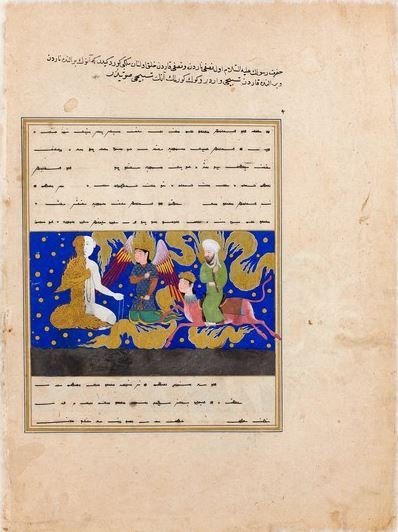
A depiction of the Miʿraj
Where is the Israʾ mentioned in the Quran?
The Israʾ is mentioned in Surah Al-Isra (17:1), which describes Muhammad’s journey from the Sacred Mosque (Masjid al-Haram) to the Farthest Mosque (Masjid al-Aqsa), emphasizing divine signs shown to him.
What happened at Al-Aqsa Mosque?
Upon reaching Al-Aqsa Mosque, Muhammad led a congregational prayer with earlier prophets, signifying his leadership and Islam’s continuity with past revelations.
Who did Muhammad meet during the Miʿraj?
During his ascent through the seven heavens, Muhammad met prophets including Adam, Jesus, Moses, and Abraham, before reaching the Lote Tree (Sidrat al-Muntaha) at the highest boundary.
How was the number of daily prayers determined?
Initially, 50 daily prayers were commanded by God, but after advice from Moses, Muhammad repeatedly requested a reduction, ultimately setting the obligation to five daily prayers.
How do different Islamic perspectives interpret the journey?
Most scholars believe the Israʾ and Miʿraj were both physical and spiritual, while some Sufi and philosophical traditions interpret them as purely mystical or visionary experiences.
How is the Israʾ and Miʿraj observed today?
Muslims commemorate the event on Lailat al-Miʿraj (27th Rajab) with special prayers, sermons, and celebrations, particularly in countries like Pakistan, Turkey, and Indonesia.
What significance does this event hold in Islamic spirituality?
The journey reinforces faith in God’s power, the importance of prayer, and Muhammad’s prophetic authority, serving as a reminder of spiritual elevation and divine mercy.





