Aristoxenus of Tarentum (c. 375–335 BCE) was a Greek philosopher and one of Aristotle’s most distinguished pupils. Although renowned for his contributions to philosophy and ethics, Aristoxenus is best known for his groundbreaking work in music theory, particularly his treatise Elements of Harmony (Harmonika Stoicheia), which remains a pivotal source on ancient Greek music. Born in Magna Graecia (modern-day southern Italy), Aristoxenus combined his upbringing in a Pythagorean environment with the teachings of Aristotle, resulting in a unique intellectual legacy.
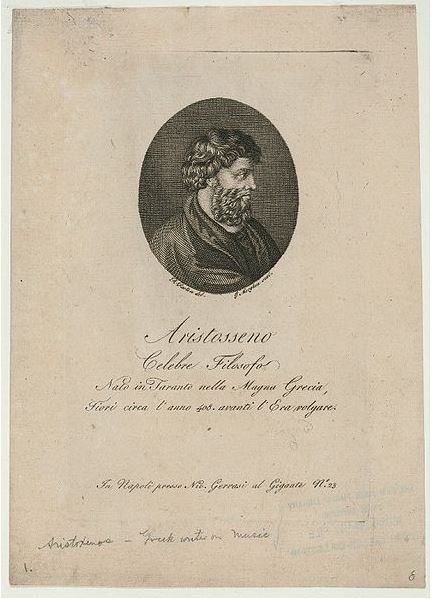
A modern depiction of Aristoxenus.
Life and Education
Aristoxenus was born in the Greek city of Tarentum (modern Taranto), a hub of Pythagorean philosophy and culture. His father, Spintharus, was a musician and possibly a Pythagorean, influencing Aristoxenus’ early exposure to music and philosophical inquiry. He later studied under Lamprus of Erythrae and Xenophilus the Pythagorean before becoming a student of Aristotle.
Relationship with Aristotle
Aristoxenus achieved significant distinction as Aristotle’s pupil, yet his relationship with the philosopher remains contentious. Some sources, such as the Suda, allege that Aristoxenus resented Aristotle for naming Theophrastus, rather than himself, as the head of the Peripatetic school. However, other accounts, including Aristocles, contradict this, asserting that Aristoxenus always spoke of Aristotle with the utmost respect.
Aristotle’s Lyceum in Ancient Greece
Philosophical Influences
Aristoxenus’ philosophy was shaped by various traditions, blending Pythagorean, Platonic, and Aristotelian ideas. Growing up in Tarentum, home to Pythagoreans like Archytas and Philolaus, Aristoxenus absorbed the mathematical and musical theories prevalent in Pythagorean thought. However, he diverged from strict Pythagoreanism, favoring empirical observation over abstract numerical speculation.
Pythagorean Roots
The influence of Pythagoreanism is evident in Aristoxenus’ extensive writings on education, ethics, and music, including treatises on Pythagoras and his followers. Titles like Life of Pythagoras and On the Pythagorean Life reflect his engagement with Pythagorean traditions, particularly their conservative educational practices and emphasis on harmony.
The Pythagorean Theorem: History & Facts
Musical Theories
Aristoxenus’ Elements of Harmony (Harmonika Stoicheia) is a cornerstone of ancient Greek music theory. This incomplete treatise systematically explores the principles of melody, scales, and intervals, offering insights into Greek musical aesthetics and practices.
Empirical Approach
Breaking from Pythagorean tradition, Aristoxenus emphasized the role of the ear in judging musical intervals rather than relying solely on mathematical ratios. He argued that melody and harmony are best understood through sensory perception and memory, asserting that “the nature of melody is best discovered by the perception of sense.”
Seven Parts of Music
In the second book of Elements of Harmony, Aristoxenus identified seven key components of music: genera, intervals, sounds, systems, tones (modes), mutations, and melopoeia (melodic composition). This classification provided a comprehensive framework for analyzing musical structures.
Critique of Pythagorean Theory
While Aristoxenus admired Pythagorean contributions to music, he criticized their reliance on arithmetic rules to define harmonic systems. He believed that musical intervals should not be constrained by fixed mathematical ratios, as these could not fully capture the nuances of auditory experience.
Aristoxenus’ departure from the numerical rigidity of Pythagorean theory marked a significant evolution in music theory.
Aristoxenus introduced the concept of topos—a range of pitch locations rather than fixed points. This flexible approach allowed for variations in tuning and scale construction, reflecting the dynamic nature of Greek musical practice.
Contributions to Rhythm and Meter
In addition to his work on harmony, Aristoxenus wrote extensively on rhythm and meter. His treatise Elementa Rhythmica examines the principles of rhythmics and metrics, emphasizing the temporal aspects of music and poetry.
Fragments of Elementa Rhythmica have been preserved, including a five-column manuscript discovered in Oxyrhynchus. These writings provide valuable insights into Greek theories of rhythm and the relationship between musical and poetic structures.
Ethics and Philosophy
Beyond music, Aristoxenus authored numerous works on ethics, education, and politics, reflecting his broad intellectual interests. His ethical writings, informed by Pythagorean and Aristotelian thought, emphasized the cultivation of virtue and the harmonious development of the soul.
Aristoxenus is associated with the Pythagorean theory that the soul is a “harmony” of bodily elements. This idea, also discussed by Plato, suggests that the soul’s composition mirrors the ordered structures of music and the cosmos.
Lost Works
Although Aristoxenus reportedly authored over 450 works, the majority have been lost. Surviving fragments indicate his diverse interests, which included biographies of Pythagoras, Socrates, and Plato, as well as treatises on musical instruments, education, and political laws.
Key fragments of Aristoxenus’ writings, preserved in later commentaries and manuscripts, include:
- On the Primary Duration: A study of temporal aspects in music.
- On Melodic Composition: An exploration of music’s role in lyric poetry.
- Life of Archytas: A biography of the Pythagorean philosopher and mathematician.
Influence and Legacy
Aristoxenus’ empirical approach to music and his integration of philosophy and science had a lasting impact on both ancient and modern thought.
His ideas were debated and developed by figures such as Archestratus and Ptolemais of Cyrene, who examined his methodology in the context of broader philosophical debates between rationalism and empiricism.
Modern scholars regard Aristoxenus as a pioneer in music theory, whose work bridges the gap between abstract speculation and practical analysis. His emphasis on sensory perception and memory anticipates contemporary approaches to musicology.
Elements of Harmony: A Closer Look
Aristoxenus’ Elements of Harmony is his most celebrated work, offering a detailed account of Greek musical theory.
Structure and Content
The treatise is divided into three books:
- Book One: Introduces the genera of Greek music and defines key terms such as sound, interval, and system.
- Book Two: Outlines the seven parts of music and discusses their interrelationships.
- Book Three: Describes twenty-eight laws of melodic succession, providing practical guidance for composers.
The Elements of Harmony serves as a vital source for understanding the technical and aesthetic principles of ancient Greek music, shedding light on its theoretical foundations and cultural context.
10 Most Famous Ancient Greek Philosophers
Frequently Asked Questions about Aristoxenus





