Wadjenes: Pharaoh of the 2nd Dynasty
Wadjenes, also rendered as Wadj-nes, Wadjlas, Ougotlas, or Tlas, was a lesser-known king who likely reigned during Egypt’s 2nd Dynasty. His name, meaning “fresh of tongue,” suggests symbolic or ceremonial significance. The absence of contemporary attestations of the name Wadjenes as a royal title and its later appearance in Ramesside kinglists has left modern Egyptologists puzzled. The historical ambiguity of Wadjenes revolves around the scarcity of direct evidence and the challenges of connecting him with known Horus kings.
Ramesside Kinglists and the Turin Canon
The name Wadjenes is documented only in Ramesside-era kinglists, consistently positioned as the successor of King Nynetjer and the predecessor of King Senedj. The Turin King List, although partially damaged, also includes Wadjenes, preserving only the years of his rulership. Despite the agreement across sources on his chronological placement, his identity and reign remain shrouded in mystery.
Debate on Name Origin
Scholars such as Winfried Barta, Bernhard Grdseloff, and I.E.S. Edwards have proposed that the hieroglyphic sign in Wadjenes’s name, resembling a papyrus haulm, is a misreading. It may instead represent the Weneg flower, an infrequent symbol in Egyptian writing. This suggestion links Wadjenes to King Weneg-Nebti, whose name appears in black ink on alabaster fragments and schist vessels from Djoser’s Step Pyramid complex at Saqqara.
The visual similarity between the papyrus haulm and the Weneg flower in hieratic script could explain the confusion by Ramesside scribes. The Weneg-Nebti name, in particular, appears on several artifacts, bolstering the theory that Wadjenes may be a distorted record of this earlier figure.
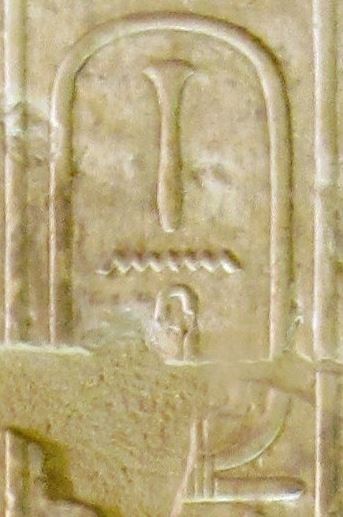
The cartouche of Wadjenes, as recorded in the Abydos King List, highlights his place among Egypt’s early rulers.
Artifacts Bearing the Name
Inscriptions featuring the name “Wadj-sen” further complicate the narrative. These objects, often associated with the Sed festival, suggest that Wadj-sen might have been a crown prince rather than a ruling king. The titulary “Wer-ma’a” (interpreted as “he who sees the greatest”) linked to Wadj-sen typically denoted the eldest son of a reigning monarch. This has led some scholars, such as Wolfgang Helck, to argue that Wadj-sen’s role was dynastic rather than sovereign.
READ MORE: 10 Important Religious Festivals in Ancient Egypt
Manetho’s Record
The historian Manetho referred to Wadjenes as “Tlas,” a name likely derived from a Coptic adaptation, “Ougotlas,” which translates to “fresh of tongue.” This rephrasing reflects linguistic shifts over time and reinforces the challenges in reconstructing the identity of early Egyptian rulers.
Reign of Wadjenes
The Turin King List assigns a reign of 54 years to Wadjenes, whereas Manetho attributes a much shorter period of 17 years. Egyptologists generally consider these durations as either scribal exaggerations or misinterpretations. A lack of significant archaeological evidence makes it difficult to corroborate either claim.
If Wadjenes was an independent king, as theorized by Richard Weill and Peter Kaplony, he might have been the last ruler of a unified Egypt before its division. His inclusion in both Memphite and Thinite records supports the idea of his transitional significance. However, the fragmented historical record complicates efforts to confirm his sovereignty and role in 2nd Dynasty politics.
A key theory surrounding Wadjenes is his potential role in Egypt’s fragmentation. The successor of King Nynetjer is believed to have overseen or been affected by the division of the kingdom. This schism resulted in two kings ruling concurrently—one in Lower Egypt and the other in Upper Egypt.
Evidence supporting this theory includes the reign of King Peribsen, who succeeded Nynetjer and adopted the Seth-animal atop his serekh. This marked a departure from traditional Horus names and suggested Ombite origins. Peribsen’s rule in Upper Egypt, contrasted with his absence from Memphite kinglists, highlights a division in the kingdom’s political and religious landscape.
READ MORE: 10 Most Revered Gods and Goddesses in Ancient Egypt
Theories and Interpretations
Many Egyptologists, including Peter Kaplony and Jürgen von Beckerath, argue that Wadjenes and Weneg-Nebti are the same individual. They propose that Wadjenes’s Horus name may have been Sekhemib-Perenmaat or Horus Sa, linking him to a known lineage of 2nd Dynasty rulers. This interpretation aligns with the archaeological evidence of Weneg-Nebti’s name on vessels and inscriptions.
Some scholars suggest that Wadjenes’s name was retroactively constructed to fill gaps in the Ramesside kinglists. This practice might have aimed to legitimize the continuity of royal lineage. If so, Wadjenes may not represent a historical figure but rather a ceremonial or symbolic placeholder.
The evolution of Wadjenes’s name across centuries—spanning hieroglyphic, Coptic, and Greek interpretations—reflects broader cultural and linguistic transitions. These shifts complicate efforts to pinpoint his identity but underscore the dynamic interplay between historical memory and documentation.





