Hannibal Hamlin
Hannibal Hamlin (1809–1891), a prominent American politician and the 15th Vice President of the United States, played a significant role in shaping the nation’s political landscape during a transformative period.
From his early beginnings in Maine to his influential anti-slavery stance and leadership in the emerging Republican Party, Hamlin’s life reflects the complexities of 19th-century American politics and the fight against slavery.

Hannibal Hamlin (1809–1891) was the 15th vice president of the United States (1861–1865) under Abraham Lincoln during his first term.
Early Life and Education
Hannibal Hamlin was born on August 27, 1809, in Paris, Maine (then part of Massachusetts). He was the sixth-generation descendant of James Hamlin, an English settler in Massachusetts in 1639. His parents, Cyrus and Anna Livermore Hamlin, provided a modest upbringing. According to folklore, Hamlin’s life was saved in infancy by Molly Ockett, a Native American healer, who prescribed warm cow’s milk to cure him of a severe illness.
Hamlin attended local district schools and later studied at Hebron Academy. His early life was spent working on his family’s farm and publishing the Oxford Jeffersonian newspaper (1827–1830) with Horatio King. Afterward, he studied law under Samuel Fessenden, was admitted to the bar in 1833, and began practicing law in Hampden, Maine.
Personal Life
In 1833, Hamlin married Sarah Jane Emery, with whom he had four children: George, Charles, Cyrus, and Sarah. After Sarah’s death in 1855, Hamlin married her half-sister, Ellen Vesta Emery, in 1856. They had two children together, Hannibal Emery Hamlin and Frank Hamlin. Ellen outlived Hannibal by over 30 years, passing away in 1925.
Political Beginnings
Hamlin’s political career began in 1835 when he was elected to the Maine House of Representatives. He also served as a militia officer during the bloodless Aroostook War of 1839, where he mediated between Maine and New Brunswick officials to help resolve a territorial dispute, paving the way for the Webster–Ashburton Treaty.
In 1843, Hamlin was elected to the U.S. House of Representatives, where he served two terms. In 1848, he was elected to the U.S. Senate, filling a vacancy and later winning a full term in 1851. As a Democrat, Hamlin initially supported Franklin Pierce’s presidential candidacy in 1852 but quickly became disillusioned with the party’s increasingly pro-slavery stance.
Break with the Democratic Party and Republican Leadership
Hamlin’s opposition to slavery defined his political career. Early in Congress, he supported the Wilmot Proviso, which sought to ban slavery in territories acquired during the Mexican-American War. He also opposed the Compromise of 1850, which included the Fugitive Slave Act, and he strongly condemned the Kansas-Nebraska Act of 1854, which repealed the Missouri Compromise.
In 1856, when the Democratic Party officially endorsed the Kansas-Nebraska Act at its national convention, Hamlin left the party. His decision to join the newly formed Republican Party marked a turning point in his career. His defection caused a national sensation, as he was among the most prominent Democrats to oppose slavery.
Hamlin became a leading figure in the Republican Party, which was founded on an anti-slavery platform. That same year, he was elected governor of Maine but resigned after only a few months to return to the Senate, where he continued advocating against slavery and supporting the Republican agenda.
Vice Presidency Under Abraham Lincoln
In 1860, Hamlin was selected as Abraham Lincoln’s running mate for the Republican presidential ticket. As a former Democrat from Maine, Hamlin brought regional balance and appealed to anti-slavery Democrats, bolstering the ticket’s appeal in the Northeast. Lincoln and Hamlin won the election, taking office in March 1861 as the Civil War loomed.
As vice president, Hamlin served primarily in his legislative role as president of the Senate, where he worked closely with Radical Republicans. He supported key policies such as the Emancipation Proclamation and the arming of Black soldiers, both of which were central to the Union’s war effort.
Hamlin and Lincoln were not personally close and had limited direct interaction. Vice presidents during this era had little involvement in the executive branch and did not regularly attend cabinet meetings. Despite this, Hamlin remained a staunch supporter of Lincoln’s administration and its efforts to preserve the Union.
A strong abolitionist, Hamlin began as a Democrat in the Maine House of Representatives before joining the Republican Party in 1856. He supported key initiatives like the Emancipation Proclamation.
In 1864, Hamlin was replaced on the Republican ticket by Andrew Johnson, a War Democrat from Tennessee. Lincoln sought to broaden his political coalition and appeal to Southern Unionists in preparation for post-war Reconstruction. Hamlin’s exclusion from the ticket ended his term as vice president in March 1865.
Post-Vice Presidency Career
After his vice presidency, Hamlin briefly served as Collector of the Port of Boston, a position he resigned in protest over President Andrew Johnson’s Reconstruction policies. Johnson’s lenient approach toward the South and his opposition to Congressional Republicans’ more stringent Reconstruction measures alienated Hamlin, who returned to the Senate in 1869.
Replaced by Andrew Johnson in 1864, Hamlin later served in the Senate and as U.S. Minister to Spain, retiring from public life in 1882.
Hamlin served two additional terms in the Senate, continuing his advocacy for civil rights, Reconstruction policies, and Republican reforms. He declined to run for reelection in 1880 due to health concerns.
In 1881, President James Garfield appointed Hamlin as U.S. Ambassador to Spain at the urging of Secretary of State James G. Blaine. Hamlin served in this role for just over a year before retiring from public life in 1882.

Image: Andrew Johnson during the early 1870s.
Later Life and Legacy
After retiring, Hamlin returned to his home in Bangor, Maine, where he lived quietly until his death on July 4, 1891. Remarkably, Hamlin outlived six of his successors as vice president, more than any other vice president in U.S. history. He was buried in Mount Hope Cemetery in Bangor.
Hamlin’s legacy is intertwined with his strong anti-slavery stance and his role in shaping the early Republican Party. His decision to leave the Democratic Party in 1856 underscored his commitment to abolitionism, and his efforts as vice president and senator reflected a lifetime dedication to advancing civil rights.
Numerous locations across the United States bear his name, including Hamlin County, South Dakota; Hamlin Peak in Maine; and several towns and schools. Statues in his honor stand in Bangor, Maine, and the U.S. Capitol, commemorating his contributions to the nation.

Image: Statue of Hamlin in Bangor, US.
Contributions to the Republican Party and the Civil War
Hamlin’s contributions to the Republican Party were instrumental in its early success. His ability to appeal to anti-slavery Democrats helped establish the party as a viable political force.
As vice president, Hamlin lent his support to crucial war measures that strengthened the Union’s position during the Civil War. His advocacy for the Emancipation Proclamation and the recruitment of Black soldiers highlighted his progressive views on civil rights for the era.
Although his role as vice president was largely ceremonial, Hamlin’s presence on the ticket with Lincoln symbolized the unity of diverse anti-slavery factions, a critical factor in the Republican Party’s rise to dominance during the 1860s.
Conclusion
Hannibal Hamlin’s life and political career reflect his unwavering dedication to justice and equality. From his early days in Maine politics to his role as vice president during one of the most challenging periods in American history, Hamlin stood firmly against the institution of slavery and worked tirelessly to promote civil rights.
Frequently Asked Questions

Where and when was Hannibal Hamlin born?
He was born on August 27, 1809, in Paris, Maine, which was then part of Massachusetts.
How was Hamlin’s life reportedly saved as an infant?
According to folklore, a Native American healer named Molly Ockett prescribed warm cow’s milk, which saved his life during a serious illness.
What was Hamlin’s early career before entering politics?
He managed a farm, published the Oxford Jeffersonian newspaper, and became a lawyer after studying under Samuel Fessenden.
What roles did Hamlin serve in before becoming Vice President?
He was a member of the Maine House of Representatives, a U.S. Representative (1843–1847), and a U.S. Senator starting in 1848.
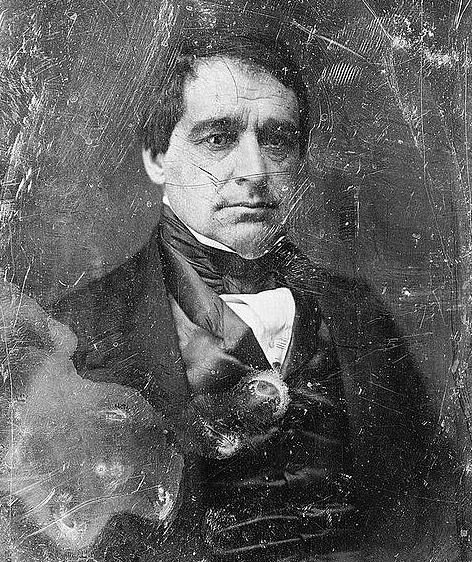
Image: Hamlin’s photograph during the late 1840s.
Why did Hamlin leave the Democratic Party in 1856?
He opposed the Kansas-Nebraska Act, which repealed the Missouri Compromise, and joined the newly formed Republican Party to fight the extension of slavery.
Why was Hamlin chosen as Lincoln’s running mate in 1860?
As an anti-slavery leader from Maine, he provided regional balance to the ticket and appealed to former Democrats who opposed slavery.
What contributions did Hamlin make as Vice President?
While not deeply involved in Lincoln’s administration, he supported the Emancipation Proclamation, the arming of Black troops, and Radical Republican policies.
What positions did Hamlin hold after his vice presidency?
He briefly served as Collector of the Port of Boston, returned to the U.S. Senate (1869–1881), and was U.S. Ambassador to Spain (1881–1882).
What is Hannibal Hamlin’s legacy?
Hamlin is remembered for his strong anti-slavery stance, his role in shaping the Republican Party, and his contributions to the Union cause during the Civil War. Numerous locations, including Hamlin County, South Dakota, are named in his honor.