The Ka’ba-ye Zartosht (Cube of Zoroaster) is an enigmatic and historically significant structure located in the Naqsh-e Rustam compound near Zangiabad village in Fars, Iran. This ancient rectangular edifice, constructed from white limestone, dates back to the Achaemenid Empire (550–330 BCE). Its name, derived in the 14th century, reflects a presumed connection to Zoroastrianism, though its original purpose remains a subject of debate. The Ka’ba-ye Zartosht is not only an architectural marvel but also a repository of Sassanian inscriptions, making it a key cultural and historical landmark.
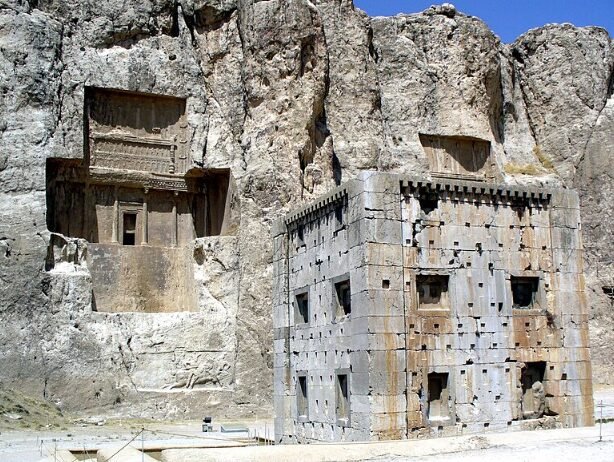
Ka’ba-ye Zartosht in front of Darius II’s mausoleum
Historical Background
The structure was likely built during the reign of Darius I (522–486 BCE) or Xerxes I (486–465 BCE), evidenced by its architectural features, such as the dovetail joints and alternating black and white stones—common in Pasargadae and Persepolis. The precision in construction and lack of mortar reflects the ingenuity of Achaemenid builders.

Also known as Darius the Great, Darius I embarked on a number of infrastructure projects that played a vital role in the empire’s administration and economic development. Image: The relief stone of Darius the Great in the Behistun Inscription
In the Sassanian period (224–651 CE), the Ka’ba-ye Zartosht became a monumental repository for inscriptions. Shapur I, the second Sassanian ruler, documented his victories over the Romans on its walls in three languages: Middle Persian, Parthian, and Greek. Below these, the priest Kartir inscribed his religious achievements and campaigns, further cementing the structure’s historical significance.

Rock-face relief at Naqsh-e Rostam of Shapur (on horseback) with Philip the Arab and Emperor Valerian
Etymology and Naming
The structure’s original name remains unknown. During the Sassanian period, it was referred to as Bon Khaanak (“Cold Foundation”), as mentioned in Kartir’s inscriptions.
The name Ka’ba-ye Zartosht emerged in the 14th century, likely due to European travelers who mistook the structure for a Zoroastrian fire temple. Its cubic shape and smoke-stained interior led them to associate it with fire worship, which they erroneously linked to Zoroastrian practices. This name persists despite no evidence connecting the structure to Zoroaster himself.
Architectural Features
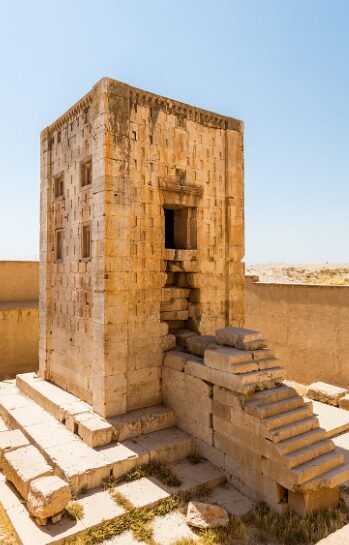
The Ka’ba-ye Zartosht is a 12-meter (39 ft) tall rectangular structure, or 14.12 meters (46.3 ft) with its three-tiered platform. Each side of its base measures 7.3 meters (24 ft). Built from white limestone blocks fastened by dovetail joints, the structure lacks mortar, showcasing advanced engineering.
A 30-step stone staircase on the northern wall leads to a small chamber, measuring approximately 3.74 by 3.72 meters (12.3 by 12.2 ft). The walls, 1.54 to 1.62 meters (5 to 5.3 ft) thick, make the space compact. The roof comprises four large stones, arranged to form a slight pyramid-like slope.
Blind windows and alternating black stone shelves adorn the exterior, adding architectural diversity. These details, combined with the structure’s proportions, demonstrate a blend of functionality and aesthetic design.
Theories About Its Purpose
Early European scholars theorized it was a fire temple, as smoke stains were visible inside. However, the lack of proper ventilation and the enclosed design make this theory unlikely.
The structure’s resemblance to the Tomb of Cyrus and other Achaemenid burial sites led some to believe it was a royal mausoleum. However, no human remains or burial artifacts have been found.
Many historians suggest it served as a repository for royal documents, sacred texts, or treasures. Inscriptions by Shapur I and Kartir imply its use as a secure location. However, the chamber’s small size raises questions about this theory.
Some modern scholars propose it functioned as a solar calendar, using shadows cast by its windows and stairs to track the sun’s movements. Yet, its misalignment with the geographic north weakens this hypothesis.
A minority believes the tower was a shrine to the goddess Anahita, though no direct evidence supports this.
Inscriptions and Their Significance
Known as the “Great Inscription,” this trilingual text on the structure’s walls commemorates Shapur I’s victories over Rome, including the capture of Emperor Valerian. It provides a detailed account of Sassanian military achievements and territorial expansions, marking a pivotal moment in Persian history.

Parthian version of the Shapur I inscription at Ka’ba-ye Zartosht
Below Shapur’s text lies the inscription of Kartir, a Zoroastrian priest who played a significant role in religious reforms. His text describes efforts to suppress rival religions like Christianity, Manichaeism, and Judaism, while promoting Zoroastrian orthodoxy. It offers valuable insight into the ideological and religious dynamics of the Sassanian period.
Cultural and Architectural Importance
The Ka’ba-ye Zartosht exemplifies the technical prowess of Achaemenid architects. Its precise construction, without mortar, and aesthetic use of contrasting stones reflect a mastery of engineering and design.
As a repository for inscriptions, the structure links the Achaemenid and Sassanian eras, illustrating continuity in Persian cultural and political identity.
As part of the Naqsh-e Rustam compound, Ka’ba-ye Zartosht serves as a timeless testament to Persia’s architectural ingenuity and cultural heritage.
The Ka’ba-ye Zartosht stands as a symbol of Iran’s rich history, bridging ancient empires. Its blend of functionality, artistic detail, and historical significance highlights the enduring legacy of Persian civilization.
Conclusion
The Ka’ba-ye Zartosht remains an enigmatic yet pivotal structure in Persian history. Its Achaemenid origins, Sassanian inscriptions, and debated purpose have made it a focus of scholarly interest.
Whether a treasury, mausoleum, or observatory, it continues to captivate historians and visitors alike.
Frequently Asked Questions
The Ka’ba-ye Zartosht is a rectangular stone structure located in the Naqsh-e Rustam compound in Fars, Iran, known for its mysterious origins and architectural significance. It dates back to the Achaemenid Empire and has ties to the Elamite, Achaemenid, and Sassanian periods.
What is the structure made of?
The Ka’ba-ye Zartosht is built from white limestone blocks stacked without mortar, fastened with dovetail joints, showcasing advanced construction techniques.
How tall is the Ka’ba-ye Zartosht, and what are its dimensions?
The structure stands 12 meters (39 ft) tall or 14.12 meters (46.3 ft) when including its platform. Each side of the base measures 7.3 meters (24 ft).
Why is it called the Ka’ba-ye Zartosht?
The name, meaning “Cube of Zoroaster,” emerged in the 14th century. It was mistakenly associated with Zoroastrianism and fire worship due to its cubic shape and smoke stains inside.
What are the notable features of its design?
The structure has a single entrance accessed by a 30-step staircase, blind windows on its exterior walls, and decorative black and white stone elements for visual contrast. Its chamber is small, measuring 3.74 by 3.72 meters (12.3 by 12.2 ft).
What inscriptions are found on the Ka’ba-ye Zartosht?
Inscriptions by Shapur I and Kartir from the Sassanian period are engraved on its walls. Shapur’s trilingual inscription details his victories over Rome, while Kartir’s describes his religious campaigns.
What theories exist about its purpose?
Scholars propose several possibilities, including:
- A fire temple due to smoke stains (though its design lacks proper ventilation).
- A mausoleum for Achaemenid royalty.
- A treasury or archive for sacred texts and royal records.
- A solar calendar or observatory based on its alignment and design.
- A shrine to Anahita, though evidence is sparse.
Why is it architecturally significant?
The Ka’ba-ye Zartosht exemplifies Achaemenid engineering, with precise stone cutting, dovetail joints, and balanced proportions. Its aesthetic use of contrasting stones adds to its visual appeal.
What is the historical significance of the inscriptions?
Shapur I’s inscription provides insights into Sassanian military and administrative history, while Kartir’s inscription sheds light on religious dynamics and Zoroastrian orthodoxy during the late Sassanian period.
What role does the Ka’ba-ye Zartosht play in Persian heritage today?
It stands as a symbol of Persian architectural and cultural achievements, bridging the Achaemenid and Sassanian eras. It is now a protected site under Iran’s Cultural Heritage, Handicrafts, and Tourism Organization.





